Brands walk the talk with human ads & pop-up booths
Industry players say brands are taking to pop-up stores as they act as a bridge between offline immersion and online amplification while generating intrigue
 by
by
Published: Jan 4, 2025 9:05 AM | 5 min read
 Follow Us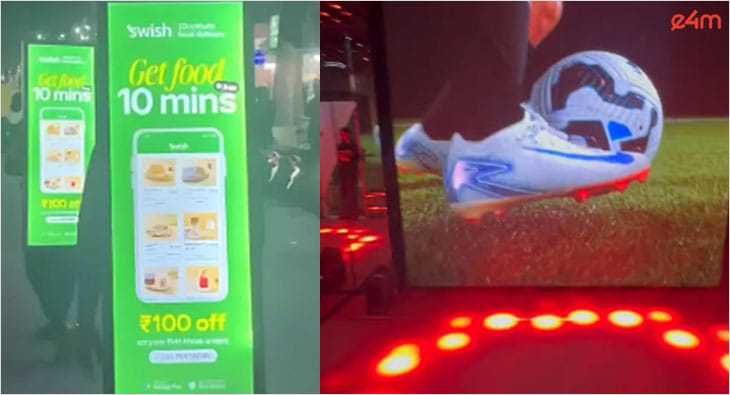

Last year, a Dubai clothing store, Manto Bride took marketing quite literally when they used a live model, Angelina, as a mannequin in their storefront. Meanwhile in India, a Bengaluru food app got a few men to carry billboards promoting the platform, triggering a lot of noise for and against the move.
With over a lakh views and scathing comments like “Capitalism exploiting cheap labor” and “Worse kind of advertising,” the stunt got people asking: When did ads start looking like they walked straight out of the Stone Age?
View this post on Instagram
Is there a better way to wow customers without resorting to such tactics? Experiential marketing is the answer, say some industry players. Pop-up booths – they’re a marketer’s Swiss Army knife, perfect for launching new products, testing markets, and creating that much-needed brand buzz.
Pop-Up Booths: The Real Crowd-Pleasers
Brands can set up pop-up skincare booths with selfie stations in malls or food stalls that encourage visitors to share their Instagram-worthy meals, creating instant online buzz. For greater reach, they can collaborate with influencers, but if that’s out of your budget, Gen Z—the driving force behind 43% of India’s consumer spending—can do the heavy lifting. One snap, one hashtag, and your brand is trending.
According to a report by consulting firm Accenture, the global social commerce market is projected to nearly triple, growing from $492 billion in 2021 to $1.2 trillion by 2025. India's market is expected to expand at the fastest pace during this period.
Social commerce is set to grow three times faster than traditional ecommerce, with its share of total ecommerce spending rising from 10% to 17% by 2025.
The Squid Game 2 series released on December 26, is still creating a buzz in the advertising world through collaborations with various brands across India. What sets their promotion apart is the introduction of interactive pop-up booths, allowing fans to meet characters and immerse themselves in the thrilling experience firsthand.
View this post on Instagram
Expert Take
Shan Jain, Independent Director and Brand Strategist, shares "While pop-ups stores are not a direct sales driver, it acts as a bridge between offline immersion and online amplification, making them a powerful tool for connecting brand discovery with long-term engagement. They also help gather first-party data, which is invaluable now and in the future."
According to her, "For startups, pop-up stores provide the ideal testing ground—a space to create immersive experiences, validate products, and establish physical touchpoints with their audience. Every corner becomes an Insta-ready stage. It’s not just about footfall; it’s a launchpad for loyalty and buzz, all without burning through advertising budgets."
On the role of pop-up stores for large and legacy brands, Shan explains, "Pop-up stores amplify the experience as part of a content strategy. Take Nike’s AR-powered pop-ups, for instance, where customers could design sneakers live, turning each visitor into a micro-influencer. The content generated—user-generated videos, influencer coverage, or brand shoots—feeds digital campaigns, expanding the brand’s reach."
View this post on Instagram
According to Accenture’s Consumer Research 2024, 74% walked away from purchases in late 2023 because decision-making felt like a chore. Add to that the fact that 75% feel bombarded by ads and 73% find too many options daunting. One respondent even quipped, “Finding information is easy, but (it’s) difficult to make a decision from so much.”
Pop-ups simplify this mess. They don’t just scream, “Buy me!” They let customers touch, feel, and experience products in a way that feels less like a sales pitch and more like an invitation to a party.
Vishesh Sahni, Founder and CEO of White, puts it, “With pop-up spaces, what started out as smaller points of sale and shop-in-shop formats have transcended into thriving and immersive marketing touch points.” These dynamic spaces not only serve as testing grounds for startups but also act as powerful brand activators. From exclusive previews and live demos to celebrity meet-and-greets, pop-ups allow brands to engage consumers in ways traditional billboards simply cannot.
Sahni explains, “By virtue of its format, pop-ups intrinsically generate intrigue. But the level of intrigue and memorability that is created largely depends on factors like novelty, innovative design, and meaningful call-to-action.”
Another key aspect of modern pop-up stores is the integration of cutting-edge technologies like AR and VR.
Marketing experts say, “AR and VR technologies will elevate pop-ups by adding a layer of “personalised perception” of the experience. These mechanisms allow customers to interact with the products in alternative environments; even realms of their own making which are most emotionally resonant with them. In contrast to billboards which are static and unidimensional, tech-enabled pop-ups turn consumers into active participants while also tracking their responses and mining valuable insight.”
Read more news about Experiential Marketing, Internet Advertising, Marketing, PR & Corporate Communication& Television Media.
For more updates, be socially connected with us onInstagram, LinkedIn, Twitter, Facebook YouTube & Google News