e4m Video Story: Cannes Lions 2025: Aalap Desai of Tgthr. on building a legacy beyond awards
In a freewheeling chat with e4m, Aalap Desai, Chief Creative Officer and Co-Founder, Tgthr., opens up about how this year the agency’s focus has been on ‘what felt true to us, not just what might win’
.png) by
by
Published: Jun 11, 2025 9:03 AM | 3 min read
 Follow Us
In the bustling halls of Cannes Lions 2025, where global advertising elites gather to celebrate creativity, one Indian agency stands out for its unapologetically local yet globally resonant campaigns. Tgthr., the independent agency that made waves last year with its Glass Lion-winning Harpic Loocator campaign, is back this time with two bold entries that encapsulate the spirit of modern India: problem-solving through jugaad and cultural storytelling at scale.
Led by Aalap Desai, Chief Creative Officer and Co-Founder, Tgthr. represents a new wave of Indian agencies proving that creativity doesn’t need massive budgets, just sharp insights, fearless execution, and a deep understanding of the country’s grassroots realities.
Last year’s win was a turning point for the young agency. The Harpic Loocator campaign, which addressed India’s sanitation challenges with a tech-driven solution, didn’t just earn Tgthr. a Lion, it put them on the global map as a creative force. “Winning as an independent agency was surreal,” recalls Desai in an exclusive interview by e4m. “But it also brought pressure. People expect you to repeat the magic. This year, we focused on work that felt true to us, not just what might win.”
That work includes UV Lync, a frugal innovation bridging India’s EV charging divide, and Anti-Scam Shala, a mass-awareness campaign leveraging the Kumbh Mela’s cultural footprint. Both ideas are quintessentially Indian yet tackle universal themes like sustainability and digital literacy, making them strong contenders on the Cannes stage.
India’s electric vehicle revolution has a glaring gap: while four-wheelers have a robust charging network, two-wheelers don’t. UV Lync, developed for electric bike maker Ultraviolette, is a simple adapter that lets two-wheelers charge at four-wheeler stations, solving “range anxiety” without costly infrastructure upgrades.
“It’s peak Desi attitude,” laughs Desai. “Why build a parallel system when you can hack the existing one? The global jury loves that Indian pragmatism, we solve problems differently.” The campaign’s brilliance lies in its scalability. With EV adoption rising worldwide, UV Lync’s jugaad approach offers a blueprint for emerging markets.
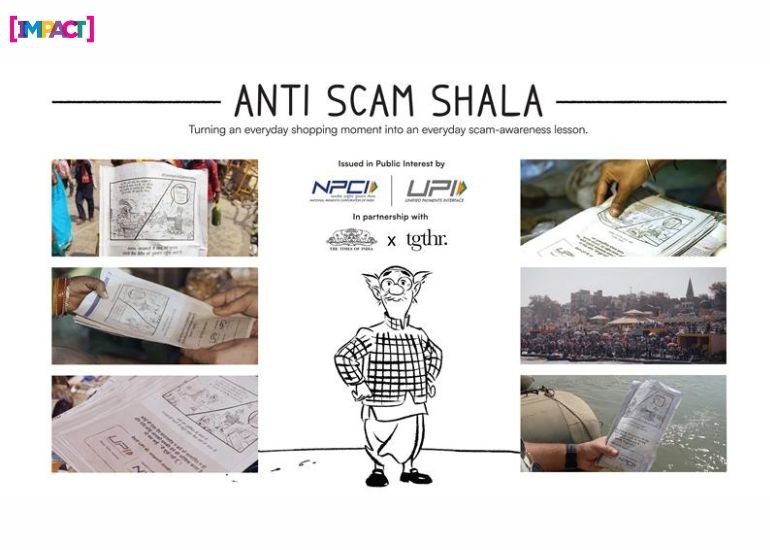
For its second entry, Tgthr. partnered with NPCI and Times of India to combat UPI payment scams targeting rural Indians. The insight? The Maha Kumbh, where millions gather, was the perfect classroom. The team transformed NPCI’s print ads into newspaper pouches, a nostalgic yet functional medium in small-town India, and distributed them through 207,000 vendors.
The result? 160 million people, exposed to anti-scam messaging in regional languages, with a measurable drop in fraud reports. “We didn’t just advertise; we activated culture,” says Desai. “Newspaper pouches are part of India’s fabric, everyone from Kanpur to Kolkata has carried groceries in them.”
Beyond Tgthr.’s entries, Desai is rooting for India’s indie agencies to shine. “The myth that only networked agencies can dominate Cannes is fading. Independents have the hunger and agility to win big.” His vision for Tgthr.? “Agency culture where creativity thrives without cutthroat competition. When people feel safe, they do their best work. The awards follow.”
Tgthr.’s Cannes 2025 journey underscores a larger shift: Indian creativity is no longer about mimicking the West but celebrating its own genius, whether through frugal engineering or cultural hacks. As Desai puts it, “We’re showing the world that ‘Made in India’ ideas don’t just solve local problems. They inspire global solutions.”
Read more news about Cannes Lions Festival, Advertising, Marketing, Digital Media, PR & Corporate Communication News
For more updates, be socially connected with us onInstagram, LinkedIn, Twitter, Facebook YouTube , WhatsApp & Google News