The Mismatch Formula: Why are unlikely faces sharing ad frames?
From film auteurs with Gen-Z actors to podcasters with wrestling icons, contrast casting has become advertising's sharpest hook in the scroll economy
 by
by
Published: Jan 30, 2026 9:38 AM | 8 min read
 Follow Us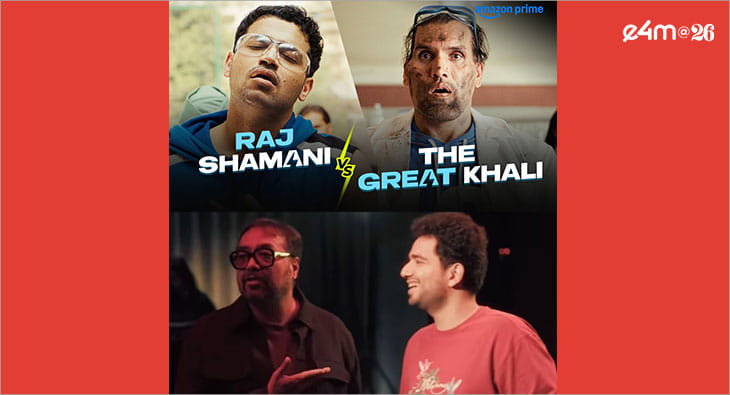

In a campaign that refuses to play by the rules, TRESemmé's newest film opens on disruption disguised as direction. Ananya Panday is tied to a chair, screaming for help, when filmmaker Anurag Kashyap cuts the scene, grumbling about something that should never look perfect in a kidnapping situation: her hair.
The meta-humour unfolds when Kashyap realizes her hair looks salon-perfect despite the narrative chaos, and Panday, no longer willing to play coy, launches into a monologue calling him out for his passive-aggressive 'Bandra Panday' jibes. The film, created by Braindad, isn't about shampoo, though. It's mostly about contrast.
While Kashyap was also seen in a spot with Samay Raina, the comic also paired with mentalist Suhani Shah for Boldfit.
The gravitas of Indie cinema's most celebrated auteur clashing with Bollywood's Gen-Z fixture creates a hook sharp enough to cut through the doomscroll. And the irony isn't lost: this isn't their first time together. They paired up for Cadbury Perk commercials six years ago, back when Panday was fresh out of her Student of the Year 2 debut. The difference now is that the pairing has evolved from novelty into narrative fuel. The friction, the banter, and the tonal mismatch are no longer incidental. It's the overall idea.
View this post on Instagram
Why creators are writing ideas around personality collisions
This isn't an isolated experiment. The advertising industry is now deliberately stacking personalities from different worlds into the same frame, and the mismatch itself has become a creative device. It's showing up everywhere.
From film directors with internet comedians to business podcasters with wrestling legends, brands are betting on cognitive dissonance as the first line of attack in the reels-first battlefield. In a media environment where attention is measured in seconds, not minutes, the pairing becomes the pattern-break. You stop because something doesn't fit. And in that pause, the brand has already won.
According to Abhinav Tripathi, National Creative Head at FCB Kinnect, this approach isn't exactly new. "While I agree that we are seeing interesting and unusual combinations of celebs and ideas, I do not believe it's a new approach. Our brains are inherently pattern-finding machines. When we break a pattern, it's new information, it's exciting, it registers better. It is one of the oldest tricks in the advertising handbook. We've just upped the ante on it. So with the clutter increasing, get ready for even weirder collabs," he says.
What has changed is the velocity and the format. In long-form television commercials, unusual pairings had to be built up with narrative arcs. Now, the pairing itself can carry a 15-second reel. The setup is instant, the payoff is visible, and the social amplification is baked in.
Manoj Shroff, Business Head and Executive Producer at Equinox Films, sees this as a deliberate strategy to broaden appeal across segments. "It feels like brands are consciously trying to widen their appeal by pairing personalities from different generations or different disciplines. We have seen this in films with actors of equal stature, and now even in sports where legends from different eras or disciplines come together. It becomes an instant talking point, not just for audiences but also for the client among their peers," he explains.
"This approach presents celebrities in a fresh, more relatable light, showing them interacting together like in a multi-starrer advert. Ultimately, it creates a strong thumb-stopper and elevates the overall impact of the campaign, and if done cleverly, adds to the recall."
The shift is somehow strategic. Rather than relying on a single star's pull, brands are engineering moments of friction that feel culturally fluent. The conversation around the pairing often outlives the product message itself, but that extended life is precisely what brands are now chasing.
Pattern-disruption as precision targeting
Aayush Bansal, Co-founder of Black Cab, frames this as a behaviour-driven response to platform dynamics. "Absolutely, in today's reels-first era, unusual celebrity or personality pairings aren't just creative flair; they're a strategic attention hack. In feeds where you literally have 2–3 seconds to stop a scroll, contrast becomes a cognitive spark," he says.
"Unexpected combos, like a classical film auteur with a viral Gen-Z creator, trigger curiosity and pattern disruption, which drive initial engagement. Research shows that attention and perceived authenticity boost ad attitude and recall when the pairing feels purposeful, not random, and driven by culture and audience insight, not just star power."
Bansal's agency isn't interested in shock for its own sake. The real work, he argues, happens in the curation. "At Black Cab, we don't just chase shock value. We anchor these pairings in contextual relevance, community insight, and behaviour-driven creative design. The result? Content that not only stops the scroll but also starts a conversation, the real currency in social ecosystems, where authenticity outperforms just visibility."
This philosophy is evident in how scripts are now being structured. Priyank Dattani, Associate Creative Director at White Rivers Media, says the format has fundamentally altered how creatives approach storytelling.
"Unusual pairings have become a deliberate creative device in today's reels-first advertising landscape. In short-form environments, the first few seconds determine whether viewers stay or scroll, and contrast creates an instant pattern-break. Bringing together personalities from completely different worlds generates surprise and curiosity before the brand message even lands," he notes.
"These casting choices are engineered to disrupt predictability and make the content feel fresh, talk-worthy, and inherently shareable. In a feed filled with similar-looking ads, the pairing itself often becomes the hook that earns attention upfront."
The chemistry between mismatched personalities becomes the narrative engine. Dattani explains that writers now build stories around friction, banter, and unexpected chemistry rather than straightforward product explanation, saying, "The 'odd couple' tension creates humour and momentum quickly, which is essential in ultra-short formats to hook audiences and build strong view-through-rates. Storytelling also becomes more modular, with the mismatch thickening the plot for bite-sized entertainment. It is structured around quick collision beats, role reversals, and payoff moments that audiences can easily remix or share."
From sameness to social currency
The evidence is piling up across campaigns. Samay Raina, the comedian whose India's Got Latent show became a cultural flashpoint earlier this year, has been showing up in ads with personalities no one expected.
Recently, he appeared alongside Anurag Kashyap again, this time for Bold Care, a sexual wellness brand. The ad leans into self-aware humour, with Raina disrupting a film shoot and roasting Kashyap in real-time. The dynamic isn't forced. It's rooted in the public's understanding of both personalities, Kashyap's grit and Raina's irreverence, and the collision between the two creates the entertainment. Separately, Raina also paired with mentalist Suhani Shah for Boldfit, where the banter around gym excuses became the content. The workout wasn't the story. The interaction was.
Meanwhile, Amazon Prime Video India promoted Beast Games, MrBeast's reality competition series, by featuring business podcaster Raj Shamani, a figure known for interviewing the likes of Bill Gates and Vijay Mallya, alongside The Great Khali, the towering wrestling icon. The pairing is absurd on paper. One represents intellectual hustle, the other physical dominance. But in the promo ecosystem, that contrast translates into curiosity. It signals that the show isn't just for one demographic. It's for everyone willing to be surprised. The casting itself becomes a statement about ambition, scale, and unpredictability, all themes central to the MrBeast brand.
Even older examples now read differently through this lens. When McDonald's partnered with Ranveer Singh for the ‘Ranveer Singh Meal’, it wasn't just about celebrity wattage. Ranveer's hyperkinetic, boundary-pushing persona clashed with McDonald's historically wholesome, family-friendly image. That tension made the collaboration feel alive.
Similarly, when Dream11 brought in Samantha Ruth Prabhu to promote fantasy cricket, it wasn't an obvious choice. Samantha's fanbase skews heavily towards cinema and regional markets, not hardcore cricket enthusiasts. But that mismatch expanded the brand's reach beyond the usual suspects. The collaboration signalled that fantasy sports weren't just for stats nerds; they were for everyone.
Amitabh Bachchan's appearance in Just Dial ads followed a similar logic. Seeing one of India's most towering legends dialling up local services felt jarring at first. However, that jarring quality is what caught people's attention. The gravitas lent credibility, the everydayness lent relatability, and the collision of both became the memory.
About four years ago, CRED's partnership with Neeraj Chopra turned the Olympic gold medalist into a comedic chameleon, playing multiple roles in an ad that poked fun at his own media hype. The surprise wasn't just that Chopra was in an ad. It was that he was willing to play against type. The mismatch between his serious athletic image and the absurdist tone of the film created a loop of shareability.
Collision as craft
What emerges from these examples isn't randomness. It's precision. Brands are no longer casting for reach alone. They're casting for collision. Pairing personalities whose differences create a frisson that cuts through. The creative brief has shifted. Where once it might have asked, "Who can we get?" it now asks, "Who shouldn't be together, and what happens when they are?"
The chemistry doesn't need to be warm. It needs to be watchable. And in a landscape where watchability determines virality, that's the only metric that matters. As platforms continue to prioritise short-form content and audiences continue to scroll more quickly, the pairing will matter more than the pitch. The mismatch will be the message. And the brands that understand this earliest will own the conversations longest.
Read more news about Internet Advertising India, Marketing News, PR and Corporate Communication News, Digital Media News, Television Media News
For more updates, be socially connected with us onInstagram, LinkedIn, Twitter, Facebook YouTube & Google News