From ₹49,480 Cr to ₹1,15,291 Cr: PMAR 2026 tracks India’s 10-year advertising surge
Digital’s share rose to 46% in 2025 from 42% in 2024, reflecting a decisive reallocation of advertiser budgets
 by
by
Published: Feb 24, 2026 5:12 PM | 3 min read
 Follow Us

Released on February 24, the latest Pitch Madison Advertising Report (PMAR) 2026 maps how India’s AdEx journey over the last ten years has moved from traditional dominance to an increasingly digital-led ecosystem, revealing the scale and pace of the Indian advertising market’s decade-long transformation. As per the report, total AdEx growth stood at 7% in 2025, taking the market to ₹1,15,291 crore under the legacy definition, or 12% growth to ₹1,55,105 crore under the new expanded definition. This translated into incremental revenue of ₹7,311 crore (legacy) and ₹16,156 crore (new) over the previous year. While this growth may appear modest compared to the high-growth years of the past decade, the numbers underline the resilience of the Indian advertising ecosystem amid macroeconomic uncertainty and cautious advertiser sentiment.
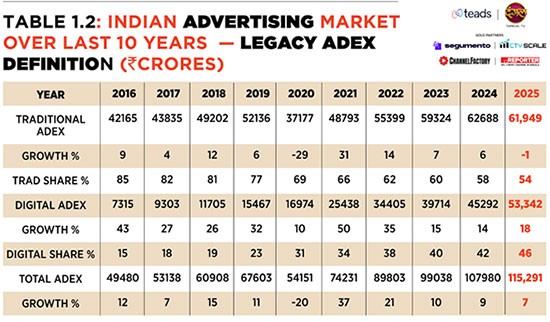
Behind this aggregate number lies a fundamental structural reality that earlier editions of the report had only begun to hint at: India has already crossed into majority-digital advertising under the expanded view. Even under the legacy AdEx definition, the shift is unmistakable. In 2025, traditional AdEx declined by ₹739 crore, while digital AdEx grew by ₹8,050 crore, more than accounting for the entire net growth of the market. Digital’s share rose to 46% in 2025 from 42% in 2024, reflecting a decisive reallocation of advertiser budgets. The era of broad-based expansion across media formats is giving way to more selective, channel-driven investments anchored in performance, measurability, and commerce-linked ecosystems.
But the bigger story is not just growth. It is structural shift. In 2016, traditional media commanded a staggering 85% share of total AdEx, with digital accounting for just 15%. Nearly a decade later, by 2025, traditional media’s share has fallen to 54% under the legacy definition, while digital has climbed to 46%, bringing the two nearly at par. In absolute terms, traditional AdEx has grown from ₹42,165 crore in 2016 to ₹61,949 crore in 2025, but its dominance has steadily eroded as digital scaled exponentially—from ₹7,315 crore in 2016 to ₹53,342 crore in 2025.
The inflection points across the decade reveal how this shift unfolded. Between 2016 and 2019, digital steadily expanded its share as advertisers embraced search, social, and mobile-first platforms. The pandemic year of 2020 accelerated the transition: while traditional ADEX contracted sharply, digital continued to grow, pushing its share to 31% and permanently altering media allocation strategies. The post-pandemic recovery in 2021 and 2022 delivered strong overall growth, but digital consistently outpaced traditional, deepening its structural advantage.
By 2023 and 2024, even as headline growth rates moderated, the pattern had become clear—incremental expansion was increasingly being driven by digital formats. In 2025, that dynamic intensified, with digital alone contributing more than the total net growth of the industry under the legacy definition. The data signals that India is no longer merely approaching a digital majority; it is operating within a fundamentally rebalanced advertising economy.
Over the last ten years, the Indian advertising market has more than doubled in size, but its centre of gravity has shifted decisively. What was once a traditional-media-led ecosystem has evolved into one, where digital commands nearly half the legacy market, and a clear majority under the expanded definition. The decade, as PMAR 2026 illustrates, has not just been about expansion. It has been about transformation.
To download the full Pitch Madison Advertising Report (PMAR) 2026, click on this link: https://e4mevents.com/pitch-madison-advertising-report-2026/download-report
Read more news about Internet Advertising India, Marketing News, PR and Corporate Communication News, Digital Media News, Television Media News
For more updates, be socially connected with us onInstagram, LinkedIn, Twitter, Facebook YouTube & Google News