Galgotias University robot dog row explained: From viral video to expo vacate order
What started as a seemingly impressive demo at the India AI Impact Summit 2026 in New Delhi quickly snowballed into a full-blown controversy for Galgotias University
 by
by
Published: Feb 18, 2026 1:33 PM | 4 min read
 Follow Us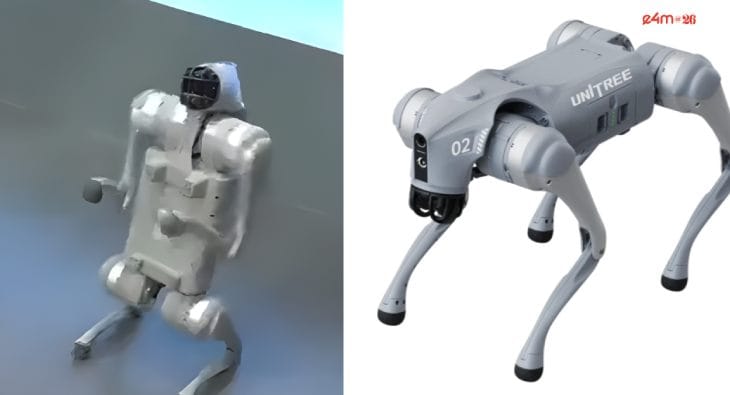

In a fresh development to the ongoing controversy, Galgotias University issued a new statement on February 18, 2026, distancing itself from Professor Neha Singh’s claims about the robot dog showcased at the India AI Impact Summit. The university described Singh as "ill-informed" and not authorized to speak to the media, apologizing for the "confusion" caused by her "factually incorrect" statements made in enthusiasm. They emphasized that there was no institutional intent to misrepresent innovations and confirmed they had agreed to vacate their pavilion at the summit.
— Galgotias University (@GalgotiasGU) February 18, 2026
Netizens quickly labelled this a “blame game,” with X users accusing the university of throwing Singh “under the bus” to save face. Comments like “Don't put one person under the bus-have some shame,” “Now blaming the poor professor for your mistake” and “Galgotias University make Neha Singh scapegoat #Galgotiyas” have flooded social media.
This has come after Galgotias University was reportedly asked to vacate its exhibition space at the India AI Impact Summit 2026 in New Delhi following a controversy over a robotic dog it displayed at the event. The decision came amid widespread online criticism and questions about the origin of the device after a video from the summit quickly went viral.
#WATCH | Delhi | On row over Galgotias University's display of a Chinese-made robot dog at AI Impact Summit, the university's communications professor, Neha, says,"By one misinterpretation, the internet has gone by storm. It might be that I could not convey well what I had wanted… pic.twitter.com/U6dqbBKLXO
— ANI (@ANI) February 18, 2026
Professor Neha Singh, who appeared in the viral videos, later spoke to media and took partial responsibility: “The controversy happened because things may not have been expressed clearly. I take accountability that perhaps I did not communicate it properly.”
What is the controversy?
The summit’s Expo segment, held at Bharat Mandapam as part of the five-day India AI Impact Summit, had featured innovative academic and industry demonstrations. Among them was a robotic dog named “Orion” at the Galgotias University stall. Videos shared on social media showed university representatives discussing the device as part of their artificial intelligence showcase saying in the video, “This has been developed by the Centre of Excellence at Galgotias University,” positioning “Orion” as a crowd-puller amid the summit’s focus on indigenous innovation.
Can you just once explain us why she is claiming that this robo is “developed” with in the campus? And please apologise to nation instead to giving clarification statements. Bythe way thankyou for not using ChatGPT this time for your statement.https://t.co/svv0IvNwFu
— naman sharma (@namansh11141280) February 18, 2026
The twist came when eagle-eyed netizens dissected the footage. Social media users quickly identified “Orion” as a commercially available Unitree Go2 robodog, manufactured by Chinese company Unitree Robotics, sold online in India for around Rs 2-3 lakh, rather than an indigenous innovation, sparking widespread backlash.
One user wrote on X: “Have some shame, in this video ur Professor is clearly saying that it's developed by Galgotias University.” Another post quipped, “This Indian uni presented a China-made robodog as its own—until netizens fact-checked it,” and one X user asking, “What multiverse is this where universities rebrand Chinese tech for clout?”
After the backlash intensified online, Galgotias University issued a statement on X clarifying that the robot had been procured for student learning and that it had “not built this robodog, nor have we ever claimed to do so.” The statement described the robot as a “classroom in motion” being used to help students experiment and expand their skills.
https://x.com/GalgotiasGU/status/2023764251689844898?s=20
On February 17, they also posted a clarification on X in the form of a press release. Galgotias University's press release expressed deep disappointment over what they called a propaganda campaign targeting the institution. They clarified that their robotic programming efforts are aimed at helping students learn AI skills by using globally available tools and resources, noting that developing such talent is crucial in today's world.
https://x.com/GalgotiasGU/status/2023852646927643040?s=20
Despite the clarification, an X community note countering the university’s claim described the assertion as misleading, pointing to the original video where representatives had explicitly said the unit was developed by their team.
This episode highlights that credibility in India's growing AI ecosystem depends not only on ambition or access to technology, but equally on the accuracy and consistency of how progress is communicated. For universities positioning themselves as innovation leaders, the incident stands as a practical reminder that in the public eye, every claim is only as strong as the verifiable facts behind it.
Read more news about (internet advertising India, internet advertising, advertising India, digital advertising India, media advertising India)
For more updates, be socially connected with us onInstagram, LinkedIn, Twitter, Facebook YouTube & Whatsapp