Operation Sindoor & the newsroom: Gaurav Sawant, Charu Pragya on crisis reporting
At e4m NewsNext Summit, Gaurav Sawant, Managing Editor - India Today TV, & BJP Spokesperson Charu Pragya, exchanged notes about covering Operation Sindoor & the challenges they encountered
 by
by
Published: Dec 13, 2025 2:22 PM | 4 min read
 Follow Us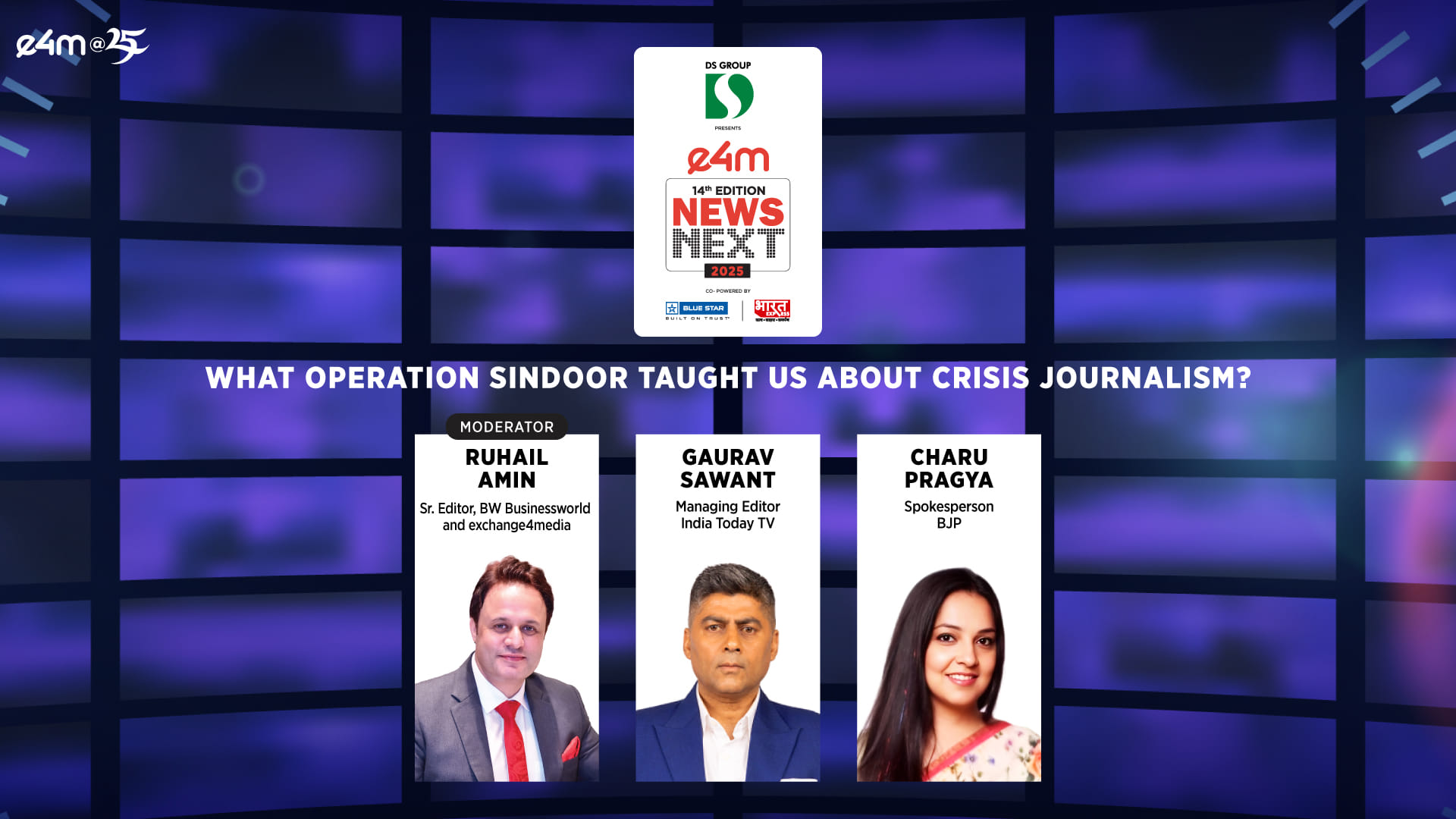

Operation Sindoor saw a large volume of information emerge within a short period. The experience of reporting during the operation was discussed at e4m NewsNext Summit by Gaurav Sawant, Managing Editor at India Today TV, and Charu Pragya, Spokesperson, Bharatiya Janata Party, who spoke about verification, newsroom processes and the release of information during the crisis.
Speaking about his experience of covering Operation Sindoor, Sawant said developments were taking place at a fast pace and information was coming from multiple sources at the same time. He said a significant amount of information, including visuals, was emerging from Pakistan during the operation. According to him, visuals related to strikes on locations such as Muridke and Bahawalpur surfaced from across the border.
Sawant said that in such situations, Indian newsrooms repeatedly went back to the government for verification. He described the period as one of information overload, with inputs coming in from several places simultaneously. He said misinformation and disinformation were also being circulated, particularly on social media.
He said that the effort at India Today TV, and across Indian media, was to verify as much information as possible and put it out after verification. He said social media platforms were circulating a large volume of information, including false content, and that newsrooms were required to separate verified facts from unverified claims.
Referring to editorial decision-making during the operation, Sawant said India Today TV focused on putting out verified facts rather than being the first to report. He acknowledged that mistakes were made during the coverage and said these were addressed publicly. He said a 9 pm anchor went on air to acknowledge the error and that the organisation conducted an internal audit.
“For us, it’s not fastest fingers first. We are happy to be a little late, but we have to be truthful,” Sawant said.
Sawant said that following this, the organisation examined its systems. He said India Today TV has a fact-checking team that worked round the clock during Operation Sindoor, as well as an open-source intelligence team that verified videos and images being circulated. He said these teams checked every piece of information that came in before it was broadcast.
He also spoke about misinformation and disinformation during the operation, which he described as deliberate. He said false information and visuals were being circulated by hostile actors. According to him, whenever incorrect information went on air, corrective steps were taken immediately.
On international coverage of Operation Sindoor, Sawant said Western media outlets presented narratives that reflected the positions of their governments or defence lobbies. He said several confirmed developments, including strikes on multiple locations in Pakistan, were not reported by international media, while focus remained on developments on the Indian side. He said Indian newsrooms relied on their own reporting and verification rather than responding to international coverage.
Charu Pragya, speaking from the government’s perspective, said journalists were not being asked to stop reporting during national security situations. She said the government expected credibility, accountability and seriousness from the media while reporting such events. According to her, reporting during a crisis should not be treated as a race to break news without verification.
She said caution in releasing information should not be interpreted as concealment. “Being careful does not mean that you are concealing,” Pragya said. She added that information is sometimes released after a delay because it goes through verification and approval.
Pragya said responsibility during a national security situation extends beyond journalists to political leaders and citizens using social media. She said statements made by individuals in positions of influence can be amplified in adversarial countries.
Referring to past conflicts, Pragya said that during the Kargil war and the 26/11 Mumbai terror attacks, information broadcast by Indian television channels benefited the adversary, according to the armed forces. She said these instances were discussed to underline the need for caution during such situations.
She said that during Operation Sindoor, certain information was not put out in real time, even when journalists had access to it. According to her, information was reported only after official confirmation was provided by the government.
Speaking about the pace of official communication, Pragya said government decision-making during wartime involves multiple layers of verification and approval. She said this process can take time. While improvements in the speed of information flow can be considered, she said accuracy remains important.
Read more news about Television Media, Digital Media, Advertising India, Marketing News, PR and Corporate Communication News
For more updates, be socially connected with us onInstagram, LinkedIn, Twitter, Facebook YouTube & Google News