Not competitors but supplements: Alok Mehta on why TV, print and digital must coexist
Veteran journalist Alok Mehta spoke at e4m NewsNext Summit 2025 on how audiences move between platforms and why coexistence of mediums has become inevitable rather than optional
 by
by
Published: Dec 13, 2025 1:11 PM | 3 min read
 Follow Us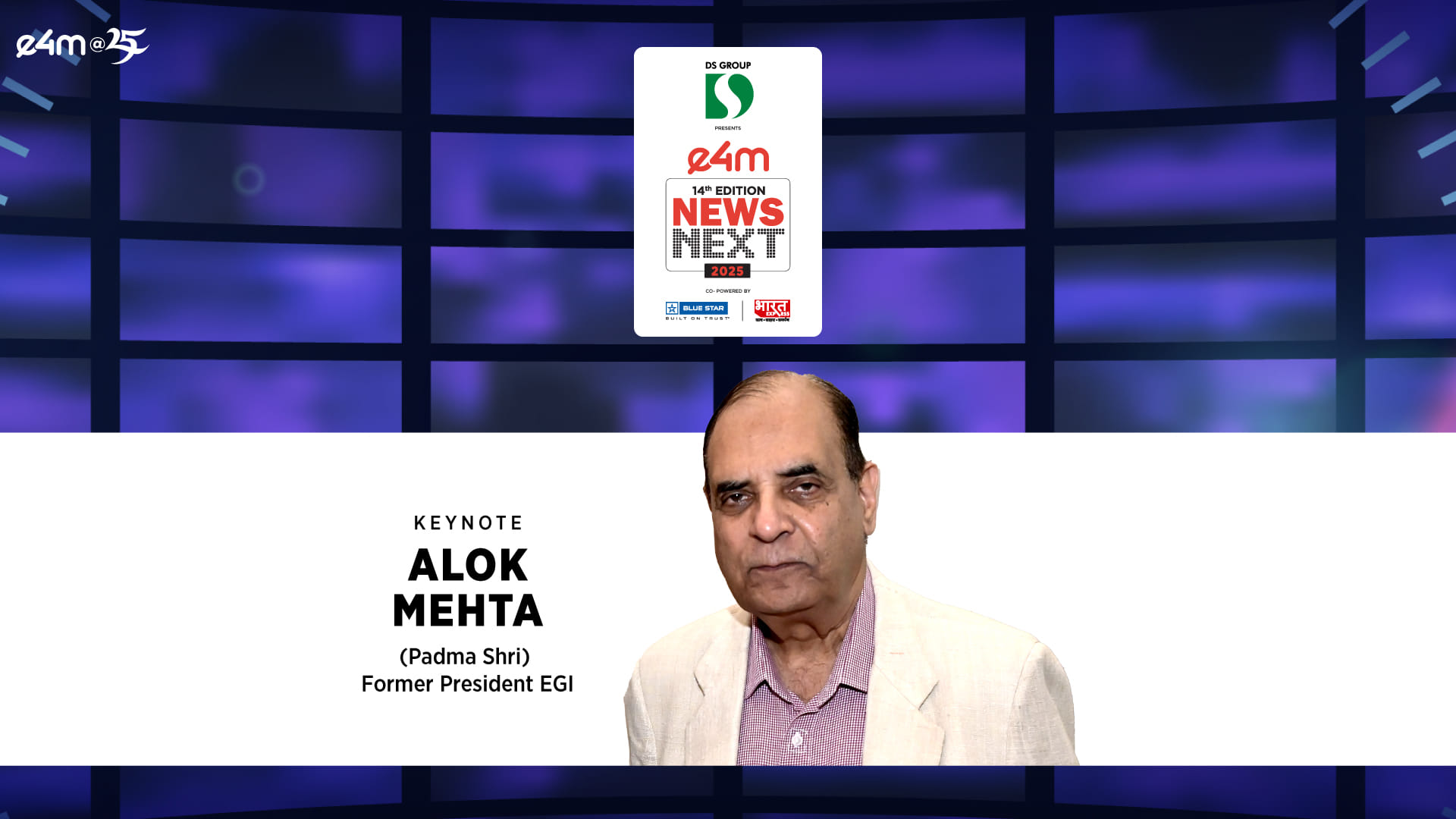

The e4m NewsNext Summit 2025 started on Saturday with a reflective and deeply personal session by veteran journalist and Padma Shri awardee Alok Mehta. He spoke on the evolution of Indian media, the myth of platform rivalry, and the enduring relevance of television, print and relationships in journalism.
Opening his address by responding to the ongoing narrative around television’s decline, Mehta was unequivocal. “TV is alive. TV will always be alive,” he said, urging the industry to stop writing premature obituaries for legacy media platforms .
Tracing his own journey that began in 1971, Mehta reminded the audience that disruption is not new to journalism. “We started with the typewriter, I started with the telegram, not today’s Telegram, but the wire,” he said, adding that he has worked across agencies, radio, television, international media collaborations and early digital experiments, witnessing each transition firsthand .
Using this lived experience, Mehta challenged the idea that platforms are locked in competition with each other. “We are not competing. We are supplementing each other,” he asserted. According to him, audiences naturally move between platforms, from TV to digital to print, based on depth, detail and convenience, making coexistence inevitable rather than optional.
He also reflected on the early days of exchange4media, recalling how its beginnings were modest and uncertain. “When e4m started, it was a small get-together… even then we used to ask - how will it work?” Mehta said, noting how industry ecosystems grow through patience, credibility and sustained effort .
Citing high-profile interviews and global media moments, Mehta questioned why editorial decisions are often viewed through a lens of rivalry. Referring to President Vladimir Putin’s choice of platform for an interview, he remarked, “If President Putin gave an interview, it shows the importance of Indian media. This should be seen as a matter of pride, not a house battle.” He added that editorial choices are often strategic and contextual, not adversarial.
On newsroom culture, Mehta cautioned against internalising conflict manufactured by ownership or market forces. “Management will want Alok Mehta and others to fight. But when it comes to advertising rates, all owners become one,” he observed, urging journalists to understand the economics without letting it corrode professional relationships.
Drawing from decades of reporting across politically volatile environments, Mehta underlined the importance of engagement over hostility. “Anybody who is in power is not your enemy,” he said, recounting instances where dialogue, respect and firmness helped him navigate threats, political pressure and confrontation without compromising editorial integrity.
Risk, he noted, is inseparable from journalism, whether on the battlefield or in investigative reporting, but it must be accompanied by institutional responsibility. “If you want to take risks, you must also ask for protection,” he said, acknowledging the dangers journalists face while reporting from conflict zones and sensitive beats.
Returning to the subject of television’s future, Mehta pointed to consumer behaviour rather than perception. “Look at how many TV sets are still being sold… people are still buying television,” he said, arguing that big screens, shared viewing and credibility-driven consumption continue to anchor TV’s relevance even in a mobile-first era.
Concluding on a philosophical note, Mehta likened journalism to surgery. “The doctor who operates never asks whose blood it is,” he said. “That should be the power of the media, to do the operation, regardless of personal equations.” For Mehta, relationships, resilience and responsibility, not rivalry, will determine whether journalism survives the next 50 years.
Read more news about Television Media, Digital Media, Advertising India, Marketing News, PR and Corporate Communication News
For more updates, be socially connected with us onInstagram, LinkedIn, Twitter, Facebook YouTube & Google News