Why can’t profit and doing good coexist? Asks Channel Factory’s Kartik Mehta
Kartik Mehta, Chief Business Officer at Channel Factory, spoke at the e4m Confluence Media Investment Summit on the power of conscious and unconscious biases, particularly within media
 by
by
Published: Nov 11, 2024 2:24 PM | 4 min read
 Follow Us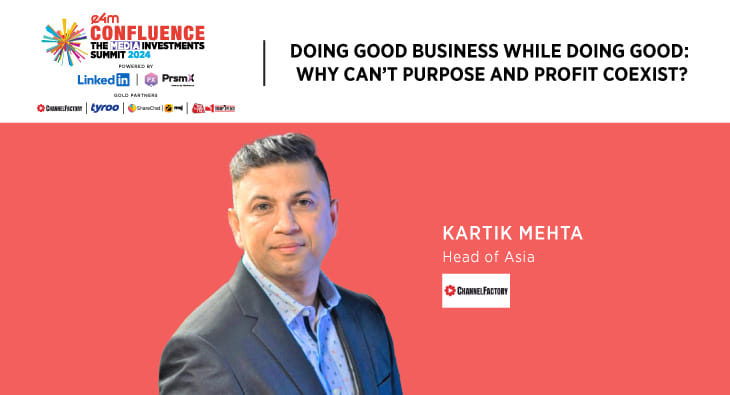

The e4m Confluence Media Investment Summit held in Mumbai on November 11 saw an enviable gathering of media and advertising industry leaders, who broke down the math, science, and creativity behind media strategy and planning.
In a compelling address, Kartik Mehta, Chief Business Officer at Channel Factory, challenged the conventional separation of profit and purpose in business. “Why can’t profit and doing good coexist?” Mehta asked, framing his call for a shift in how businesses approach social responsibility. His argument was clear: businesses don’t need to choose between making money and driving a positive impact; rather, the two can and should reinforce each other.
Mehta acknowledged that companies are traditionally seen as profit-driven entities, but he highlighted the potential they have to do good while thriving financially. “If businesses aren’t generating enough revenue while aiming to do good, then it starts resembling charity. And without revenue, there’s no scale, no expansion, no lasting influence,” he said. For Mehta, the solution is for businesses to “be conscious”—to balance their revenue goals with the responsibility to foster societal progress.
The heart of Mehta's address revolved around the concept of “consciousness,” which he described as "just about being aware—aware of ourselves and what’s around us." He emphasized the power of both conscious and unconscious biases, particularly within media, noting that these biases influence decisions on what content to promote or avoid. “Our unconscious biases often come from our upbringing, education, and culture,” Mehta said, “and they shape the way we respond to things, especially in our professional lives.”
In the context of social media, Mehta acknowledged the positives—creators generating content, income, and community—but also the negatives, such as misinformation and cyberbullying. “When it comes to harmful content, unconscious biases play a big role,” he explained.
To address these issues, companies often resort to exclusion—filtering out or avoiding content seen as risky. “By doing this, we gave rise to an era of exclusion,” he observed, “where the easiest thing became just excluding everything deemed problematic, without considering the impact of who we might be leaving out.”
For Mehta, it’s time to replace this exclusion-first approach with an inclusive strategy. “We can’t ignore diverse audiences just because their needs don’t align perfectly with our comfort zones,” he said, challenging the industry to think more inclusively.
He shared a recent Channel Factory campaign in Europe that intentionally reached out to diverse creators discussing taboo topics like climate change and disability. “Some marketers might hesitate to engage with topics like sustainability or disability,” he noted, “but the results show that a more inclusive approach brings immense value.”
As a proof of concept, Mehta referenced Procter & Gamble’s recent success, where much of its three-year growth stemmed from reaching previously excluded audiences. “The exclusion era served its purpose, but now it’s time to shift to an inclusion-first approach,” he affirmed.
Building on this shift, Mehta formally announced Channel Factory’s new “Conscious Advertising Program” in India. “Through this program, we’re committing to fostering diversity—whether it’s sustainability, gender inclusion, or other crucial issues,” he explained. This initiative, designed to help brands and marketers embrace inclusion, represents a critical step toward “creating media ecosystems that truly reflect the world we live in.”
Mehta closed with a memorable call to action, urging attendees to adopt the ‘Dot Principle.’ His advice was simple yet profound: “Just do one thing to make a difference. If you do one thing, the person next to you will do another, and that’s how the circle completes.” He illustrated how these small acts can create substantial change, building a culture of inclusion one step at a time.
In an era where consumers increasingly expect brands to take a stand, Mehta’s message is both timely and strategic. “Businesses don’t have to choose between profit and purpose,” he reiterated. For the media industry, he believes this means evolving beyond traditional exclusionary practices to embrace diverse voices—a shift that is both ethically sound and commercially wise.
As India’s media landscape continues to expand, Channel Factory’s Conscious Advertising Program provides a roadmap for fostering inclusivity and impact. With his parting words, Mehta left no room for doubt, remarking, “Doing well and doing good are not at odds—they’re two sides of the same coin.”
Read more news about Marketing News, Advertising News, PR and Corporate Communication News, Digital News, People Movement News
For more updates, be socially connected with us onInstagram, LinkedIn, Twitter, Facebook, YouTube & Google News