Why are brands now speaking in local languages too
At the e4m iDAC 2024 summit, regional agency leaders explored the vital balance between traditional and digital media, while emphasising the importance of building trust through diverse touchpoints
 by
by
Published: Sep 28, 2024 9:28 AM | 7 min read
 Follow Us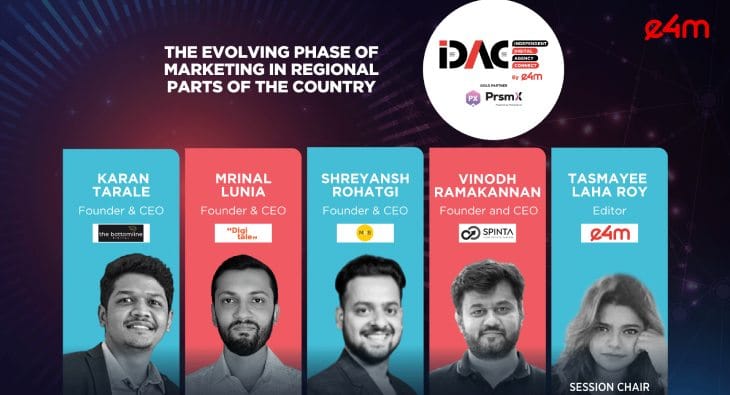

A panel of regional agency leaders explored the evolving landscape of marketing in India’s regional markets at the recent e4m iDAC 2024 summit. The discussion focused on how economic growth and government-driven digitisation have boosted purchasing power and increased internet usage in these areas.
The panellists included Karan Tarale, Founder & CEO of The Bottomline Digital; Mrinal Lunia, Founder & CEO of Digitale India; Shreyansh Rohatgi, Founder & CEO of Marko & Brando; and Vinodh Ramakannan, Founder & CEO of Spinta Digital. The session was chaired by Tasmayee Laha Roy, Editor at exchange4media.
The discussion began by Ramakannan sharing insights on the unique challenges of regional marketing, noting how diverse customer personas across India require a high degree of customisation emphasising that even smaller brands are now recognising the importance of this localisation, adding, “Even UGC content that we create needs to resonate with the audience. It’s about making the content feel relatable, like it’s coming from someone next door.”
Tarale discussed the challenge of moving traditional brands, with established ways of working, into the digital space. “We’re working with a lot of national brands that have been in legacy businesses for decades. Shifting them from their traditional mediums has been a challenge,” he said. “We’re seeing the next generation of brands adopting a digital-first approach, which is working well, though there’s still a long way to go even with them.”
Lunia highlighted the importance of regional strategies in marketing. “When we work with regional brands, there’s a clear demarcation in how content is created and planned for different parts of the country,” he said.
For instance, he noted how content for the contractor community or architects must be tailored to specific regional needs. He also pointed out the rising trend of on-ground activations being amplified digitally. “Brands are open to regional faces, speaking in local languages, and addressing cultural nuances. That’s a key trend shaping marketing strategies today,” Lunia added.
Rohatgi shared a case study from his experience working with Shyam Steel, a brand running a new venture called GharEka. “We were running campaigns for them, but the initial results weren’t great. However, when we switched the communication to Bengali, the audience outside of Calcutta responded much better. The cost per lead dropped from around 700 rupees to just 80 or 90 rupees,” he revealed.
He also emphasised the impact of regional nuances, explaining, “The marketing calendar in West Bengal operates differently from the rest of India. While the rest of the country does promotions during Rakhi and Independence Day, in Bengal, it’s Bhadramas—an inauspicious time to make purchases. This difference in timing shows just how important it is to customise marketing efforts regionally.”
"We’ve used examples of how steel companies have leveraged digital platforms and influencers to encourage other brands to do the same. That’s where the difference lies—regional brands need more education but are often more open to experimenting.”
This was followed by Tarale emphasising the significance of adapting to regional audiences in the digital age. "I believe that everyone has Amazon on their phones right now, and as a national brand, Amazon has successfully integrated regional languages into their app to better cater to diverse audiences," he noted.
He illustrated this point with an example from Kinetic Green, a brand under their management focusing on two-wheelers and three-wheelers. "Our target audience isn’t confined to metropolitan areas; we’re looking at tier 2 and tier 3 cities. This Bharat audience is evolving and value-conscious. It’s essential to convey the right value proposition in our communications to resonate with them."
All clients, whether national or regional, have their quirks and are equally demanding. Lunia discussed that it’s a misconception that national clients are easier to manage; they come with specific protocols and processes that require careful navigation.
He said that for national brands, it’s often about presentations and key performance indicators, while with regional brands, the focus shifts to handholding and functioning as their extended marketing team. This builds a foundation of trust and dependability.
He emphasised the importance of understanding client needs, noting, "With that expectation of trust, you need to know how and what services to pitch. It’s not solely about upselling or cross-selling," highlighting the rising significance of user-generated content (UGC) and regionalised content creation. "The notion that regional brands are reluctant to spend is actually a myth. It’s about winning their trust and guiding them through the process.”
Rohatgi then added to the discussion, focusing on budget considerations. "The budget for regional marketing is often lower than for national campaigns, largely due to the larger market size for national brands. For regional brands, it’s essential to understand that there isn’t a one-size-fits-all solution. Each strategy must be customised to fit the specific client and region."
He further discussed the integration of marketing strategies. "While many claim that traditional marketing is dead, I believe that traditional and digital marketing need to coexist and support one another. There’s a crucial element of trust that we must establish with clients, encouraging them to invest in both marketing avenues. Just because they are seeing leads or sales from digital efforts doesn’t mean they should neglect traditional methods. A balanced approach will yield optimal results for their brand."
When asked about the openness of real estate clients to experimenting with media mixes, Rohatgi emphasised, "It primarily depends on the ticket size of the project. This factor significantly influences whether we recommend a larger allocation to traditional media or a stronger focus on digital channels."
He elaborated on the necessity of traditional media for high-ticket clients, stating, "For high-net-worth individuals, investing in traditional media such as hoardings and print is essential. Visibility is key—clients need to see the brand everywhere, whether in digital, print, or outdoor media. This omnipresence fosters trust, which is crucial in real estate transactions."
For brands across sectors like FMCG, real estate, cement, and plywood, traditional advertising plays a tactical role, especially during new product launches or promotions. Agreeing with Rohatgi, Lunia said that having a presence in mainline media in India still adds credibility, indicating to consumers that the brand is trustworthy. “While digital marketing enhances recall and visibility, allowing for measurable KPIs, both traditional and digital channels complement each other in achieving overall brand success."
Tarale addressed the challenges of influencer marketing, stating, "The primary challenge lies in identifying the right influencer that aligns with the brand's messaging. You cannot choose an influencer who overshadows the brand; it’s crucial to find someone who conveys the right emotions and connects authentically with the audience."
He continued, "Additionally, budget considerations are paramount. Securing an influencer is just one part of the equation; promoting their content effectively is essential as well. In the regional landscape, we are witnessing a surge in local content creators, each carving out their own niche. Staying updated on emerging content creators is vital."
It's essential to budget appropriately. For brands with limited budgets, Ramakannan recommended focusing more on digital channels, including influencers. For regional targeting, a combination of digital and traditional methods can be effective. “However, for national brands with tighter budgets, digital marketing may be the better option, as traditional media can be prohibitively expensive."
He said, "Brands need to understand that their campaign goals should dictate their media mix. When I express interest in purchasing real estate, I provide my information to multiple developers. If all their sales teams reach out to me, my decision may hinge on how many times and in what ways I encounter their branding. This is often referred to as the 'seven-hit strategy'—it's about how many touchpoints a brand can establish to build trust. Trust is crucial when making a purchase, and it’s developed through consistent exposure across different channels."
Read more news about Marketing News, Advertising News, PR and Corporate Communication News, Digital News, People Movement News
For more updates, be socially connected with us onInstagram, LinkedIn, Twitter, Facebook, YouTube & Google News