‘To build brand loyalty, it’s crucial to maintain a continuous conversation with the user’
Industry experts at e4m Auto Marketing Summit 2025 explored how brands can leverage digital content and community-driven strategies to deepen customer engagement
 by
by
Published: Feb 20, 2025 4:48 PM | 6 min read
 Follow Us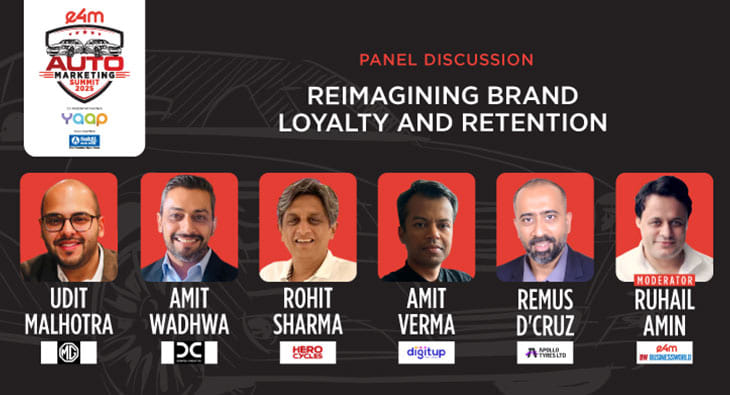

At the e4m Auto Marketing Summit 2025, industry leaders discussed the evolving landscape of brand loyalty and retention in the automotive sector. The panel explored how after-sales service, digital engagement, and community-driven initiatives are shaping long-term customer relationships.
The panel featured Udit Malhotra, Chief Marketing Officer at MG Motor India; Amit Wadhwa, CEO of Dentsu Creative India; Rohit Sharma, Chief Marketing Officer at Hero Cycles; Manan Kapur, Senior Partner at Yaap; Amit Verma, CEO & Founder of DigitUp; and Remus D’Cruz, Global Head of Marketing - Sports & Community Engagement at Apollo Tyres Ltd. The session was moderated by Ruhail Amin, Senior Editor at e4m.
Sharma opened the discussion by highlighting Hero Cycles’ long-standing presence in the market and the evolving nature of brand loyalty. “We've been a brand for the last 70-odd years, and we're pretty much a household name. But what we've realized is that the excitement of buying a cycle is very high in the first three months, and then it starts to taper down.”
“To build brand loyalty, it’s crucial to maintain a continuous conversation with the user and find ways to integrate the product into their daily lives,” he explained. Sharma emphasized that loyalty stems from emotional connections, word-of-mouth advocacy, and cultural integration.
Malhotra provided insights into MG Motor India’s approach to building customer trust despite being a relatively young brand. “We started our operations in India in 2017, and from day one, we took a disruptive approach. We don’t just sell cars; we aim to be an auto-tech leader,” he stated. He cited MG’s introduction of India’s first internet car, the Hector, as an example of the brand’s innovation-led positioning.
Discussing the role of after-sales service in driving loyalty, Malhotra highlighted MG Shield, a comprehensive package that offers five years of unlimited kilometer warranty, free service, and roadside assistance. “These building blocks ensured that customers from day one had a worry-free experience. From a CRM perspective, we trust the customer rather than questioning them. This philosophy has helped us rank number one in JD Power’s sales satisfaction index three times in just seven years,” he added.
He also pointed to the brand’s focus on digital integration through the MyMG app, enabling customers to book services and receive doorstep assistance, further enhancing the ownership experience.
The session was taken forward by D’Cruz sharing a unique perspective from the tire industry, where brand loyalty functions differently due to the nature of the purchase cycle. “Ours is what people would term a grudge purchase or a low-involvement purchase. Once you buy a tire, you ideally don’t think about it for the next three years unless something goes wrong,” he explained.
To counter this challenge, Apollo Tyres engages with customers well before they make a purchase, focusing on brand affinity through community initiatives.
He elaborated on their approach through motorsport and adventure riding communities. “We have a community called Bad Road Buddies, engaging with the two-wheeler and SUV communities through rides and expeditions. These aren’t just influencers—they’re advocates with strong reputations in motorsports, helping us build brand loyalty at a grassroots level,” D’Cruz said.
He also highlighted Apollo Tyres’ partnerships with major marathons and football events to connect with target audiences and leverage these engagements for future sales opportunities.
Different segments within the automotive industry require tailored loyalty strategies, from continuous customer engagement to leveraging digital tools and community-driven advocacy.
The significance of digital channels in maintaining brand loyalty was discussed by Verma. "Normally, when we talk about brand loyalty, we think of it as part of the post-purchase experience. But loyalty is also built in the minds of future customers," he noted. Citing Tesla as an example, Verma explained how the brand cultivated loyalty even before entering certain markets, by making use of platforms like YouTube, websites, and social media.
Verma emphasized that digital presence must be carefully curated to maintain consistency in brand messaging. "A lot of brands struggle with maintaining a focused digital identity. If you're selling to everyone, you're selling to no one," he cautioned, stressing the importance of targeted engagement.
Wadhwa shared key principles for fostering brand loyalty beyond the purchase phase. "Loyalty is about building a tribe, and it depends on the category. Everyday FMCG brands have frequent interactions, while categories like auto require more effort to maintain engagement. The challenge increases with longer purchase cycles," he explained.
He compared loyalty-building to a long-distance relationship. "The less frequently a consumer interacts with the brand, the more effort is required to sustain the connection. To make it work, brands must focus on three elements: materialistic benefits, emotional connections, and regular check-ins."
Materialistic rewards, such as loyalty points, discounts, and exclusive offers, keep customers engaged at a transactional level. Emotional connections, on the other hand, are essential for long-term loyalty. "Royal Enfield is a great example," Wadhwa noted. "They've built communities that foster a deep emotional bond, even beyond direct brand involvement."
The third pillar, regular check-ins, has been revolutionized by digital tools and AI. "It’s not just about sending birthday or anniversary messages. It’s about reaching out unexpectedly, making customers feel valued without crossing into the ‘creepy’ territory of digital surveillance," he added. The balance of these three elements, tailored to each brand’s category, forms a strong foundation for lasting customer relationships.
Kapur took the stage next to emphasize that content remains at the heart of brand-customer interactions. "We've always heard ‘content is king,’ but today, content is everything. As we sit here, half of us are scrolling through Instagram—that’s the power of content," he remarked.
Kapur categorized content into two key types: saveable and shareable. "If your content doesn’t fit into either, it’s ineffective," he stated. He highlighted how consumers actively engage with brand narratives across platforms, from social media reels to long-format commercials. "Consumers today are highly informed. By the time they make a purchase, they have done extensive research. The entire journey—from pressing enter to swiping a card—is influenced by content."
Short-form videos, particularly reels, have emerged as the most effective format, followed by other visual content types. "Even influencers today have largely shifted to reels because they work best. The key is creating compelling content at every stage of the customer journey," Kapur concluded.
Taking the discussion forward, Sharma challenged traditional influencer marketing. "We don’t believe in influencers; we believe in evangelists. It’s not about hiring someone with a million followers, but about finding those who genuinely live the cycling lifestyle," he said. These passionate advocates drive meaningful conversations, shaping brand narratives in an authentic and impactful way.
By combining data-driven insights, community-building efforts, and a sharp focus on engaging content, brands can create lasting loyalty. Sharma emphasized, "It’s all about giving people reasons to keep coming back, to keep pushing the pedal—both literally and figuratively."
Read more news about Marketing News, Advertising News, PR and Corporate Communication News, Digital News, People Movement News
For more updates, be socially connected with us onInstagram, LinkedIn, Twitter, Facebook, YouTube & Google News