‘The future matters, but what truly defines a brand is the stand it takes’
At e4m Pitch Brand Talk 2024, a panel of industry experts explored the critical balance between short-term ROI and long-term brand building
 by
by
Published: Oct 17, 2024 2:23 PM | 5 min read
 Follow Us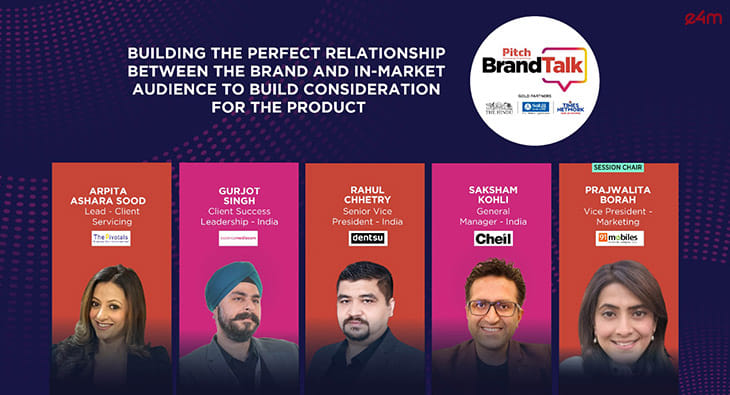

At e4m Pitch Brand Talk 2024, the ‘Audience Affinity’ panel delved into how brands can build the perfect relationship with in-market audiences to drive product consideration. The discussion emphasised the significance of understanding audience behaviour, crafting relevant messaging, and leveraging digital platforms to create lasting brand connections.
The panellists included Arpita Ashara Sood, Lead - Client Servicing at The Pivotals; Gurjot Singh, Client Success Leadership at EssenceMediacom; Rahul Chhetry, Senior Vice President at Dentsu India; and Saksham Kohli, General Manager at Cheil India. The session was chaired by Prajwalitha Borah, Vice President - Marketing at 91mobile.
Bohra began the session with a thought-provoking quote: “Good marketing makes the company look smart, but great marketing makes the consumer feel smart.” She emphasised the critical role agencies play in today’s multi-channel, multimedia landscape, particularly in crafting the right messaging for target groups, especially those in-market.
Turning to Kohli, Borah posed the question of how to balance different media platforms to effectively position a brand and engage with in-market audiences.
Kohli replied, "In-market audiences are a very defined data set. There is affinity-based buying, and you have to go contextual. In tech, for example, you work with tech bloggers and key opinion leaders who play a huge role in the consideration funnel."
He continued, "There is also the whole CRM database play because there’s a captive audience that you’re sitting with. The choice of platform is guided by the data set available. In some cases, the value proposition is less about the product and more about the convenience of buying." He provided an example of a quick commerce platform delivering a premium smartphone in ten minutes, illustrating how accessibility and convenience shape messaging.
Chhetry added to the conversation, "For in-market audiences, we first need to understand the audience persona and what they are doing. If we have first-party data, we can leverage it effectively. We use our proprietary tool, Dentsu Marketing Cloud, to slice and dice audiences and understand their behaviour and content consumption habits."
"In-market audiences generally consist of those searching in Google or Amazon, but understanding audience behaviour and niche characteristics allows us to broaden our targeting," he pointed out.
Borah next asked Sood about best practices for balancing media and messaging, particularly when working with multiple brands targeting similar audiences.
Sood responded, acknowledging the inherent overlap among brands within the same industry, “There always tends to be a certain amount of overlap when looking at brands in a particular segment. That overlap will stay, which is a challenge when multiple brands are competing.”
While acknowledging the challenge, she also emphasised the role of unique selling propositions (USPs) or "catch points" in distinguishing between brands. "Catch points are interesting moments in our campaigns where we can capture the audience's attention. Audiences today have high brand stickiness but very minimal attention spans. If I can create these catch points while building a long-term narrative, my campaigns will, over time, differentiate between brands."
Singh took the session forward by talking about how the wealth of signals available today can lead to overcomplication, stressing the need to use data wisely. "Being responsible marketers is exceptionally important. The kind of signals available today are so many that you end up overdoing it sometimes."
He pointed out the importance of bringing these teams together early in the process, sharing that this collaboration is essential to crafting effective, well-integrated campaigns. "Sometimes creative and media agencies need to jam together before the final approach or long-term marketing swap is presented."
On the digital front, Singh explained how creative content directly influences the cost-effectiveness of campaigns. "Digital is the only media where creative subsidises the cost of media. If your communication is better, you end up with better CPCs, lower CPCs, which means a lower cost of acquisition," he explained.
Next, Kohli stressed that brand building is a long-term strategy, requiring consistent efforts over time. He said, "You don't build trust and authenticity around brands in the short term unless there's a complete disruption like what Indigo did to airlines or Paytm to payments." He highlighted the importance of owning both micro and macro moments in a consumer's journey, which requires sustained effort.
Kohli also emphasised the need for integration across all consumer touchpoints. "At Cheil, we’ve cracked this model with what we call the 'business connected approach,' integrating touchpoints like retail, online, ORM, and CRM to offer a cohesive brand experience." This holistic approach, he noted, is crucial for ensuring a unified brand voice.
Chhetry added that brands should balance short-term ROI with long-term brand building: "Brands should set long-term and short-term KPIs. For the short term, focus on marketing objectives and ROI, but for the long term, invest in awareness and brand loyalty."
He shared that consistent investment and patience are key. "Brands need to be consistent, not just look for immediate ROI. Over time, upper-funnel audiences will move into the lower funnel and drive returns."
Discussing the future prospects and technological advancements, Singh said that while anticipating future trends is important, a brand's present stance and values are even more crucial. "Yes, the future is important, but the present is more important. A brand needs to take a stand." He highlighted how companies like Maruti, BMW, and Mercedes have clearly defined their market positioning based on customer experience and trust. "It's about the promise you give to the customer and living up to that promise, which helps build long-term relationships."
Sood echoed Singh's thoughts, adding that as the market evolves, brands must stay true to their identity while adapting to trends. "The market is changing fast, and younger generations will demand more in the coming years. Brands need to know who they are and who they want to be." She also stressed the importance of collaboration, where agency partners and publishers help brands gain consumer insights and stay ahead of trends, "It has to be a collaborative exercise to continue building the brand narrative."
Read more news about Marketing News, Advertising News, PR and Corporate Communication News, Digital News, People Movement News
For more updates, be socially connected with us onInstagram, LinkedIn, Twitter, Facebook, YouTube & Google News