‘Short-form content isn’t killing creativity; it’s demanding precision’
At e4m Screenage Conference, marketing leaders delved into the evolving role of video marketing, exploring how short-form videos and interactive AI-driven content are reshaping consumer engagement
 by
by
Published: Dec 2, 2024 1:12 PM | 9 min read
 Follow Us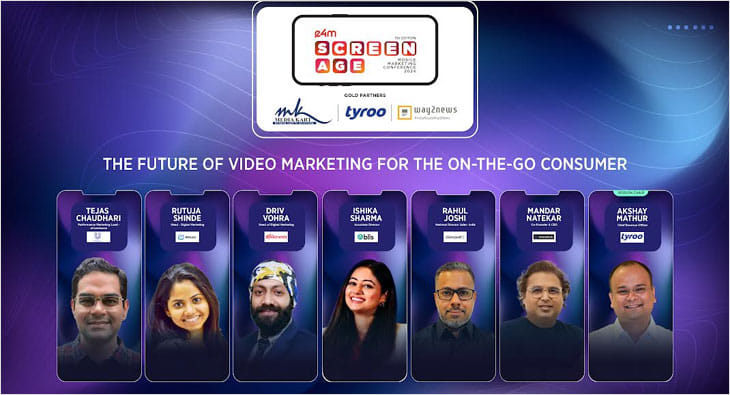

At the e4m Screenage Conference 2024, industry leaders discussed the ever-evolving dynamics of video marketing and how brands can cater to consumers on the move. The session highlighted trends, technologies, and strategies that redefine video storytelling, particularly in the context of mobile-first audiences.
The panel comprised Tejas Chaudhari, Performance Marketing Lead - eCommerce, Unilever; Rutuja Shinde, Head - Digital Marketing, Abbott India Limited; Driv Vohra, Head of Digital Marketing, Kellanova; Ishika Sharma, Associate Director, Sales, Blis; Rahul Joshi, National Director Sales - India, Silverpush; and Mandar Natekar, Co-Founder & CEO, Visual Dub. Akshay Mathur, Chief Revenue Officer at Tyroo, moderated the session.
Mathur set the stage by underlining the significance of immersive video marketing in today’s fast-paced digital landscape. “This is like a resurrection of immersive videos,” he remarked. “The topic of the future of video marketing for the on-the-go consumer brings a lot of action and discussion points to the table.”
Chaudhari addressed the evolving dynamics of short-form content and its impact on creativity. “The attention spans are going down, and we’re all hooked to so many apps now. There’s so much content, and everyone wants to see everything in a short span,” he said. Highlighting platforms like TikTok, he observed, “TikTok is one of the biggest examples of how short-form content has shaped consumer behaviour. Creativity has become more important than ever because you need to hook audiences in just one or five seconds.”
He also acknowledged the challenges faced by brand marketers in creating engaging content. “We need to understand why people spend so much time on these platforms—it’s about entertainment. The real challenge is finding content that is entertaining yet delivers the message effectively. That’s the shift we’re all navigating right now,” he explained, adding that platforms like YouTube and Instagram have set the standard with their short-form formats.
Shinde took a strategic approach to the conversation, emphasising the alignment of content with brand objectives. “We’re not in the business of entertainment. We are here to solve the brand’s challenge and deliver on the brand KPIs,” she said. She stressed the need for relevance, saying, “As marketers, our fundamental challenge is to find a place in the busy lives of our customers. If we can do this creatively, the message will stick. If not, they’ll scroll past and move on to the next best reel.”
While acknowledging the dominance of short-form content, Shinde also made a case for long-form formats. “We have to adapt to trends pushed by platforms like Meta and YouTube, but that doesn’t mean long-form content is dead. If it’s engaging and compelling, consumers will stick around. It’s about understanding the spectrum and ensuring both formats deliver on our brand KPIs,” she noted.
Vohra reinforced this perspective, highlighting the precision required in short-form content. “Short-form content isn’t killing creativity; it’s demanding precision,” he said. Reflecting on changing metrics, he said, “The 30-second video has been the gold standard for decades, but now, metrics like average watch time challenge brands to pack a punch within 10 to 12 seconds.”
For Vohra, the focus remains on creating impactful, thumb-stopping content. “In this fast-scroll culture, you need content that resonates and connects immediately. It’s not about losing creativity—it’s about evolving it to meet the demands of the platform and the audience,” he concluded.
Exploring Precision Marketing and Personalization in Video Campaigns
Continuing the discussion on the future of video marketing, the panel delved into the dichotomy of long-term brand building versus performance marketing, and how personalisation plays a pivotal role in engaging today’s on-the-go consumer.
Mathur raised a thought-provoking question, asking whether long-format videos are more suited for building long-term brand equity, while short-format videos excel in capturing attention for performance marketing. “Should we be looking at it from both perspectives?” he queried, adding that long-form videos deliver value over time, while shorter formats thrive on engagement and quick reactions.
Natekar responded by highlighting the shifting dynamics of consumer behaviour. “Social behaviour leads to consumer behaviour,” he remarked. “Today’s generation has less attention span and fragmented media habits. For instance, when you look at the younger generation, less is more.”
He stressed that the brevity required in short-form videos demands a higher level of creativity. “Everything becomes an elevator pitch. You have to articulate your brand’s conviction and message in just three, five, or ten seconds. This is where creativity thrives because you can’t afford fluff. Storytelling now must happen in the shortest possible time.”
Sharma brought a fresh perspective to the discussion, illustrating how AI and personalization can amplify the effectiveness of video marketing. Responding to Mathur’s query on Bliss’s use of AI for personalization, she shared a successful case study:
“A couple of years ago, we ran a weather-targeted banner campaign for an FMCG brand. As temperatures rose, creatives encouraged users to hydrate, and the messaging appeared on health-related websites. What made it truly engaging was that the creatives were in vernacular languages—Kannada for Karnataka, Malayalam for Kerala, and so on. Users responded to a simple yes-or-no question in their own languages,” Sharma explained.
The integration of real-time weather data with regional languages created a highly personalized experience. “The campaign saw impressive results, with a CTR of 1.8%, and clients were thrilled with the engagement,” she added, emphasizing the importance of tailored messaging.
Balancing Personalization and Privacy in AI-Driven Video Marketing
The panel next explored the delicate balance between leveraging AI for personalization and maintaining user privacy, a pressing concern in the evolving landscape of video marketing.
Joshi emphasized the structured approach Silverpush employs in AI-driven advertising. “There are four buckets we focus on,” he shared. “The first is creative personalization, where interactivity enhances engagement. The second is perfecting targeting using hyper-contextual AI solutions to reach audiences consuming content relevant to the brand. The third is optimization, ensuring campaigns are run more effectively and efficiently to meet KPIs. Lastly, analytics helps derive insights from campaign performance to enhance brand outcomes.”
He also acknowledged the growing need for privacy considerations. “We focus on sustainable AI, ensuring it pinpoints content without compromising user privacy. Additionally, integrating third-party data partners for brand safety creates a dual-layered protection system,” Joshi explained.
When asked for his take on the use of AI in video marketing, Natekar highlighted the transformative power of AI in speeding up the marketing process. “In the past, go-to-market strategies involved analyzing consumer behaviour, creating appropriate creatives, deploying them on media, and waiting for feedback. It was time-consuming. Today, we’re in the era of momentum marketing—you need to react instantly,” he stated.
AI, he explained, has revolutionized this by eliminating delays and reducing production costs. “For example, AI allows you to create one ad unit and repurpose it across ten regional languages without additional costs. This is a game-changer for brands looking to connect with diverse audiences quickly and effectively,” Natekar added.
Using Geo-Contextual Targeting for Effective Video Campaigns
The conversation shifted to how brands can leverage geolocation and contextual targeting to create videos that resonate with mobile audiences while aligning with local trends and market dynamics.
Chaudhari provided a compelling example from the e-commerce space. “We worked with Purplle, a beauty platform, which discovered through data analysis that a significant portion of its traffic came from a single state—Kerala. This insight allowed us to create state-specific content,” he said. By tapping into regional preferences and scaling video production, they successfully contextualized campaigns. “We now produce hundreds of videos monthly, enabling us to scale across different platforms and even tailor TV campaigns for sharper targeting,” he added.
Shinde emphasized the importance of social listening and micro-market strategies. “Social media chatter reveals region-specific health conditions, like gut health concerns in the east or diabetes prevalence in the south,” she explained.
Vohra shared how L’Oréal combined external factors like weather and air quality with internal first-party data for hyper-personalized campaigns. “For instance, in the north, dry scalp ads were promoted in local slang and set to regional music, yielding impressive results,” he noted. The campaigns also took into account regional habits and preferences, further enhancing relevance.
Sharma added an example from the automotive sector, showcasing the power of geo-fencing. “We collected device IDs from competitor dealership locations and layered them with contextual data like premium content browsing habits and the type of handsets used. This approach helped create highly targeted cohorts for a premium auto brand,” she elaborated.
Future Innovations in Video Marketing for Engaging Mobile Consumers in India
Looking ahead, Joshi highlighted the growing importance of interactive videos as a key innovation in the video marketing space. “Interactive videos, infused with dynamic elements, are the future,” he said, emphasizing the need to keep users engaged with the content. He shared an example of a luxury car manufacturer’s campaign for their first electric vehicle (EV) launch in India. “The challenge was to target content that resonated with users while addressing specific queries they often have, such as battery range, charging time, and acceleration,” Joshi explained. To address this, the team integrated a chatbot feature into the video ad, allowing viewers to get instant answers to their questions. Furthermore, the ad included a lead form, effectively capturing user information and creating a full-funnel marketing experience.
This blend of interactivity and personalized engagement through video, Joshi suggested, represents a significant shift toward more user-centric and dynamic marketing strategies.
Read more news about Marketing News, Advertising News, PR and Corporate Communication News, Digital News, People Movement News
For more updates, be socially connected with us onInstagram, LinkedIn, Twitter, Facebook, YouTube & Google News