‘Ramayana’ sparks a scramble for cinema ad slots as demand rises
The ‘Ramayana’ rush has pushed cinema ad inventory into premium territory, with brands across categories competing for visibility around the high-profile release
 by
Published: Nov 6, 2026 8:46 AM | 7 min read
 Follow Us


- The theatrical release of "Ramayana: Part 1" has generated significant advertiser demand, leading to premium pricing for cinema ad inventory, with rates reportedly 2.5 times higher than usual for Miraj Entertainment and up to 50% more for premium spots.
- The film is being screened across 225 Miraj screens with nearly all advertising inventory sold out for the opening week, attracting a diverse mix of advertisers from FMCG, jewellery, automobiles, and technology sectors.
- Advertisers are increasingly seeking integrated marketing opportunities beyond traditional on-screen spots, including lobby branding and experiential activations, to capitalize on the film's cultural relevance and audience engagement.
- Industry experts suggest that the success of "Ramayana" could significantly impact the cinema advertising landscape, potentially contributing 30-35% of Miraj's annual advertising revenue and demonstrating cinema's value as a national advertising platform.
A film can be a big-screen spectacle for audiences, but for advertisers, a major theatrical release can also become a fight for some of the most coveted real estate in cinema: the few seconds before the film begins, the spots immediately after the interval and the opportunity to reach audiences gathered for a shared cultural experience. That opportunity appears to be playing out around Ramayana: Part 1.
Advertiser demand has pushed inventory into premium territory, with cinema operators reporting strong bookings and brands from categories ranging from FMCG and jewellery to automobiles, BFSI and consumer technology.
Read On: Cinema advertising goes beyond the screen, but not year-round
Ramayana pushes cinema ad rates higher
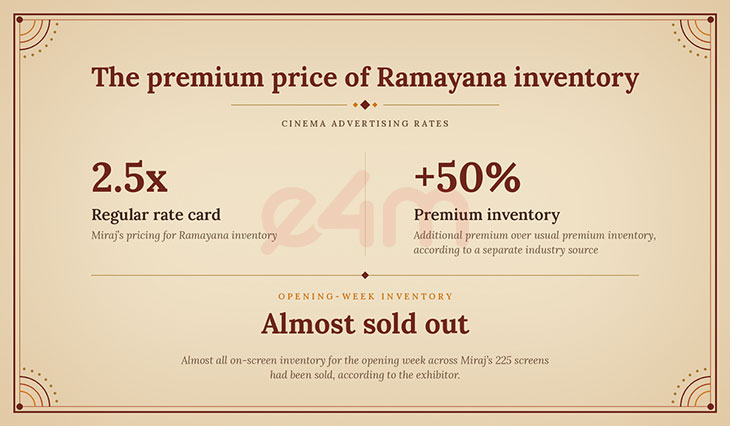
The clearest indication of demand comes from Miraj Entertainment. Deepak Adwani, Executive Director, Miraj Entertainment Ltd, said the film is playing across 225 Miraj screens, with 960 shows daily. Almost all on-screen inventory for the opening week had already been sold out, making it one of the strongest advertiser responses the exhibitor had seen for a single release.
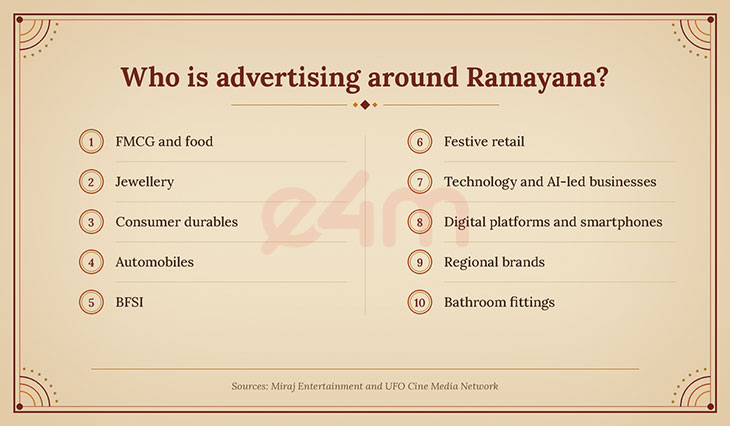
The advertiser mix reflected the breadth of the film's appeal. FMCG and food, jewellery, consumer durables, BFSI, automobiles and festive retail are among the categories showing interest. For brands, the draw is not simply the film's scale, but the prospect of reaching family audiences in an environment where viewers were already invested in the content.
That demand is also being reflected in pricing. Adwani said rates for Ramayana were around 2.5 times Miraj's regular rate card, although the final price varied by city, property and format. This was a Miraj-specific pricing disclosure, not a uniform rate across cinema chains.
A separate industry source put the premium at another level, saying inventory for the film was being charged around 50% more than what was usually charged for premium inventory.
The distinction matters because it shows how a high-demand release can create a pricing tier of its own.
Sachiin Guptaa, Country Head, Enterprise Business, UFO Cine Media Network, described the situation as a demand-and-supply equation, with the most sought-after placements commanding higher premiums. “A property of this scale naturally commands a premium advertising proposition. The inventory spans conventional 10-second, 20-second and 30-second on-screen spots, along with opportunities for premium placements and customised packages. The value proposition goes beyond advertising seconds.”
Read On: As audiences return to theatres, brands turn cinemas into marketing hubs
A cinema advertising executive, speaking off the record, described the limited availability of these positions. "The spots are limited. Especially the most premium spots, which are just before the movie starts and just after the interval and all. They are extremely premium. And they are also sold."
Advertiser mix widens
The categories entering the film's advertising inventory suggest that cinema's appeal is not restricted to brands traditionally associated with mass entertainment. FMCG, food, jewellery, automobiles, consumer durables and financial services feature prominently in the conversations with cinema stakeholders. New-age technology businesses, AI-led companies, digital platforms and smartphone brands are also part of the wider interest described by UFO.
An on-ground observation of one Ramayana screening offered another view of this advertiser mix. The advertising before the first trailer ran for approximately 13 minutes, with brands including SBI Mutual Funds, Nippon India Mutual Funds, Birla Opus, Colgate, Thums Up, Dollar Innerwear, Vicco, Everest, Kisna Diamonds and Gold Jewellery, Audi, IndianOil Servo, L'Oréal Paris, Sensodyne, Helios Luxe and Beyond Lab Grown Diamonds, among others.
The interval break featured another extensive mix, including Ahujasons, Barter Exchange of India, Om Sweets, Austin Plywood, Sprite, Devo by Siyaram's, Macroman, Colors Rupa, Lux Cozi, Swiss Beauty, Havells, Agilus Diagnostics, Monte Carlo, Fevicol, Oppo, Ray-Ban Meta and Joyalukkas. Local and NCR-specific advertisements also appeared, including a regional Sugar and Spice spot and a Bharat Reshma designers' advertisement.
This was an observation from a particular screening, not a representation of every cinema or show. However, it illustrated the range of advertisers using the film's theatrical audience, from national brands and financial services to regional businesses seeking local visibility.
Read On: Is box office shift turning cinema into a 365-day advertising platform?
A separate industry source identified Joyalukkas, Pepsi, UltraTech and Hero among the highest-paying advertisers for Ramayana cinema inventory.
For UFO Cine Media Network, the interest was not limited to mass-market categories. They pointed to the role of film genres and audience profiles in shaping advertising decisions, noting that different kinds of films attracted different advertiser groups.
“Beyond traditional categories such as FMCG, jewellery, automobiles, consumer durables and financial services, we see opportunities from new-age technology companies, AI-led businesses, digital platforms, smartphones and emerging consumer brands. This reflects the changing perception of cinema as an advertising medium. Brands today are looking for environments that offer attention, impact and an opportunity to connect with consumers at scale. Ramayana brings all three together,” said Guptaa.
Brands seek a larger cinema presence
The opportunity around Ramayana was also pushing cinema advertising beyond conventional on-screen spots. Exhibitors and cinema media networks were looking to monetise the wider theatre environment through lobby branding, standees, digital screens, entrance branding, installations, sampling and experiential activations.
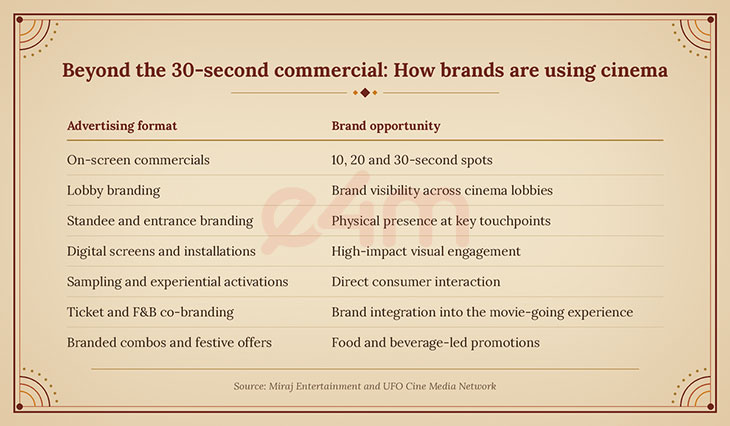
Miraj said brands were increasingly seeking integrated packages that combined on-screen advertising with lobby branding, ticket and food-and-beverage co-branding, festive activations and sampling. Food and beverage tie-ups, branded combos and festive offers were also finding interest.
UFO was exploring a similar expansion. Guptaa said brands could use theatre branding, interactive installations, sampling and customised experiences to build a presence around the film rather than rely only on a 30-second commercial.
Read On: Can blockbuster films bring more brands to the big screen in 2026?
For advertisers, the scale of audience attention around the release itself is a draw, making it an opportunity to ride the buzz. “There are two types of brands. One integrates its communication with the story and the platform. The other type looks at it as an opportunity to amplify an ongoing campaign. My campaign is already running, so they just put it to work like a multiplier effect,” UFO Cine Media Network added.
This distinction is important. The first approach makes the film part of the brand's communication; the second uses the film as a high-attention media environment for an existing campaign.
Can One Blockbuster Change Cinema's Ad Economics?
The immediate opportunity is significant, but the bigger test for cinema advertising is whether the momentum around Ramayana can create a lasting change in advertiser participation and revenue.
Miraj expected the film to contribute 30-35% of its annual advertising revenue at its cinemas. Adwani attributed the opportunity to premium pricing, higher inventory sell-through and the volume of shows, while also pointing to the additional revenue potential from integrated branding and activations. He estimated the wider Indian cinema advertising market at around ₹1,000 crore.
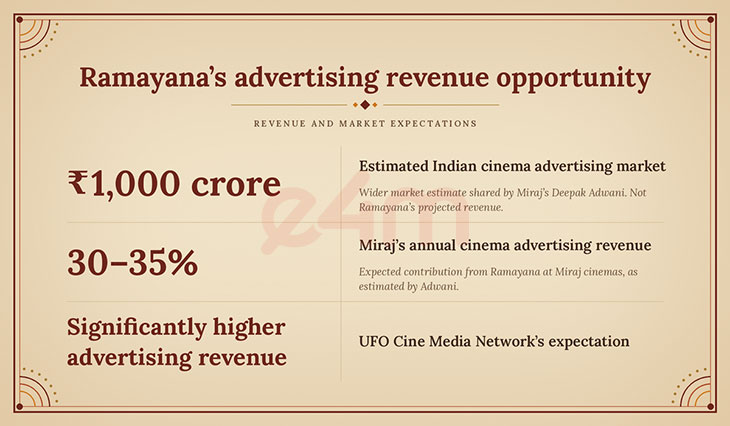
UFO, meanwhile, expected advertising revenues from the release to be significantly higher than those from regular big-budget films, citing the film's scale, pan-India appeal, cultural relevance, premium pricing and integrated theatre branding. “We believe Ramayana has the potential to deliver advertising revenues significantly higher than a regular big-budget theatrical release. Its anticipated scale, pan-India appeal and cultural relevance create a much larger advertiser universe. Ramayana has the potential to demonstrate the true commercial power of cinema as a national advertising platform. It is an opportunity not just for the film or individual exhibitors, but for the entire cinema advertising ecosystem.”
The Ramayana rush has pushed cinema ad inventory into premium territory, but whether this momentum will last beyond the film’s theatrical run remains to be seen.
Read more news about Marketing News, Advertising News, PR and Corporate Communication News, Digital News, People Movement News
For more updates, be socially connected with us onInstagram, LinkedIn, Twitter, Facebook, YouTube & Google News
