Pantone 11-4201 Cloud Dancer: The global-local clash over 2026’s Colour of the Year
Indian marketers question cultural blind spots after Pantone names ‘Cloud Dancer’ Colour of the Year 2026
 by
by
Published: Dec 10, 2025 9:19 AM | 6 min read
 Follow Us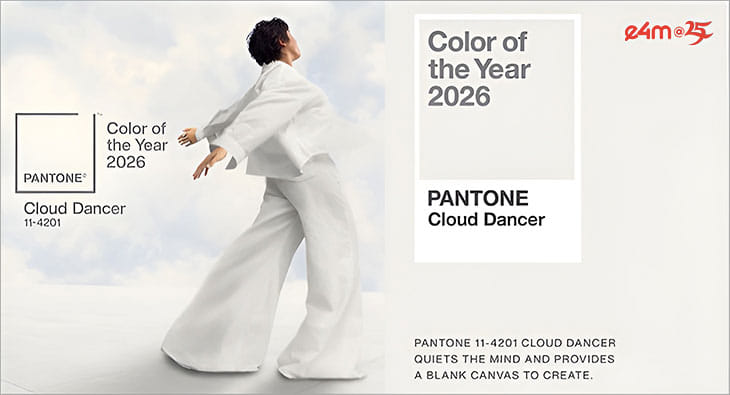

Pantone’s announcement of Pantone 11-4201 Cloud Dancer, stating, “A billowy white imbued with serenity, it invites true relaxation and focus, allowing the mind to wander and creativity to breathe”, set off an unusually intense debate this year. The annual Colour of the Year is typically met with brand campaigns, designer moodboards, and enthusiastic adoption across industries. But the 2026 pick sparked something bigger: a cultural debate over meaning, representation, and whose emotional experience the colour is meant to reflect.
Pantone’s choices carry weight because the organisation’s influence spans decades. Since the 1960s, the Pantone Matching System has acted as the universal language for designers, printers and marketers across the world. When Pantone introduced its Colour of the Year programme in 2000, it wasn’t just naming a shade, it was reading the global room.
View this post on Instagram
Each year’s tone is chosen after months of tracking shifts in fashion, socio-economic mood, design, entertainment, and even geopolitical events. This gives Pantone an almost oracular role in the design and advertising ecosystem, with brands often aligning campaigns and product launches to the chosen colour. But this year, the “reading” did not land evenly around the world.
View this post on Instagram
The sharpest criticism came from Indian marketers and design leaders who questioned the cultural distance built into global forecasting. Designer Varija Bajaj set the tone for the counter-conversation when she wrote: “Someone needs to call it out and stop being dictated by ‘International Media and Trends’. India is barely a blip on their research radar.” She argued that white, in much of India, represents mourning rather than serenity, saying: “It is not a colour of celebration, festivity, or joy.”
Bajaj’s frustration wasn’t about disliking the colour, but about how India ends up adopting trends that aren’t rooted in its emotional or cultural reality. She warned that fashion schools, retailers and designers would still “shove these colours down your throat,” encouraging brands to resist blind conformity with her succinct advice: “Apni akal lagao. Trend ke naam par mat bevkoof bano.”
View this post on Instagram
Creative Director Mriga Kothare Pushkar approached Cloud Dancer from a more reflective angle. She acknowledged its softness while pointing out the tension brands face in an overstimulated world. “How will brands create emotional safety and influence trust in a world that is overwhelmed and overstimulated, and increasingly fragmented?” she asked. For her, the issue is not white itself, but the superficial way in which brands often approach colour. “Colour has always been one of the most democratic forms of communication,” she wrote, emphasising that colour choices signal emotion, memory and identity. Her reminder was clear: brands that treat colour as a cosmetic layer will fall behind those that treat it as strategy.
On the other side of the spectrum, marketer Nidhi Rastogi framed Cloud Dancer as a response to global sensory fatigue. “Move over mocha mousse, the new Pantone colour of the year is white! A visual reset for an overstimulated world?” she asked, noting that Pantone’s process involves a full year of analysing entertainment, art, fashion, technology, and socio-economic change. Her interpretation aligns closely with Pantone’s own description of Cloud Dancer as “a softly white hue that serves as a symbol of calming influence… encouraging true relaxation and focus.” While she acknowledged the monotony critiques around white, she also recognised its potential to act as a clean slate for creativity in chaotic times.
If Pantone expected Cloud Dancer to be welcomed as a universal symbol of calm, the internet had other plans. The colour sparked a surprisingly fierce wave of criticism, especially across Indian creative circles where cultural context heavily influences aesthetic interpretation.
Actor and comedian Anu Menon joined the chorus of users who dismissed the shade as unimaginative and disconnected from reality, echoing a sentiment widely shared online: that in a chaotic, overstimulated world, choosing white felt more like an evasion than a statement. Designers and marketers were even more vocal. Luxury and design expert Niti Gupta, fashion designers Mehakk Jain and Achint Mehta, and stylist Madhuri Singh each pointed to the cultural and expressive limitations of Cloud Dancer, arguing that India’s design identity is rooted in warmth, symbolism and celebration, qualities a blank white simply cannot hold.
View this post on Instagram
Even marketers like Shalini Lahiri, who unpacked the strategic weight colour has on packaging and consumer behaviour, noted that Cloud Dancer’s emptiness makes it a risky anchor for brands searching for emotional resonance. Together, their responses reflect a broader online mood: the colour may be globally neutral, but its meaning is anything but universal.
The reason this debate has gained such prominence is that it exposed a fault line that has been growing for years: the tension between globalised aesthetics and local systems of meaning. A colour is never just a colour; it carries cultural memory, emotional resonance, and symbolic associations. In the West, white may suggest purity, stillness, or elegance. In many parts of India, it signifies loss, austerity, and widowhood. When a global authority declares that a colour represents the collective emotional direction of the world, it risks flattening these nuances. In an era when Gen Z demands cultural specificity, authenticity, and locally grounded identities, this gap feels more pronounced than ever.
This is why the backlash matters for marketing and advertising. For decades, global trend reports have shaped visual identity across industries. Yet the 2026 debate demonstrates that top-down trends no longer carry unquestioned authority. Indian marketers are pushing back, not because they reject white, but because they resist being expected to feel what the West feels. The Colour of the Year controversy is, in many ways, a referendum on who decides the global mood, and whether cultural nuance is optional or essential.
White is already prevalent in premium and wellness aesthetics, and Cloud Dancer aligns with this language of calm luxury. However, its adoption in India is likely to be more measured, context-driven, and locally adapted. Brands may pair the softness of Cloud Dancer with warmer colour palettes, regional motifs, and storytelling that reflects Indian cultural and emotional associations rather than Western ones.
View this post on Instagram
View this post on Instagram
View this post on Instagram
The key takeaway is that 2026 will not be defined by a single global shade, but by the conversation it sparks. While Pantone has selected Pantone 11-4201 Cloud Dancer as Colour of the Year 2026, India has questioned its meaning. In doing so, the country signals a turning point for global advertising: aesthetic decisions now need to be culturally aware, emotionally intelligent, and grounded in lived experiences, not just global forecasts.
Read more news about Marketing News, Advertising News, PR and Corporate Communication News, Digital News, People Movement News
For more updates, be socially connected with us onInstagram, LinkedIn, Twitter, Facebook, YouTube & Google News