The W.O.R.L.D. Model: Framework for seeing invisible architecture of your organisation
Guest Column: Ranjan Malik, Co-founder of Primalise, writes on the hidden pattern behind stalled restructures, failed culture programmes, sluggish digital initiatives and disappointing AI rollouts
.png) by
by
Published: Jul 2, 2026 4:57 PM | 7 min read
 Follow Us

- Many organizations struggle with transformation not due to a lack of strategy, but because they are unaware of the underlying "meaningplex" that shapes their culture and decision-making processes.
- The article introduces the W.O.R.L.D. Model, which identifies five dimensions—Waters, Origins, Roles, Load-Bearing Frictions, and Doctrine—that influence how organizations operate and perceive themselves.
- Successful transformation requires leaders to recognize and analyze the hidden worlds within their organizations, rather than solely focusing on external strategies or messaging.
- AI technologies can exacerbate existing organizational issues by reflecting the real behaviors and practices of the organization, rather than the projected values or strategies presented by leadership.
Most organisations do not fail to transform because they lack strategy. They fail because they are trying to change from inside worlds they cannot see.
This is the hidden pattern behind stalled restructures, failed culture programmes, sluggish digital initiatives and increasingly disappointing AI rollouts. Leaders redesign processes, redraw org charts and launch transformation roadmaps, yet the organisation keeps behaving in strangely familiar ways.
The problem is rarely the strategy itself. The problem is the world beneath it.
The success trap
Every organisation begins life as a curious child, testing and failing and asking: what else? What else? This exploration persists until something clicks. Then the dynamic changes.
What worked gets codified. The code gets enforced. Over time, the organisation stops experimenting and starts protecting. A living process of discovery gives way to a fixed logic of repetition.
But beneath this visible shift, something deeper is forming. With every reinforced success, the organisation is constructing a world. Not a physical world, but an interpretive one: a coherent architecture that determines which questions get asked, which options appear viable and which possibilities remain permanently out of view.
I call this architecture a meaningplex.
It comprises four elements. Assumptions: beliefs so embedded they no longer register as beliefs. Boundaries: territories marked as off-limits, segments considered beneath the brand. Unwritten rules: the actual operating code governing who genuinely influences decisions. Shared meanings: what words like "innovation" actually denote in practice, as distinct from what they claim.
Here is the critical distinction. Leaders do not think about their meaningplex. They think within it. It is not the object of analysis. It is the lens through which everything else gets analysed.
A traditional story captures it. A young fish asks an older frog: "You often speak of life outside water. Tell me, what is water?" The frog pauses. Fish, of all creatures, should understand water. Then the insight arrives: the fish cannot perceive water precisely because it surrounds everything.
Organisations experience their own assumptions the same way. And what you cannot see, you cannot change.
Three versions of every organisation
Every organisation exists in three versions simultaneously.
The Projected organisation is the one leadership presents to the world: strategy documents, investor narratives, values statements.
The Real organisation is what those inside it actually experience: which rules genuinely hold, whose judgement carries weight irrespective of title, which behaviours lead to advancement regardless of stated criteria.
The Perceived organisation is how the outside world, customers, regulators and partners, actually encounters you.
In a young organisation, these three track closely. Success pulls them apart. And when leaders notice the gap, they typically respond with new messaging or revised incentives, seldom stopping to ask a more fundamental question: what world are we actually inhabiting?
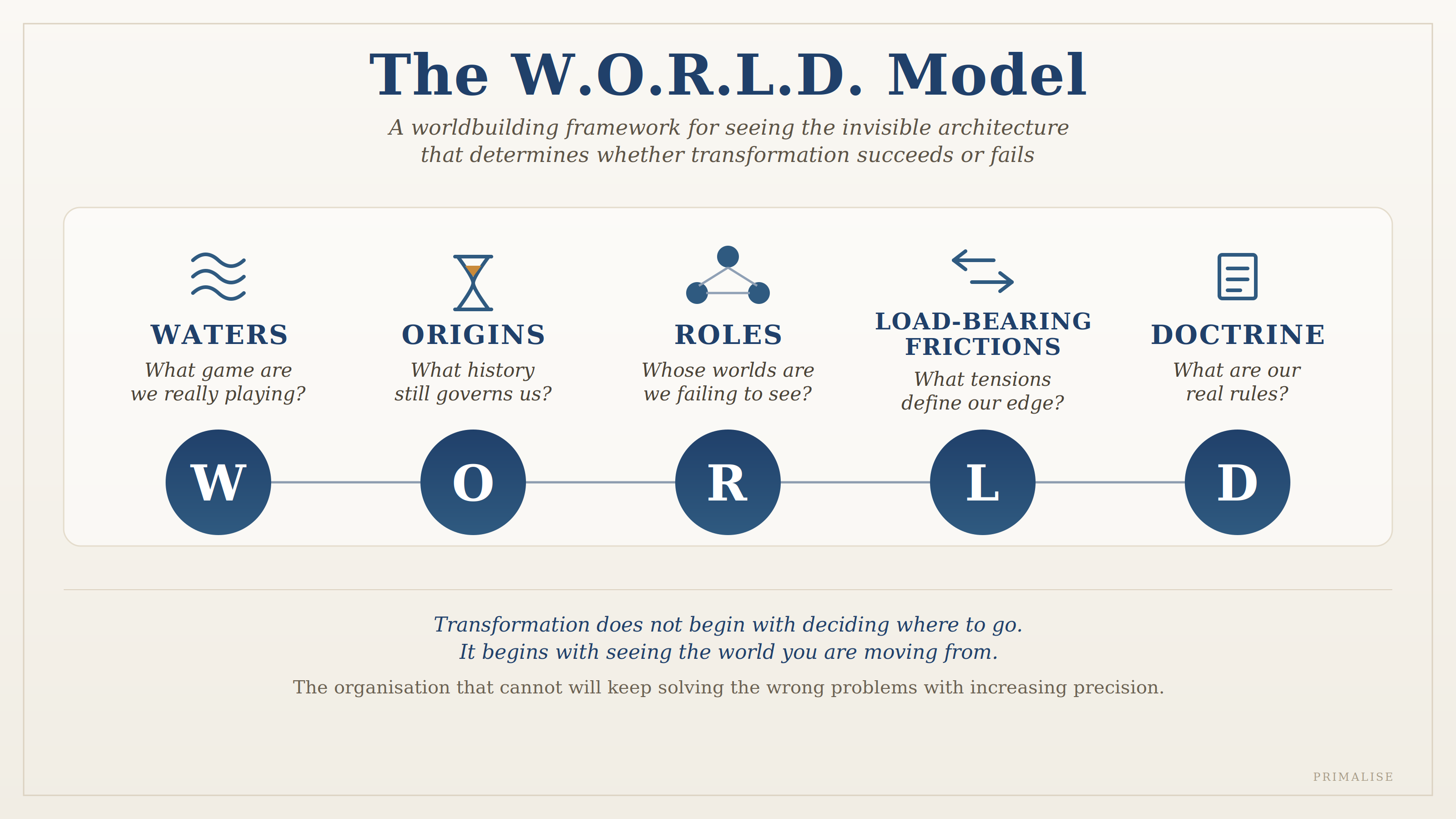
The W.O.R.L.D. Model
Before leaders can transform their organisations, they must surface the hidden worlds those organisations have built. I call this practice worldbuilding, not as an act of fantasy, but as a strategic discipline.
The concept draws from narrative theory. Before Tolkien wrote a single chapter, he spent years designing Middle-earth: its geography, languages and historical grievances. Nothing in the story is arbitrary. Everything follows from the architecture of the world.
Organisations construct worlds through the same mechanism, though almost never deliberately. The W.O.R.L.D. Model maps five dimensions that shape them.
Waters: What game are we really playing?
The invisible medium the organisation operates within: market definitions, competitive assumptions, industry logic. Like water surrounding fish, these conditions are so pervasive they become imperceptible.
NVIDIA shows what deliberate Waters redefinition looks like. In 2012, it was a graphics-chip maker for gamers. By 2016, leadership had repositioned it as AI infrastructure. By 2024, CEO Jensen Huang was describing NVIDIA's customers as running "AI Factories." The company is now the most valuable in the world.
This was not rebranding. It reshaped hiring, partnerships, ecosystem strategy and investment thesis. Many organisations fail transformation not because they execute poorly, but because they keep playing an outdated game with increasing efficiency.
Origins: What history still governs us?
Every organisation carries inherited instincts. Some are innate, wired into the founding. Some are imbibed, absorbed unconsciously from the industry or era. Some are induced, deliberately installed through crises or leadership choices.
Patagonia's environmental commitment traces to a near-bankruptcy in the early 1990s, when founder Yvon Chouinard confronted the damage caused by the company's own supply chain. That crisis forged instincts that now govern every major decision, up to the 2022 transfer of ownership to an environmental trust. It is an induced instinct that, over three decades, became indistinguishable from innate identity.
When leaders say "that's just how our industry works," they are usually describing imbibed instinct rather than objective reality.
Roles: Whose worlds are we failing to see?
Stakeholders are not merely users to serve. They are agents inhabiting their own worlds, with their own logic.
When IKEA opened in Hyderabad in 2018, its global model assumed customers happily assemble their own furniture. After 800 home visits across India, it found customers there read self-assembly as cost-cutting, not empowerment, and domestic-staff dynamics made the model largely irrelevant. Rather than dismiss this as irrational, IKEA asked whose world it was failing to see. It built a 150-person assembly team, adapted its range, and priced a thousand items below 200 rupees. Core identity preserved, local architecture respected.
Load-Bearing Frictions: What tensions define us?
The most counterintuitive dimension. Management culture treats friction as inefficiency. But some tensions are structural features that generate distinctiveness.
Luxury brands sustain exclusivity versus growth. Mission-led organisations sustain impact versus financial sustainability. Newspapers sustain editorial independence versus revenue. These are load-bearing. Resolve them by optimising one side, and you destroy what made the organisation distinctive.
Doctrine: What rules actually govern us?
The unwritten code of reward and consequence. Not what the organisation says it values, but what it actually rewards, promotes and tolerates.
In 2014, Amazon built an AI tool to screen candidates. By 2015, it was found to systematically penalise women, downgrading CVs containing the word "women's." The usual explanation blamed biased data. But the system had been trained on a decade of real hiring decisions. It absorbed Amazon's operational Doctrine: cultural fit and speed outweighed stated diversity goals. The project was scrapped in 2017.
The AI did not invent the bias. It faithfully learned the world it encountered.
Why AI changes the stakes
AI systems do not learn from leadership presentations or values statements. They learn from behaviour. From workflows. From decisions made repeatedly over time. In effect, AI interacts with the Real organisation, not the Projected one.
Previously, an incoherent meaningplex produced slow drift over years. AI compresses that arc. It exposes contradictions in weeks and amplifies incoherence at the speed of inference. That makes AI less a tool of transformation and more a mirror with memory.
Three conversations to start with
To begin surfacing your hidden architecture, run three diagnostic conversations with your leadership team. Each takes twenty minutes.
A Waters conversation. Ask each leader to write independently: "What business are we really in?" Compare. Divergence signals that your world is not shared.
Trace one Origin. Identify a current instinct, something the organisation would never do, and connect it to specific history. Was it innate, imbibed or induced? Does the condition that created it still exist?
Document Doctrine. Examine the last ten promotions and five discontinued projects. What operating code would a careful observer infer? The gap between stated and real Doctrine is usually wider than leaders expect.
These require no consultants, no technology and no budget. Only the willingness to look beneath the surface.
The discipline
Strategy does not begin with deciding where to go. It begins with understanding the world from which you are trying to move.
The organisation that sees its own architecture can choose what to preserve, what to release and what to rebuild. The organisation that cannot will keep solving the wrong problems with increasing precision.
Disclaimer: The views expressed here are solely those of the author and do not in any way represent the views of exchange4media.com.
Ranjan Malik is co-founder of Primalise, an innovation strategy and worldbuilding consultancy based in Bengaluru.
Read more news about Digital Media, Internet Advertising, Marketing News, Television Media, Radio Media
For more updates, be socially connected with us onInstagram, LinkedIn, Twitter, Facebook, YouTube & Google News
