More festive touchpoints, but murkier attribution: Measurement trouble in beauty biz?
This festive season, beauty brands are spending on creators, social, marketplaces, quick commerce and physical retail but marketers are finding it harder to isolate what actually drove sales
 by
by
Published: Sep 24, 2026 9:05 AM | 7 min read
 Follow Us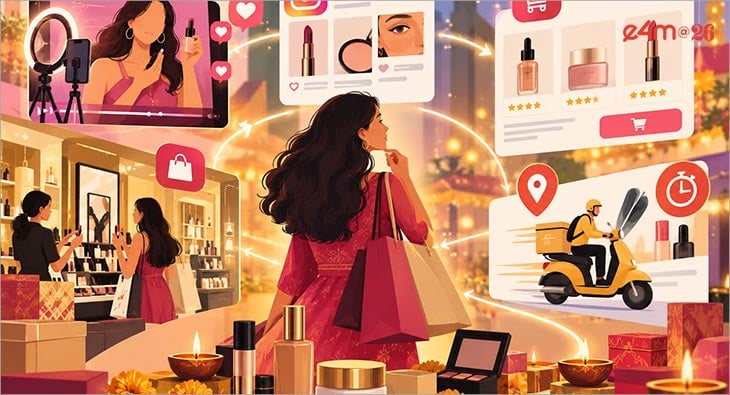

- Beauty brands are shifting their focus from last-click attribution to understanding the entire marketing journey that drives purchases, recognizing that multiple touchpoints contribute to consumer demand.
- MARS Cosmetics reports a significant increase in festive marketing investment, with a focus on e-commerce and quick commerce, while also facing rising customer acquisition costs due to increased competition.
- Brands like RENÉE Cosmetics and Dot & Key are emphasizing the quality of growth and incremental sales rather than just acquisition costs, as they navigate the complexities of digital and physical retail environments.
- The measurement of marketing effectiveness is evolving, with brands adopting a broader range of metrics to assess the impact of various channels, acknowledging that the consumer journey is becoming shorter and more integrated.
For beauty brands, the question this festive season is no longer simply how many consumers they can reach. It is becoming harder to answer a more basic question: which part of the marketing journey actually drove the purchase?
A consumer can discover a product through a creator, encounter it again on social media, search for it on a marketplace and complete the transaction through e-commerce or quick commerce, sometimes within the same day. While the sale may have a final touchpoint, the demand behind it can be built across several others.
For MARS Cosmetics, that is making last-click attribution increasingly inadequate. “We are also looking beyond last-click attribution. A creator may generate demand, social content may build consideration and commerce may close the purchase. Measuring only the final touchpoint can therefore understate the wider media ecosystem,” said Anmol Sahai Mathuur, Vice President – Marketing, MARS Cosmetics.
The shift comes as beauty brands put more money into an increasingly connected media and commerce ecosystem. MARS said its festive marketing investment is approximately 2.5X higher than in 2025, while close to 40% of its festive media investment is going towards e-commerce and quick commerce, compared with approximately 30% last year.
Investment across creator-led content, social media, e-commerce and quick commerce has also grown approximately 2X for the brand, with some high-intent commerce channels growing faster.
But rising spends are coming alongside rising acquisition costs. “We are seeing customer-acquisition costs increase in the low double digits, driven by greater competition for consumer attention, creator inventory and high-intent media placements,” Mathuur said.
MARS is therefore looking beyond a single conversion metric. “We are diversifying acquisition across creators, organic content, performance media, e-commerce and quick commerce, while monitoring CAC, ROAS, conversion, new-customer contribution and repeat potential,” Mathuur added.
For beauty marketers, the issue is increasingly about understanding the quality and source of demand, rather than simply recording the final transaction.
Acquisition is getting more expensive
RENÉE Cosmetics is approaching the issue by looking beyond acquisition cost to the quality of growth generated. “Festive competition naturally puts pressure on acquisition costs, but we don’t look at CAC in isolation. We also consider conversion, new customer acquisition and repeat purchases to assess the quality of growth,” said Ashutosh Valani, Co-Founder, RENÉE Cosmetics.
The distinction becomes particularly relevant as commerce platforms gain importance in beauty. RENÉE said BPC GMV on quick commerce grew 22.5X between CY22 and CY25, while its share of online BPC spending rose to nearly 16%.
Its own campaign data also illustrates why the metric conversation is moving beyond topline sales. “At RENÉE, performance is a key input into these decisions, with our recent Blinkit campaign delivering 11.5% incremental sales and 48% lower CPA,” Valani said.
Incremental sales matter because a platform can record a transaction without necessarily being responsible for creating the underlying demand. For marketers allocating budgets across creators, social and commerce, the question is increasingly whether a channel generated additional demand or simply captured an existing purchase intention.
This is also making the traditional distinction between brand building and performance less clear.
MARS puts its festive mix at 60:40 between performance-led advertising and brand-building, but Mathuur said the lines are increasingly blurred. “However, the lines are increasingly blurred. Creators can build both aspiration and demand, while commerce platforms capture that demand when purchase intent is highest,” he said.
That means the same consumer journey can contain both brand-building and performance activity, making it harder to assign the eventual sale to a single channel.
Commerce is becoming part of the measurement equation
The growing role of marketplaces and quick commerce is changing not only where beauty brands spend, but also what they expect those platforms to contribute.
At Dot & Key, festive demand is heavily marketplace-led, with events such as Amazon's Great Indian Festival and Flipkart's Big Billion Days driving what Siddharth Vaya, Sr. Vice President & Business Head, Dot & Key, described as a “massive share” of demand.
Quick commerce is also changing how impulse-led beauty purchases are made. “Quick commerce, in particular, has transformed how we capture impulse-led purchases, especially in flirtatious categories like lip care, where discovery and conversion happen almost instantly,” Vaya said.
Yet Dot & Key's approach is not simply to maximise visibility during the festive period. The brand said it is keeping overall festive spends measured and deploying capital behind specific products and seasonal opportunities. “Our focus remains on driving profitable conversions through marketplace search, creator commerce, and quick-commerce visibility, ensuring we capture incremental demand efficiently while building long-term brand equity,” Vaya said.
That puts profitability and incrementality alongside reach and conversion in the media conversation. A marketplace can increasingly function as an advertising, discovery and transaction environment at the same time, while creator content can serve both brand-building and demand-generation roles.
And physical retail still has a role
The measurement equation becomes more complex when the consumer journey moves between digital and physical environments.
At The Body Shop Asia South, roughly 50% of total marketing spend is allocated to digital platforms, including Instagram, YouTube, Spotify and quick commerce. Online sales currently account for around 30% of its overall business, with quick commerce contributing nearly 30% of that online total.
Yet the brand continues to see physical stores as an important part of the festive journey. “We continually evaluate these channels through the lens of engagement, conversion, and ROAS. At the same time, our physical stores remain vital to the festive journey given our retail-first, experiential focus,” said Harmeet Singh, Chief Brand Officer, The Body Shop Asia South.
The Body Shop's approach is to connect the two environments, rather than treating digital and physical retail as separate journeys. “Success comes down to combining the speed and scale of digital with the immersive discovery of physical retail,” Singh said.
The brand is also leaning on culturally relevant campaigns, targeted creator partnerships and localised messaging to stand out during the festive period, while its Jasmine Edit collection uses the flower's association with Indian celebrations as part of its festive positioning.
Who gets credit for the sale?
Across these brands, the metrics being used to evaluate festive media are widening. MARS is monitoring CAC, ROAS, conversion, new-customer contribution and repeat potential. RENÉE is looking at incremental sales, CPA, new customers and repeat purchases. Dot & Key is focused on profitable conversions and incremental demand, while The Body Shop is evaluating engagement, conversion and ROAS alongside the role of physical retail.
The common thread is not that one metric has replaced another. Rather, the transaction itself is becoming an insufficient measure of what the wider marketing ecosystem contributed.
For MARS, the consumer journey is now short enough for discovery and purchase to happen almost simultaneously. “The traditional beauty journey of discovery, research, comparison and purchase is becoming much shorter. A consumer can discover through a creator, encounter the product on social media and purchase through e-commerce or quick commerce within the same day,” Mathuur said. MARS also sees this convergence extending into festive product categories where visual appeal, price accessibility and availability can trigger impulse purchases, including lip products, makeup essentials, kits and accessible gifting-friendly products.
For beauty marketers, that creates a different measurement challenge. The data can show where the purchase happened, but the harder question is understanding what created the intent in the first place. As creators, social platforms, marketplaces, quick commerce and physical retail increasingly work as parts of the same consumer journey, the question for brands this festive season is no longer just where the sale happened. It is what actually caused it.
Read more news about Festive Season, Marketing, PR and Corporate Communication, Internet Advertising, People Movement
For more updates, be socially connected with us onInstagram, LinkedIn, Twitter, Facebook, YouTube & Google News