HUL’s Growth Puzzle: Can brands deliver more while advertising less?
HUL’s sales surged 15% in the September quarter, its strongest growth in 14 quarters, even as A&P spends fell 9.3%. Can sharper marketing offset rising costs without diluting brand equity?
 by
Published: Nov 5, 2026 9:27 AM | 8 min read
 Follow Us


- Hindustan Unilever (HUL) reported a 15% underlying sales growth in Q2 FY27, reaching a turnover of ₹18,071 crore, despite a 9.3% decline in advertising and promotion expenditure to ₹1,481 crore.
- The company's underlying volume growth was 7%, indicating resilience in consumer demand even amid price increases of approximately 7.5%.
- HUL's EBITDA rose 8% to ₹4,089 crore, but the EBITDA margin contracted to 22.6%, reflecting increased input costs and pressure on profitability across various categories.
- The reduction in advertising spending does not necessarily indicate a retreat from brand building, as HUL continues to launch new products and expand its portfolio while managing costs amid commodity inflation.
For a company whose brands occupy millions of Indian homes, growth and advertising have traditionally been closely intertwined. From Surf Excel and Rin in home care to Dove, Lux and Pears in personal care, and Horlicks, Boost and Brooke Bond in foods, Hindustan Unilever has built its market presence through a vast portfolio backed by decades of investment in brand building and distribution.
Its latest quarterly performance, however, presents an interesting divergence: sales are accelerating even as advertising and promotion expenditure is declining.
Read On: HUL Q2 ad spends decline 9.3% to ₹1,481 crore
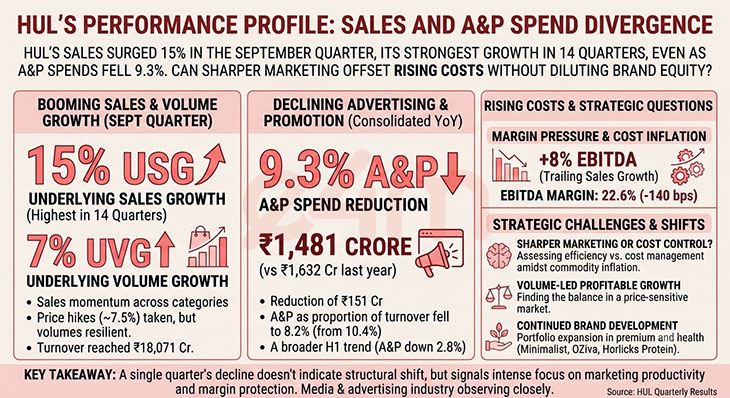
HUL reported underlying sales growth (USG) of 15% in the September quarter of FY27, its highest in 14 quarters, with turnover reaching ₹18,071 crore. Underlying volume growth (UVG) stood at 7%, despite price increases of around 7.5%. At the same time, consolidated advertising and promotion (A&P) expenditure declined 9.3% year-on-year to ₹1,481 crore, compared with ₹1,632 crore in the corresponding quarter last year — a reduction of ₹151 crore.
The contrast is particularly striking given HUL’s position as one of India’s largest FMCG advertisers. But the numbers also come with a caveat. Earnings did not grow at the same pace as the topline. EBITDA rose 8% to ₹4,089 crore, while the margin contracted 140 basis points to 22.6%. The combined cost of materials consumed, purchases of stock-in-trade and inventory changes also rose sharply, reflecting the pressure of higher input costs.
In other words, HUL is navigating two competing priorities: sustaining growth in a market where consumers remain price-sensitive, and protecting profitability as the cost of doing business rises.
The lower advertising expenditure could point to sharper media allocation and improved marketing productivity. It could also reflect a broader effort to manage costs as commodity inflation weighs on margins. The quarterly numbers alone do not establish which factor has played the larger role.
That distinction matters because advertising cuts at a company of HUL’s scale are not merely an internal budget decision. They are closely watched across the media and marketing ecosystem. The question is not simply how much HUL is spending, but whether it can continue to grow its brands, defend market share and build newer categories while extracting more from every rupee invested in marketing.
Growth is holding, but the cost of growth is rising
The 15% underlying sales growth is a strong headline number, but its components merit closer examination. Volume growth of 7% indicates that the quarter’s performance was not driven by price increases alone. HUL took price hikes of around 7.5%, yet volumes continued to expand — a sign of resilience across several categories.
Managing Director and CEO Priya Nair said during the investors’ call the company was seeing volume momentum even as it took price increases. “The fact that there is volume momentum while we are taking price increases is a very good sign for overall demand,” she said. She also pointed to the relatively low price points of everyday consumer products, noting that essentials tend to be less sensitive to price increases than discretionary categories.
However, the growth has come against a challenging cost backdrop. HUL’s EBITDA increased 8% to ₹4,089 crore, trailing the 15% growth in underlying sales. The EBITDA margin fell to 22.6% from 24% a year ago. Profit after tax before exceptional items rose 9% to ₹2,795 crore, while reported PAT remained broadly flat at ₹2,796 crore, partly because the year-ago period included a one-off tax-related gain of ₹273 crore.
The pressure is visible across categories. Home care, which includes brands such as Surf Excel, Rin and Vim, delivered 22% underlying sales growth, supported by double-digit volume growth. Yet its operating margin declined to 16.2% from 19.1%, reflecting the impact of input-cost inflation, including petrochemical-linked materials. Beauty and wellbeing, with brands such as Dove and the newer Minimalist portfolio, grew 16%, with double-digit volume growth in haircare, skincare and colour cosmetics. Its operating margin stood at 28.6%.
Personal care reported 9% growth, led by double-digit growth in skin cleansing, supported by brands such as Dove and Pears. Volume growth, however, was flat, while the segment’s operating margin declined to 17.2% from 20.3%. Foods also grew 9%, with low-single-digit volume growth. Lifestyle nutrition and packaged foods supported performance, while the mass-market tea business continued to face pressure. The segment’s operating margin improved to 21.7% from 20.3%.
Read On: HUL’s premium skincare portfolio operating at Rs 1,400 crore ARR: CEO Priya Nair
The divergence between topline growth and profitability is important in assessing the A&P reduction. A company facing higher input costs and pressure on margins has an incentive to scrutinise expenditure across functions. But cutting marketing costs is not the same as improving marketing productivity. The latter would require evidence that the company is reaching the right consumers, improving conversion and generating stronger returns from each campaign.
HUL CFO Niranjan Gupta has said commodity inflation is expected to remain elevated in the short term, while reiterating confidence in maintaining EBITDA margins in the 22–24% range over the medium term. That puts the emphasis on a combination of pricing, cost efficiencies, product mix and volume growth.
What does the advertising bill reveal?
HUL’s consolidated A&P expenditure of ₹1,481 crore in the September quarter was also lower than the ₹1,657 crore spent in the June quarter. For the first half of FY27, the company spent ₹3,138 crore on advertising and promotion, down 2.8% from ₹3,230 crore in the year-ago period.
As a proportion of quarterly turnover, A&P expenditure was about 8.2%, compared with around 10.4% in the corresponding quarter last year. This is a notable shift for a company whose brands have historically been among the most visible advertisers across television, print, digital and other media.
Yet the reduction should not automatically be read as a retreat from brand building. HUL’s results point to continued product launches, portfolio extensions and market-development initiatives. During the quarter, the company expanded Dove’s premium body-serum range, extended Minimalist’s skincare and haircare portfolio, relaunched Lux Bar and stepped up sampling and in-store activations for body wash. In foods, Horlicks entered the protein segment with a new powder offering, while Kissan refreshed its condiments proposition.
These activities underline an important distinction: the amount spent on advertising and promotion does not, by itself, reveal the nature or effectiveness of brand investment. The reported figure combines advertising and promotional expenditure, but does not disclose how the reduction was distributed across brands, media platforms or consumer-facing activities. Nor does it establish whether the company has shifted budgets towards channels or formats that deliver better returns.
HUL’s scale makes this question particularly relevant. The company reported annual turnover of ₹63,763 crore in FY26, with a portfolio spanning everyday household categories as well as premium beauty and health-and-wellbeing businesses. Its brands operate at different price points and address consumers with different purchase triggers. The marketing needs of a mass-market detergent or tea brand may not be identical to those of a premium skincare business such as Minimalist.
Read On: Next decade belongs to India, approaching it with clarity & confidence: HUL's Priya Nair
The company has also been reshaping its portfolio. The acquisition of Horlicks and Boost through the GSK Consumer Healthcare India transaction strengthened its presence in health food drinks. More recently, HUL acquired a 90.5% stake in Minimalist, deepening its presence in premium beauty, and completed the acquisition of the remaining stake in OZiva to expand its health and wellbeing play. It also divested its stake in Nutritionalab and completed the demerger of its ice cream business into a separate entity.
The moves reflect a portfolio increasingly spread across established mass-market brands and newer, higher-growth businesses. They also bring different requirements for consumer education, digital discovery, sampling and brand differentiation. The challenge for HUL is to ensure that tighter spending does not compromise the ability of these businesses to build awareness and establish long-term consumer preference.
A leadership transition and a changing portfolio
The quarter’s performance also comes more than a year after Priya Nair took over as HUL’s Managing Director and CEO on August 1, 2025, succeeding Rohit Jawa. The leadership change followed Jawa’s decision to step down, announced in July 2025. Nair’s tenure has been associated with a sharper focus on volume-led growth, portfolio priorities and execution across channels.
The company has been investing in capabilities and distribution even as it pursues cost discipline. Its stated strategy of delivering competitive, volume-led profit growth places the emphasis on balancing growth with margins rather than pursuing topline expansion at any cost. That approach is being tested by commodity inflation, uneven consumer demand and the need to sustain investment across a diverse brand portfolio.
HUL’s first-half FY27 numbers offer a broader perspective. Turnover stood at ₹35,255 crore, with underlying sales growth of 12% and volume growth of 6%. EBITDA grew 8%, while profit after tax before exceptional items increased 9%. A&P expenditure for the half-year, at ₹3,138 crore, was down 2.8% year-on-year. The decline is therefore not confined to the September quarter, although the first-half reduction is considerably smaller than the quarterly fall.
For the advertising and media industry, the larger issue is whether HUL’s spending pattern signals a shift in how large FMCG advertisers allocate budgets. A&P expenditure can move from quarter to quarter depending on campaign timing, product launches, promotional activity and the intensity of competition. One quarter’s decline, or even a half-year reduction, is not sufficient to establish a structural change in the company’s approach to advertising.
Read more news about Marketing News, Advertising News, PR and Corporate Communication News, Digital News, People Movement News
For more updates, be socially connected with us onInstagram, LinkedIn, Twitter, Facebook, YouTube & Google News