Experts on using location-based ad tech to deliver hyper-personalized experiences
Leading industry voices came together at the e4m Martech India Conference 2024 to explore how brands are leveraging data and technology
 by
by
Published: Dec 13, 2024 1:10 PM | 5 min read
 Follow Us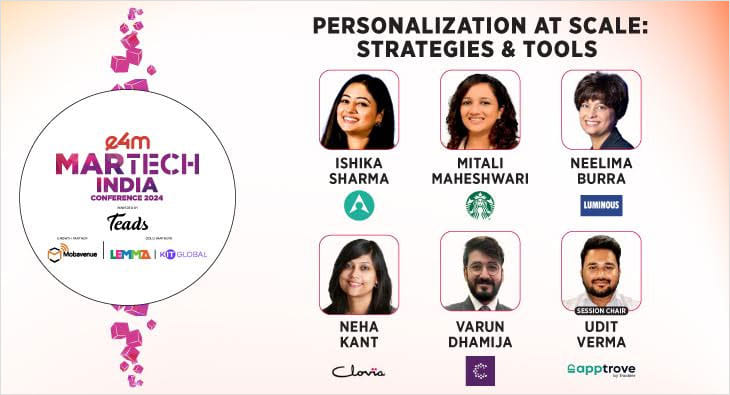

At the e4m Martech India Conference 2024, industry leaders convened to discuss the unique challenges and opportunities in delivering personalization at scale for the diverse Indian market. The session titled ‘Personalization At Scale: Strategies & Tools’ explored the role of location-based technology, data ethics, and emerging trends like hyper-personalization and voice tech, providing actionable insights and case studies for marketers navigating this complex landscape.
The panel featured Ishika Sharma, Associate Director, Sales at Blis; Mitali Maheshwari, Head of Product and Marketing at Tata Starbucks; Neelima Burra, Chief Strategy and Transformation Officer at Luminous Power Technology; Neha Kant, Founder and Director at Clovia Lingerie; and Varun Dhamija, Lead Data Scientist at Caratlane. The session was chaired by Udit Verma, Co-Founder and CMO at Trackier.
Verma opened the session by framing the discussion around the interplay of creativity and technology in delivering personalized experiences. “As marketers, our job is to deliver relevance to customers everywhere and all the time, which is not very easy. But with the right strategies, tools can transform challenges into powerful opportunities,” he said, emphasizing the potential of cutting-edge technologies to exceed customer expectations.
Sharma delved into the evolving landscape of location-based advertising and its role in hyper-personalization. “Location-based advertising technology is rapidly evolving and enabling brands to deliver hyper-personalized experiences for their customers,” she said. She highlighted how data sources like GPS, cellular networks, Wi-Fi, and even latitude-longitude coordinates allow brands to target users with precision, down to specific buildings.
Sharma also discussed how artificial intelligence and machine learning enhance these capabilities by analyzing user behavior and patterns to tailor brand communications. Sharing a case study, she said, “We worked with an FMCG brand that wanted to deliver a customized message during the rainy season. Every time the temperature dropped, users received a personalized banner in their local language—be it Kannada in Karnataka or Marathi in Maharashtra—urging them to enjoy tea because of the weather outside. This approach leveraged both weather data and vernacular customization to engage users effectively.”
Maheshwari emphasized how the brand has evolved to cater to India's diverse tastes and preferences. “India has largely been a tea-drinking nation, but a lot has shifted in the last two to three years,” she noted. Starbucks has played a significant role in this shift by offering specialty coffee for over a decade.
She highlighted Starbucks' innovative approach to the Indian market. “Our unique beverage and food portfolio is inspired by and for India,” she said, pointing to the introduction of the Pico cup size, tailored specifically for Indian customers. “Food pairings with Indian nuances—regionally and culturally—are another example of how we adapt,” she added.
Starbucks has also diversified its store formats, launching experiential stores in Delhi and Mumbai that blend global coffee offerings with Indian flavors. Other formats, like all-women stores, signing stores, and 24/7 metro stores, cater to varying consumer needs.
Maheshwari underscored the role of personalization in Starbucks' success. “Our baristas often know customers by name and preference, sometimes preparing their orders as they walk in,” she shared. This personalization extends to digital channels through tools like AI and advanced analytics, enabling a shift from broad segmentation to hyper-personalized customer experiences.
Next, Burra shared insights into how data-driven decision-making underpins their transformation strategy. “Energy as a sector is transforming, with AI at the center of this evolution,” she said.
She discussed the unique challenges of India’s power landscape, where needs vary across consumer segments and regions. “Some areas still face seven to eight hours of power cuts, while others have a 10-minute tolerance,” she explained. To address this, Luminous leverages data and trend propensity modeling to develop energy management solutions tailored to different needs.
“From apps to connected products, our aim is to enable better energy management,” Burra noted. She emphasized the role of machine learning in improving grid and electricity data, which is still imperfect. “We’re building internal learning models to create products that are conducive to each state’s usage patterns,” she said.
The session moved forward with Kant explaining how Clovia uses technology to solve a fundamental problem: women in India often lack access to properly fitted underwear. “Most brands historically offered only basic sizing and fits,” Kant said. Clovia flipped the narrative by leveraging customer data to design its offerings.
“We launched a tool that allowed women to share details about their body shapes anonymously,” she explained. Using this data, Clovia identified nine body types across six life stages, representing over 85% of the market. “This allowed us to develop personalized fits through iterative feedback,” Kant added.
As Clovia ventured into offline stores, location intelligence became essential. “In small store formats, like 100 square feet, we optimize inventory by analyzing customer demographics and shopping patterns,” Kant said. For instance, stores in student-heavy areas like Delhi’s Kamla Nagar stock different products than those catering to married women. “While 70-80% of inventory remains consistent, 20-30% varies by pricing, sizing, and preferences,” she said.
Next, Caratlane’s Dhamija discussed how the brand bridges the gap between online discovery and offline purchases. “Eighty percent of our traffic comes through online channels, where customers discover products before buying offline,” he noted.
Caratlane uses data science to streamline this journey. “We’ve developed a Prospect Model using machine learning to identify potential buyers,” Dhamija explained. By analyzing past purchasing behavior, the team predicts when and for what occasion a customer might purchase.
“This data also informs inventory management,” he added. “We know how much of each product to stock and where to place it, optimizing inventory across locations.” A forthcoming initiative, called the Preference Center, aims to better understand whether customers prefer online or in-store shopping.
Read more news about Marketing News, Advertising News, PR and Corporate Communication News, Digital News, People Movement News
For more updates, be socially connected with us onInstagram, LinkedIn, Twitter, Facebook, YouTube & Google News