Digitup's Amit Verma calls for headless CMS to beat traditional marketing limitations
At Pitch Brand Talk, Amit Verma, CEO and Founder of Digitup, spoke at length on adopting a headless CMS architecture to enhance content delivery and marketing strategies
 by
by
Published: Oct 16, 2024 1:19 PM | 4 min read
 Follow Us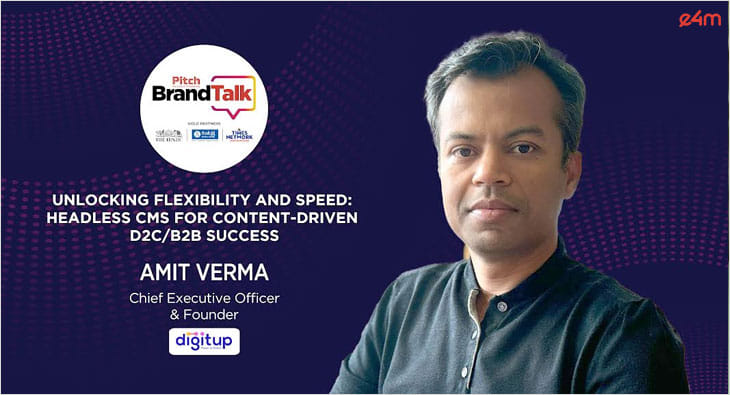

In the ever-evolving digital landscape, many brands are grappling with the limitations of traditional content management systems (CMS) like WordPress and Shopify, said Amit Verma, CEO and Founder of Digitup, at Pitch Brand Talk on Wednesday.
During his presentation, he emphasized the importance of adopting a headless CMS architecture to enhance content delivery and marketing strategies.
“Traditional CMS platforms often require users to select a predefined theme, constraining creativity and flexibility. This model creates challenges in managing brand identity, version control, and multi-language content. Moreover, as businesses scale and diversify their offerings, these systems can hinder growth and adaptability,” he said at Pitch Brand Talk, held in New Delhi on Wednesday.
During his spotlight session on ‘Unlocking Flexibility and Speed: Headless CMS For Content-Driven D2C/B2B Success’, Verma pointed out that headless CMS provides a robust solution to these challenges.
Talking about what is a content management system (CMS), Verma called it a powerful tool that allows users to create, manage, and modify content on a website without needing extensive technical knowledge.
“Many people are familiar with popular CMS platforms like WordPress and Shopify. In a typical setup, such as on WordPress or Shopify, users can find a dashboard on the left side of the screen.
“This dashboard serves as the central hub for managing various aspects of the website. Here, you can easily oversee your posts, media, pages, comments, and more. The interface also includes options for customizing the appearance of your site and managing plugins, which extend the functionality of your CMS,” he explained.
He added that a CMS offers a variety of features, including analytics, customer management, and marketing tools.
Noting that many major brands have shifted to headless CMS solutions, Verma said that it's important to examine the challenges associated with traditional CMS platforms.
“One of the main issues with a traditional CMS is its reliance on themes. Since websites are theme-based, users must select a theme upfront. This often results in a one-size-fits-all approach, where each theme is designed for specific scenarios, limiting flexibility and customization for different types of pages,” he said.
Highlighting the challenges with traditional CMS platforms, he said that they primarily revolve around their theme-based structure.
“Users must select a theme in advance, which limits them to a specific type of page for each scenario. For example, you might have one design for the homepage and another for the product page. Once a theme is chosen, you are generally locked into that design,” he explained.
Another drawback is the lack of version control.
“In a traditional CMS, if you want to maintain various versions of your homepage or blog, there is no built-in system for that. Other challenges include difficulties with multi-language support, content reuse, website speed, and a higher total cost of ownership. Managing a multi-country approach can also be cumbersome,” he said.
Suggesting headless CMS as a solution to these problems, Verma referred to the term “headless” saying it was coined by Derek Horing, CEO of Commerce Tools, in 2013, which was used for separating the front end (the user interface) from the back end (which manages content like checkout, cart, shipping, inventory, and discounts).
“In a headless CMS, both components communicate via APIs,” he said, adding that this separation allows for a component-based front end, where you can design individual elements without being constrained by a fixed theme.
“You can create all your components and sections within the CMS, giving you tremendous flexibility in how you build and present your pages, Verma said.
“With an API-driven approach, brands can leverage best-of-breed technologies for various functions such as checkout, shipping, and inventory. This allows you to adopt the latest and most effective tools available, unlike traditional CMS platforms, where you might face expensive integrations,” he said.
Integrations in a traditional CMS come with predefined formats, limiting customization. In contrast, a headless CMS allows for tailored front-end designs based on specific needs, he said.
Read more news about Marketing News, Advertising News, PR and Corporate Communication News, Digital News, People Movement News
For more updates, be socially connected with us onInstagram, LinkedIn, Twitter, Facebook, YouTube & Google News