Did Google really eat our lunch?
At the e4m Revenue Leaders Conference, media leaders debated the growing dominance of tech giants like Google and Meta, and explored how publishers can reclaim control and monetise better
 by
by
Published: Aug 5, 2025 3:53 PM | 11 min read
 Follow Us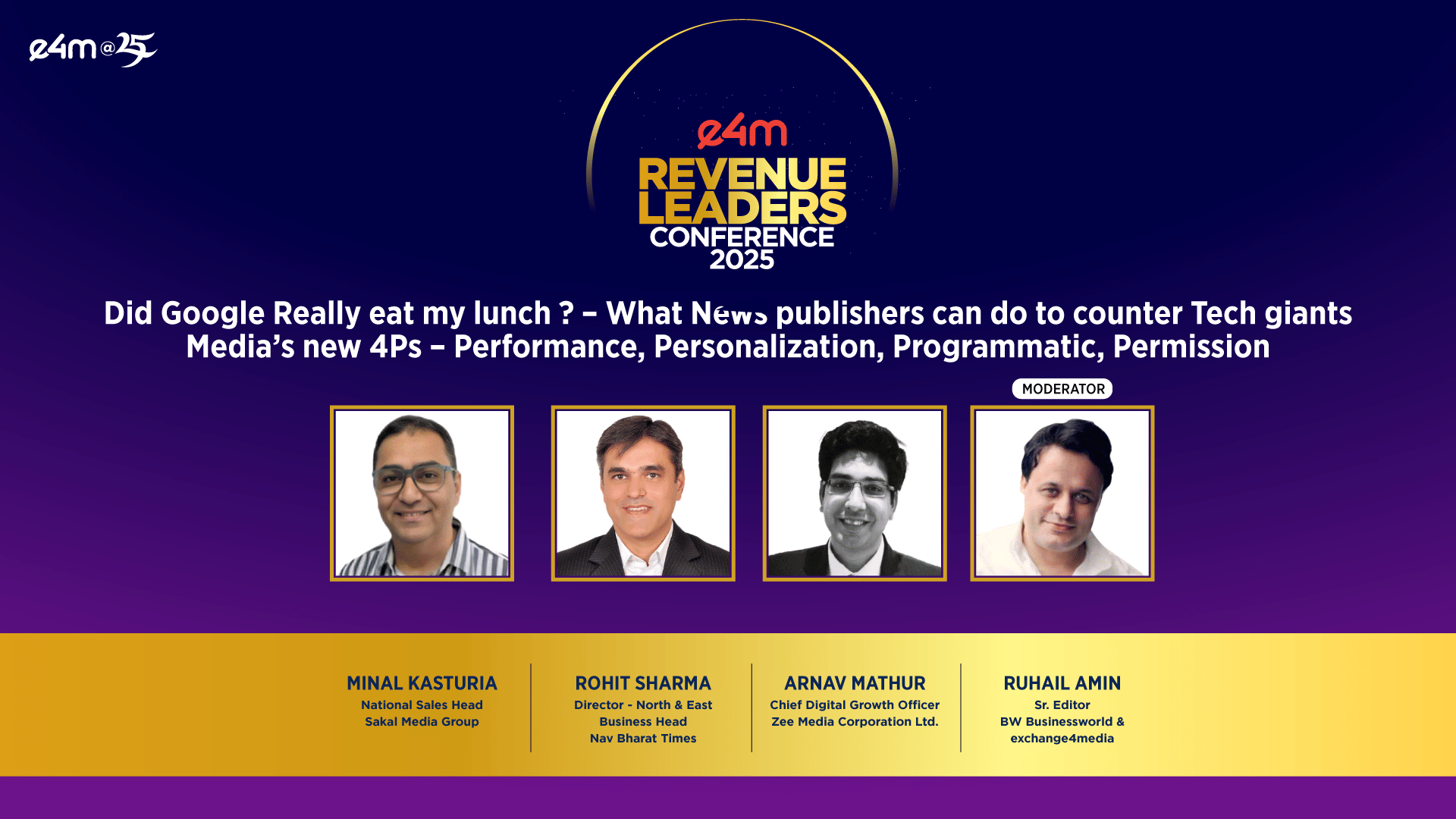

Centered around the theme "Did Google Really Eat My Lunch?", a panel of senior media executives delved into the ongoing conflict between news publishers and tech platforms, at the e4m Revenue Leaders Conference 2025.
Exploring the imbalance in revenue share, the growing influence of tech platforms, and how publishers can reclaim control through transparency, first-party data, and evolved strategies, the panel featured Minal Kasturia, National Sales Head at Sakal Media Group; Rohit Sharma, Director–North, Response, Times of India; Arnav Mathur, Chief Digital Growth Officer, Zee Media Corporation Ltd.; and Avinash Pandey, Director – Non-Executive, Laqshya Media Group. The session was moderated by Ruhail Amin, Sr. Editor, BW Businessworld & exchange4media.
Kasturia opened the discussion by highlighting the shift in India’s advertising ecosystem. “As per the Pitch Madison report, the overall advertising market in India is ₹1.07 or ₹1.08 lakh crore, and digital alone is now almost 45% of this,” he noted. Representing print, he added, “Print was ₹20,000 crore a few years back, and post-COVID, we’ve just about managed to come back to that figure. So obviously, Google has taken a big pie out of the overall advertising pie.”
He further pointed out that while Google and Meta provide publishers with reach, the monetisation doesn’t match up. The platforms are now not just the tech champions; they are a complete ecosystem. “They are providing reach to all the publishers but without the revenue.”
Pandey offered a more structural view of the issue, reflecting on his experience leading a DNPA litigation in the Competition Commission of India. “We drafted a long note on how big tech, while distributing our content, does not offer a proportionate or transparent revenue share,” he said. “The problem isn’t just Google or Meta, it’s the technology itself. It picks up content randomly, curates it, and in that process, they become publishers themselves.”
He warned that the issue has become even more complex with AI tools like ChatGPT and Gemini entering the fray. “They crawl over publisher sites and give you the news the way you want it curated,” Pandey said, stressing that media companies must now rethink how to navigate this evolving environment.
Turning to international examples, moderator Ruhail Amin asked if Australia's stance offered a good roadmap for resisting tech monopolies. Australia is stepping up efforts to curb potential tech monopolies, especially in the digital sector. The government is introducing new regulations and ramping up enforcement to check the influence of major tech firms, including imposing fines for anti-competitive behaviour.
Sharma responded affirmatively. “In my opinion, it’s perfectly fine. We should have done that. They led the way, and I think many countries will follow suit.”
He then offered a sharp counterpoint to the idea that tech platforms had outmanoeuvred publishers. “How many of you have seen a YouTube Shorts ad in newspapers?” he asked. “Google, YouTube Shorts, Instagram, WhatsApp—all had very big campaigns in newspapers. The audience knows who’s eating whose lunch.”
Reflecting on his recent transition from the consumer durables sector to media, Sharma highlighted the importance of integrated planning. “When you are making a media plan, the entire gamut makes a difference. It's a balance of science and art,” he said. “You can know the science behind marketing, but unless you add that tadka of art, it won’t be very successful.”
When asked whether tech platforms are partners or predators, Mathur offered a balanced perspective. “On one hand, these big giants are the biggest gateways for any media publisher, be it web, social, or YouTube traffic,” he said. “So, whether they’ve eaten that share or not boils down to the question: had they not been there, would those customers even have come to our platforms?”
Mathur also echoed the call for greater transparency. “We need clarity on how CPMs are priced and how we are getting customers,” he said. “As frequent updates happen, publishers need to tune themselves to better suit these changing times.”
He argued that this dependency has created an internal push among publishers to sharpen their digital capabilities. “It creates a healthy competition because we now know how best to put across our content, retain customers, get their first-party data, and build engagement. Today, these are the talking points because traffic is coming from a third party.”
Mathur concluded by emphasising the growing importance of loyalty, content recommendations, and consumer mapping. “Your first-party data and how you use it have become critical, because at the end of the day, it’s a third party that’s bringing the customer in.”
Addressing the topic of alternative monetisation for regional players, Kasturia emphasised the enduring trust factor associated with print. “Newspapers still remain the most credible medium. And credibility is one part which no one, not even Google or Meta, can take away from newspapers,” she said.
He went on to highlight Sakal’s pioneering move in building paid digital readership. “As a regional media, we’re perhaps the only one in the country so far to go behind a paywall. Our e-paper is now a paid subscription model, and I’m very proud to say that we’ve reached a paying subscriber base of 30,000 in a short span of time.”
However, Kasturia warned of the deeper issues tied to algorithm-driven content visibility. “Earlier, the narrative was set by the newsroom and the journalist. Now the algorithms have taken over,” he said.
He pointed to the emerging trend of “zero-click” consumption, where platforms like Gemini offer summaries without driving traffic to the publication site while the truth being that publications only get revenue when someone clicks on the news and lands on their site. With AI now offering summaries directly, the publishers are not getting any pie out of that.
While agreeing, Pandey said that all is not lost. He reflected on the resilience of print. “I’ve been in the media for 29 years, with 25 of those in television. When we started TV around the turn of the millennium, we thought we’d replace print. But by 2005 or 2007, newspapers had reinvented themselves.”
He added, “Anything that is printed is believed to be true. That’s how our scriptures are. It’s the credibility of the printed word. Television plays the ‘see it to believe it’ role, but social media often collapses due to lack of authenticity. Today, AI can create fake videos of anything you say. Newspapers are doing a great job in curating world-class content.”
Pandey noted that editorial courage and content discipline are key. “Apart from social necessity headlines, nothing should be available for free. It’s management pressure that puts content online. People worry about how many are reading their articles or watching their videos. But those people are not paying your salary.”
He stressed that publishers must offer real value. “If your news curation is just chasing events, no one will pay for it. Fox News, for example, is double the size of all US news channels put together, and they don’t chase events.”
As long as publishers make compelling content, there is a market, he added.
Amin then posed a strategic question: whether a consortium of publishers could rival the targeting scale of tech giants like Google and Meta.
Sharma responded affirmatively. “As news publishers, we should have a consortium to build strong bargaining power with the likes of Google. The way Australia has led on this, we are lagging. We should definitely come up as a single voice and create some impact.”
Mathur shared his thoughts on both alternative revenue and the idea of publisher alliances. “Today, most media publishers have been chasing metrics like page views. But what is the real value these page views contribute? What is the effective CPM? Are repeat users being generated, or is it just click-baity headlines?” he asked.
He stressed the need to evaluate audience value from a D2C lens. “The day media publishers start looking at users in terms of the average net value they contribute, whether through paywalls, subscriptions, or registered access, we’ll be able to chart a long-term future.”
On the idea of forming a united front, Mathur acknowledged the need but pointed out that negotiation terms may need to evolve. “The asks here may not be the same as what other countries have done. Today, if AI is taking a large chunk of traffic, negotiations may not be about traffic, but about collaboration. Their LLMs need high-quality data to train on. If publishers are creating fact-checked content, how can we partner with them to ensure they train on our data?”
He argued that media will always stay one step ahead of AI. “We are the ones generating and curating content. AI will only train on what we create. Since we are ahead, we must leverage that and make the most of it.”
The panel also addressed whether personalisation is exclusive to tech platforms or if legacy media can tap into it.
Kasturia was confident. “There’s user-generated content and anyone can create that. India Times did it long ago, and other publications are also doing it. We’ve done it too,” he said.
Responding to a question about whether publishers are seeing the full picture by focusing only on revenue loss, Pandey was unequivocal. “No, they are extremely unfair. It’s opaque. And there’s no willingness to reveal or share either the knowledge or revenue from the big tech side.”
He recalled his interactions as former President of the News Broadcasters Association. “We had a one-on-one chat with Google’s MD and CEO. They clearly said the algorithms and designs are done in California, and there’s no control here. The best they can do is navigate us within their system.”
Pandey highlighted the imbalance in the digital ecosystem, questioning why, despite digital reach being twice that of TV, it still generated significantly lower revenue.
He highlighted the revenue disparity: “All publishers together weren’t making even ₹2,000 crore from digital. Meanwhile, the tech companies’ publishing-side revenue was many times that. The gap is enormous and there’s no willingness to fix it. That’s why governments must step in.”
He referenced Australia’s model as a success driven by regulation. “The Australian government told the tech giants to negotiate or they will take the money and distribute it to publishers. That’s when big tech rushed to the table, and Meta exited the news business.”
On whether a middle path is possible between publishers and tech giants, Sharma emphasised open dialogue. “You should always keep communication channels open. That’s the first way to negotiate. You can’t have a closed interface.”
He noted that Times of India had innovated in personalisation. “Most content is free on our app, but we’ve built new verticals, Times Techies, Times Parenting, political commentary, and tailored them for specific audiences like UPSC aspirants. Personalisation has evolved.”
He added, “Nobody can take away the content we create. That’s our strength. Even when our stories go viral on social media, they do so because of our credibility.”
Sharma argued that this tension is part of a natural transition. Everybody has to co-exist. “We are at a point of transformation, and there’s always pain during that phase. But once we’ve passed through it, life will be better.”
Drawing parallels with retail evolution, he explained, “Fifteen years ago, there was no modern retail. Traditional players resisted them. But today, both models coexist. Even when e-commerce giants came in around 2013–14, there was disruption. But now, with profitability pressure, things have stabilised.”
He concluded that the media industry was undergoing a similar phase of disruption and transformation, and expressed optimism that in a few years, things would stabilise and the sector would be in a much better place.
Read more news about Marketing News, Advertising News, PR and Corporate Communication News, Digital News, People Movement News
For more updates, be socially connected with us onInstagram, LinkedIn, Twitter, Facebook, YouTube & Google News