Building memory in a click-first world
Clicks may convert, but can they build legacy? Inside the power-packed discussion between brand building and performance chasing at the e4m Revenue Leaders Conference
 by
by
Published: Aug 5, 2025 3:46 PM | 10 min read
 Follow Us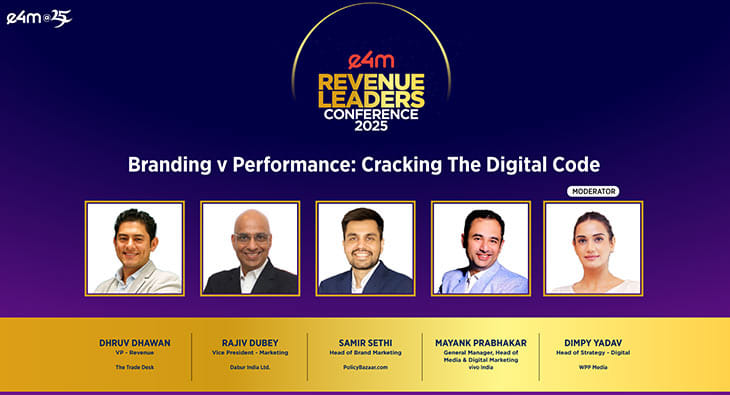

What drives growth in today’s chaotic digital landscape: long-term brand love or short-term clicks? Is it a battle, a balance, or a blur?
At the e4m Revenue Leaders Conference, some of India’s top marketing minds came together to decode this increasingly complex equation. In a session titled “Branding v Performance: Cracking The Digital Code”, the panel tackled the tension between building enduring brands and chasing immediate conversions, revealing that the answer, more often than not, lies somewhere in between.
The panel consisted of Dhruv Dhawan, VP - Revenue, The Trade Desk; Rajiv Dubey, Vice President - Marketing, Dabur India Ltd.; Samir Sethi, VP & Head of Brand Marketing, PolicyBazaar.com; and Mayank Prabhakar, General Manager, Head of Media & Digital Marketing, vivo India. The session was steered by Dimpy Yadav, Head of Strategy - Digital, WPP Media.
Opening the session, Yadav set the tone by framing the central challenge. “In a world where every click is a choice and every scroll becomes a signal, what is that thin line between branding and performance? Is it a divide or a dynamic dance?”
Dubey responded by sharing a personal anecdote. “As a consumer, I recently bought socks from a brand. I found them fascinating and kept buying more pairs. At one point, I even received an email from the CEO asking what was wrong with me for buying so many socks!” he laughed.
But while this impulse purchase exemplified a typical bottom-of-the-funnel transaction, Dubey noted that brand building runs much deeper. “In a legacy company like ours, which has been around for over 140 years, trust isn’t built in a day or through one transaction. Performance is transactional.”
Trust is built on long-term value, and that’s where branding plays a critical role.
He explained that Dabur operates across the funnel. “We have brands that focus on brand love and long-term relationships, and others where we transact much more frequently with consumers. You can’t ignore either. The transactional business is growing rapidly, and we have to meet consumers where they are.”
Speaking from the lens of a need-based category, Sethi agreed that the branding-performance binary often doesn’t hold up in practice.
“Car insurance is fairly need-based. People buy it because it’s mandatory. But for our core products, term and health insurance, people never really want to buy them,” he said. “You have to create the need, which is why a lot of our advertising is category advertising. We’re trying to explain why these products are important in people’s lives.”
Sethi pointed out that with low market penetration, especially for term insurance, there’s enormous scope for growth, but that growth can’t be driven by banners or clicks alone. “We rely heavily on brand. Storytelling, sometimes emotional and sometimes humorous, helps us create a pull in a traditionally push-driven category,” he explained.
The results speak for themselves. “Most of our traffic and leads now come from direct and organic channels. That’s quite unheard of globally in insurance. It’s all thanks to our brand-building efforts,” he added.
Offering a consolidated perspective, Prabhakar argued that brand and performance aren’t opposing camps. “None of them is a separate ecosystem altogether. From the consumer side, nobody knows whether an ad is performance or brand. It’s all one experience,” he said.
He explained that from a creative standpoint, even branding campaigns often include performance cues like a ‘Buy Now’ CTA. “Branding and performance are not competing. They are interdependent and complementary. Branding tells the story, builds the upper funnel, and creates the aura. Performance converts that demand.”
Drawing from his own habits, Prabhakar said, “I bought coffee online last night, blueberry, strawberry, all kinds. It was an impulse purchase. But would I buy a car that way? Definitely not.” He argued that for high-involvement categories, brands need to keep building equity over time while letting performance work under that umbrella.
“The myth is that branding and performance are separate. They aren’t. They are very much interdependent,” he concluded.
As the discussion progressed, the conversation turned to how technology could help balance branding with performance across diverse categories, from smartphones and FMCG to insurance.
Dhawan introduced the concept of Brandformance. “Back in 2017, we were trying to build a model by this name in my previous organisation. It’s not just about branding or just performance. It’s about where they intersect.”
He explained how omnichannel strategies can effectively drive this hybrid model. “At The Trade Desk, we emphasise that you shouldn’t limit yourself to a single platform. Be it big tech like Google, Meta, Amazon or linear TV, you have to be everywhere: CTV, display, mobile, out-of-home. The consumer is everywhere,” he said.
Addressing the pitfalls of siloed campaigns, Dhawan spoke about ad fatigue. “Often, you see the same ad too many times on a platform. How do we manage frequency across the open internet and all available touchpoints?” he asked, stressing that data plays a central role in measuring impact, whether for recall or action.
He added that memory structures matter significantly. “When we think of certain impressions, like the JavaJournal or GPLink badminton example, it stays with us. That’s how brands are built.” Performance might work in the short term, but for long-term value, consistent brand building is key.
Yadav followed up by asking Dubey about memory versus measurable brand performance in today’s content-saturated environment. “When I think of Dabur, I don’t think of a specific ad but the legacy I’ve grown up with,” she said.
Dubey referenced Simon Sinek’s The Infinite Game to frame his response. “If you are in it for infinite growth, you must build trust. And trust builds brand love. Once that happens, you don’t need to rely on specific ads to stay top-of-mind. You just remember the brand,” he said.
Citing an iconic commercial from 1982, he reflected on the power of long-term storytelling. “Most people in the room weren’t even born then, yet that memory structure remains. Over the years, every piece of content reinforces what was communicated back then. That’s what builds trust.”
But he also pointed out the realities of staying competitive. “Everyone is advertising. You have to be present where your competition is. There was a season where one of our competitors launched a new variant, spending ₹35 crore on media. We didn’t advertise that year. But when we entered the market with our variant the next year, spending zero, we actually ended up doing their business.”
He added, “They spent ₹35 crore and got ₹10 crore in business. We spent nothing and got a far bigger return.”
Shifting the focus to Gen Z, Yadav asked Prabhakar how vivo navigates the challenge of staying relevant.
“The one thing we hold on to is our brand ethos, and that is joy,” said Prabhakar. “Why joy? Because it allows us to operate across generations. For Gen Z, joy is different than that of a millennial or a Gen Alpha. But it gives us a broad, emotional palette.”
He acknowledged the difficulty of appealing to Gen Z. “They don’t care about brand legacy. They care about themselves. It’s not about Gen Z as a whole; it’s about me. Me as Sameer, or me as Dhruv. They want hyper-personalisation. If your brand doesn’t vibe with them, they move on.”
Yet even in their individuality, Gen Z behaves as a collective when it comes to trends. “They’ll say they’re individualistic, but they follow trends just like everyone else. You can't change the product for each person, but you can change how you present it,” he noted.
Sharing a recent success, Prabhakar described a campaign for a new, Gen Z-oriented smartphone. “We had the option to lead with specs: small screen, large battery, good camera. But instead, we just tapped into what was trending: Ed Sheeran’s ‘Sapphire’ song. We bought the rights, featured the track, and didn’t even talk about the product. No dialogue, just a vibe.”
The results were staggering. “We normally clock 220 million impressions in a season. This one hit 110 million already, halfway through. That’s how we cracked it.”
He concluded that brand loyalty may be absent, but the key lies in making the communication feel personal and timely, conveying that “this is for you.”
To address how digital ecosystems have become more crowded and consumer attention more fragmented, the panellists next explored how technology can simplify decision-making and deepen customer understanding.
Talking about the growing complexity of managing multiple campaigns across products and brand verticals, Dhawan noted how the weight of orchestration now rests on tech. “Post-COVID, this disruption has only accelerated. Many brands today resemble a house of brands, even if the term came later,” he said.
Highlighting how tech platforms are adapting, he added, “We’re focused on understanding identity in a privacy-safe world. The idea is to allow brands, advertisers and agency partners to really understand what’s working, when it’s working, and why it’s working.”
One area where this clarity is being applied is Connected TV (CTV). “A CTV household might include a child, a mother, and a father. You may want to reach Gen Z, but that’s not always who’s watching. So how do you measure effectiveness?” he said. The Trade Desk, he explained, uses signals from device IDs and location data to pinpoint who in the household is actually watching the ad.
“We're all operating under an attention deficit. People don't even remember brand names anymore,” Dhawan remarked. “But this is the reality, and it’s only going to get worse.” The number of brands, SKUs, and niche innovations is exploding. So, understanding your consumer is more critical than ever.
He stressed that only a small fraction of the audience, around 5%, is in the market at any given time. “That’s why we need to keep building the brand for the 95% who are not in-market today but may be tomorrow. First-party data, identity trails and behavioural understanding are key to targeting better and converting over time.”
As the discussion turned toward budgets, the panellists were asked how they manage the balance between branding and performance in media planning, especially with finite resources.
Sethi broke down how his brand allocates spend. “Traditionally, commoditised categories lean heavily on performance. But if you offer a distinct value proposition, brand becomes more prominent,” he said.
He was quick to point out that the impact of brand isn’t just long-term. “For us, brand spends deliver real, measurable results on a near real-time basis,” he shared. “If we launch a brand campaign on Sunday morning, we start seeing leads by that evening.”
More importantly, brand-led campaigns brought in the highest quality users. “People who look up your brand or download your app are putting in effort. That intent reflects in conversion rates and sales.” Brand not only brings in volume, but it also brings in the right kind of customers.
In categories like insurance, where building new demand is a business imperative, Sethi said banners alone won’t suffice. “You can’t convince someone to spend ₹30,000 on something that only gives them an email in return through a banner ad. That’s where storytelling and brand building step in.”
Read more news about Marketing News, Advertising News, PR and Corporate Communication News, Digital News, People Movement News
For more updates, be socially connected with us onInstagram, LinkedIn, Twitter, Facebook, YouTube & Google News