Reimagining the role of ad sales in a changing media landscape
At the e4m Revenue Leaders Conference, industry leaders emphasised that ad sales must evolve into a more consultative, data-driven, and content-integrated role
 by
by
Published: Aug 5, 2025 2:17 PM | 9 min read
 Follow Us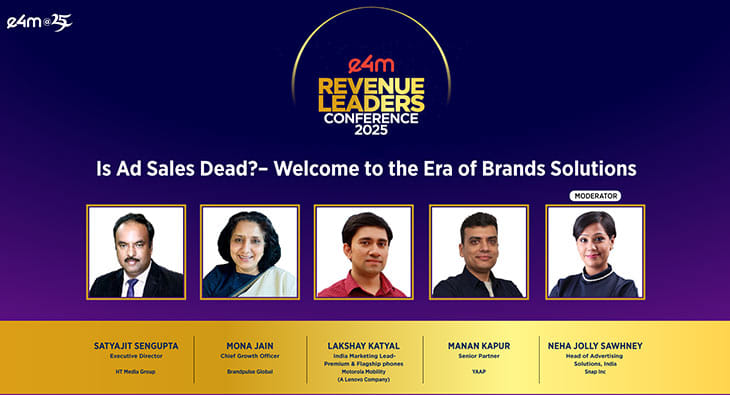

Is traditional ad sales still relevant in an era of evolving platforms and shifting brand expectations? This was the central theme explored by industry leaders at the e4m Revenue Leaders Conference. The conversation focused on how ad sales must transform in response to today’s fragmented content landscape and increasingly consultative brand demands.
The panel comprised Satyajit Sengupta, Executive Director, HT Media Group; Mona Jain, Chief Growth Officer, Brandpulse Global; Manan Kapur, Senior Partner, Yaap; and Lakshay Katyal, India Marketing Lead – Premium and Flagship Phones, Motorola Mobility (a Lenovo Company). The session was moderated by Neha Jolly Sawhney, Head of Advertising Solutions, India, Snap Inc.
Opening the session, Jain dismissed the idea that ad sales is obsolete. “I think it’s highly exaggerated to say that ad sales is dead,” she said. “Sales professionals are the facilitators who take the broadcaster’s or publisher’s proposition to the client.”
She acknowledged the growing dominance of branded content, stating that the role of sales is no longer just about pushing FCT or negotiating rates. “Salespeople must evolve. Marketers today expect a different level of engagement and solutions that go beyond reach and impressions to emotional and cultural resonance,” she said.
She emphasised how content consumption has shifted across multiple platforms, requiring brands to integrate their messaging seamlessly across TV, OTT, YouTube, and more. “Consumers are bored. They’re not easy to sell to. The competition is intense. So marketers need to engage, emotionally connect, and culturally resonate,” she explained.
To do this, Jain argued, sales must be deeply informed about the client’s category, brand challenges, geography, and audience. “Today, the expectation is for salespeople to have a more intellectual conversation. If they can’t, the marketer will take their money elsewhere,” she added. “Upskilling is crucial. Speak to marketers, understand their pain points, and evolve.”
Adding to this, Sengupta agreed that the narrative around ad sales being dead was premature. “All this news about ad sales being dead is not only highly exaggerated but kind of premature,” he said. “I’ve spent my entire career in ad sales, from the late ’90s to now, and 90–95% of the revenue we generate is still plain vanilla ad sales.”
However, he noted that the profession has undergone a significant makeover. “The language of marketing has changed, and we’ve had to keep up,” he said. Recalling earlier attempts to reposition sales roles, he added, “Twenty years ago, we started calling ourselves ‘brand solution partners’ and changed our LinkedIn bios, but it’s not about the title. It’s about truly understanding what brand solutions mean.”
Sengupta shared that marketers now expect conversations in a new language. “I recently met a non-advertiser in Mumbai, and the first feedback I received was, ‘Your languaging has changed.’ That’s the crux; how are you talking to the advertiser? Why would a CMO give you time unless you’re speaking their language and offering something of value?”
He concluded by framing the shift as one rooted in relevance. “It’s about aligning three things: the marketer’s problem, our products and assets, and the market insights we bring. Stitch these together, and you have a solution that works.”
The discussion moved towards creator-led campaigns and the widening gap between advertisers and platforms, both in terms of collaboration and measurable impact.
Manan Kapur, Senior Partner at Yaap, unpacked the shift in content formats and consumption behaviour. “The format of content absorption has changed. Earlier, an ad could last for three to six months. Ad sales were simpler. You bought FCT or a CPM on YouTube and ran a campaign,” he said.
He explained that with the economics of content shifting, marketers now operate under a ‘three-second rule’. “We’re consuming content in seconds. 10% of the audience here is probably watching reels right now,” he said, adding that India’s diverse population consumes everything, even cringe content, in vast numbers.
According to him, the obsession with virality is misplaced. “Good content isn’t viral content. It’s content that sticks with your brand and resonates over time,” he said. “It’s not about what you want to push out as a marketer, but what the consumer chooses to consume. If they’re not watching it, it’s irrelevant.”
When asked about the white spaces between advertisers and platforms, Mona Jain, Chief Growth Officer at Brandpulse Global, pointed to the challenges faced by national brands expanding into smaller markets. “Many brands believe that by using vernacular communication or regional influencers, they can connect deeply. But our research shows that local legacy brands have an emotional hold built over generations,” she said.
She explained that even with larger budgets, national brands may fail to break through unless they do more on the creative front. “It’s important to build seamless, organic storytelling using local content, and to create tailor-made IPs with the heroes of those marketplaces,” she said. “Only then can brands come close to achieving parity with the legacy players.”
Touching on measurement, Jain said the ask from brands has become sharply focused on proving impact. “Most of the briefs I get now are about brand lift studies. What’s the perception score, what’s building, and is the content association working for them?” she said.
She highlighted how even broadcasters are now initiating their own studies to measure top-of-mind recall, brand disposition, and emotional engagement before and after associations. “That data becomes ammunition for the sales team. You’re not just selling impressions anymore. You’re building sentiment and emotional connect,” she noted.
Measurement, she added, has now become a non-negotiable. “Brands are spending money, and they want actual proof of impact. It’s what helps them decide whether to stay or move on,” she said. This, in turn, raises the bar for sales professionals.
She concluded, “The salesperson must now be able to read and interpret data intelligently, and speak the language the marketer expects, like Satya said. That’s when true engagement happens.”
The panel continued to examine how brands must evolve their formats, platforms, and messaging to connect effectively with younger, more fragmented audiences.
Sengupta highlighted the multifaceted approach the organisation is taking. “At Hindustan Times, we are uniquely placed because we have four very strong platforms, legacy print, digital, audio, and on-ground activations,” he said. He pointed out that Fever is now India’s largest podcasting company, while their on-ground activations and thought leadership events form an essential part of youth engagement.
Reflecting on audience behaviour, Sengupta observed, “There’s a stage in life when one gravitates toward content of a certain kind. Once they enter their early careers, they begin reading seriously about news and business.” He cited how publications like Mint are increasingly being recommended by colleges, reinforcing the value of curated editorial content even among younger demographics.
He elaborated on various youth-oriented initiatives, such as PACE, HT’s longstanding student engagement platform, and the Hindustan Olympiad, which reaches over 600,000 students annually. “It introduces kids to competitive content early on,” he said, emphasising the importance of building content affinity from a young age.
To ensure relevance with younger audiences, Sengupta said the company follows a ‘5C framework’, i.e. context, connect, create, communicate, and calibrate. “Whenever we go to any audience, especially the younger audience, we go through all five steps. We look at brand KPIs, contextual insights, and then create and communicate a solution, which we calibrate through measurement,” he explained.
Turning to the growing need for creative synergy in digital campaigns, Kapur underlined the importance of aligning creativity with performance. “Creativity and performance, if treated as opposites, will never work. But if treated as partners, they map brilliantly,” he said.
He pointed out that content quality directly impacts ad revenue. “You can put a million dollars behind content, but if it’s not good, it won’t work,” Kapur noted. He stressed that building for the platform is critical. “You can have a superb campaign, but if it’s not optimised for the platform, it will fail.”
He criticised the current lack of balance in campaign planning. “Clients often focus only on media performance, forgetting that creativity deserves equal investment. When reports come in, no one blames the creative. They blame the platform,” he added.
Offering a marketer’s lens on premium product campaigns, Katyal spoke about audience segmentation and storytelling. “You can’t give the same treatment to a Creta and a Creta N Line, or for us, an H60 and an H60 Ultra. A flagship buyer is not buying specs; they’re buying into lifestyle and emotion,” he said.
Katyal stressed the need for content to be designed with a full-funnel approach. “From story to store, it has to be thought through from the start,” he said. A platform-first approach was also essential. “You may need high-definition vertical formats or CTV for premium users. Airports become touchpoints. Targeting must be elevated,” he noted.
Influencer marketing, he said, must also evolve. “It’s not just about giving a script to an influencer. The shift is towards co-creating content and making them brand advocates,” Katyal said. “When the audience sees the message coming organically from the influencer, it resonates more.”
He concluded by saying that engagement formats must evolve for premium positioning. “If you keep talking only tech, the audience will switch off. Interactive tools like AI-driven engagements, QR integrations and CTV help build deeper relevance and deliver value.”
Read more news about Marketing News, Advertising News, PR and Corporate Communication News, Digital News, People Movement News
For more updates, be socially connected with us onInstagram, LinkedIn, Twitter, Facebook, YouTube & Google News