Connected TV is moving from experiment to essential in media plans: Nishit Kanchan
At the Pitch CMO Summit 2026, Samsung Ads India’s Nishit Kanchan outlines why the big screen is becoming a key platform for focused attention, measurable reach and targeted advertising
 by
by
Published: Mar 30, 2026 1:11 PM | 5 min read
 Follow Us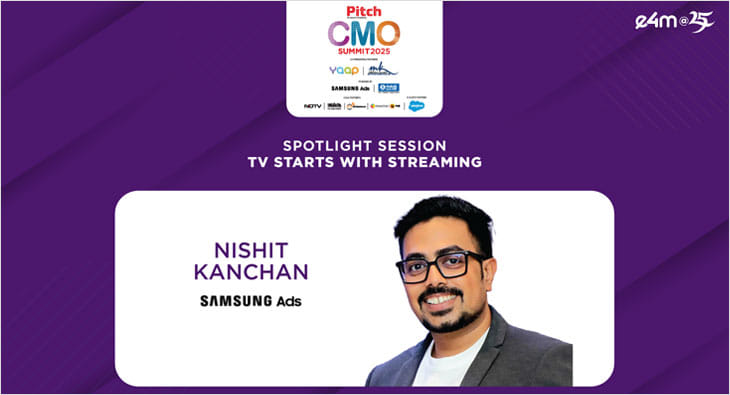

In a media environment dominated by constant scrolling and fragmented attention, television may still offer one of the few moments of uninterrupted consumer focus. A compelling and central perspective was put forward by Nishit Kanchan, General Manager and Head of Revenue at Samsung Ads India, during a session at the Pitch CMO Summit 2026.
Opening his presentation with a how the user interact with various screens during the course of the day, Kanchan said marketers must reconsider where genuine attention exists today.
“In the morning you are on your phone, continuously scrolling, notifications firing and work emails coming in. That is fractured attention,” he said. “But when you come home in the evening, sit on your couch and switch on the television, you are focused and invested. That is focused attention and that is the power of the big screen.”
According to Kanchan, that shift in viewing behaviour has accelerated the rise of connected television in India’s advertising ecosystem. What was once considered a future opportunity, he said, has already entered the mainstream. “A couple of years ago CTV was considered a future story. But it is not the case anymore. CTV is no longer the future story. It is the now story,” he said.
The scale of growth reflects that shift. Kanchan noted that by 2026 nearly 60 million households in India are expected to be addressable through connected television platforms.
Advertising investments are also following that growth. “In 2025 alone, CTV revenues hit almost Rs 6,000 crore. These are not estimated spends. These are actual spends on CTV platforms,” he said. “In 2026 the number is expected to cross Rs 8,000 crore, which means nearly 30 to 33 percent growth year on year.”
The share of advertising budgets allocated to connected television has also expanded. “Almost 30 percent of the total large screen budget has already moved towards CTV,” Kanchan said. “It is no longer an experimental line item in media plans. It has become a necessary part of the mix because it brings together the impact of the big screen and the precision of digital.”
Part of that shift is tied to the continued evolution of television technology. Kanchan pointed out that Samsung has maintained its position as the world’s largest television manufacturer for the past two decades while continuing to push display innovations.
Consumers, he said, are no longer only looking for bigger screens but also for more advanced viewing experiences. “The audience today does not just want a larger TV. They want the latest technology whether it is higher resolution, newer display formats and new tech enhancements,” he said.
For advertisers, the more significant change lies in how television now fits into the broader digital consumer journey. Instead of being the final step in the path to purchase, screens increasingly shape discovery and engagement earlier in the process.
“The journey is not a straight line anymore,” Kanchan said. “Earlier it started at a showroom or a multi-brand outlet. Today the journey starts on a screen.”
Samsung Ads maps this journey across multiple stages, beginning with the first moment a viewer switches on the television. Kanchan shared that the average Indian connected TV user engages with about five apps on their television, including both ad supported and subscription platforms.
“As soon as the user switches on the TV, you get the first level of engagement,” he explained. From there, advertisers can use immersive formats and targeting tools to build awareness and engagement.
“You can target audiences using device signals, audience signals and viewing behaviour. And once the user is engaged you can trigger action through formats such as QR codes or by moving the user from the TV screen to a mobile device,” he said.
Connected television, he added, also opens opportunities for longer storytelling formats that may not fit on other digital platforms. Some brands are experimenting with videos lasting two to three minutes, which can be accessed directly from the television interface.
Samsung’s ad ecosystem extends to Samsung TV Plus, the company’s free ad supported streaming television service that offers more than 160 channels integrated into Samsung televisions.
“Today when someone walks into a retail store to buy a television, the conversation is not only about screen technology anymore,” Kanchan said. “The services available on the television, including free streaming channels, are also becoming part of the value proposition.”
Viewing patterns on connected television also differ from traditional broadcast habits. While linear television typically sees a spike during national prime time, streaming audiences engage with content throughout the day.
“Streaming audiences are tuned in much more consistently compared to linear viewing,” he said, adding that large cultural or sporting events still create noticeable spikes in viewership.
Measurement, often cited as a limitation of traditional television advertising, is gradually evolving within the connected environment. While complete end to end conversion tracking is still developing, Kanchan said marketers are already using indicators such as brand lift and incremental reach to evaluate campaign performance.
“Most marketers want clarity on where their marketing spend is delivering value,” he said. “Metrics like brand lift and incremental reach are helping answer those questions.”
As screen sizes grow, Kanchan also emphasised the importance of adapting creative strategies for the medium. Larger televisions, particularly in the 55 inch and 65 inch categories, are becoming increasingly common in Indian households.
“A home screen immersive ad can take up nearly 35 percent of the TV screen,” he said. “That means brands need to think carefully about creative quality. A 4K creative on a large screen creates a very different storytelling experience compared to a smaller screen.”
For Kanchan, the broader message for marketers is that connected television is beginning to bridge a long standing gap in advertising between reach and precision.
“With connected TV you get the power of the big screen and the targeting capabilities of digital,” he said. “That combination is what makes it increasingly relevant for advertisers today.”
Read more news about Marketing News, Advertising News, PR and Corporate Communication News, Digital News, People Movement News
For more updates, be socially connected with us onInstagram, LinkedIn, Twitter, Facebook, YouTube & Google News
