Beyond the Logo: Why brands revisit their identity
Ganapathy Viswanathan, Communication Consultant & Author, writes on why a meaningful brand refresh is rarely about design alone but about business too
 by
by
Published: Jul 28, 2026 9:09 AM | 6 min read
 Follow Us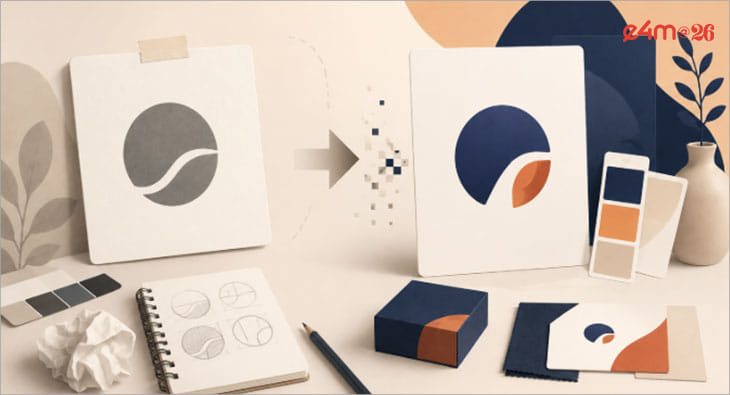

- Established brands, like iD Fresh Food and Mobavenue, often refresh their identities not just for aesthetic reasons, but to align with evolving business strategies and consumer expectations.
- A meaningful brand refresh involves extensive research and strategic planning, focusing on how the brand is perceived and its future direction, rather than merely redesigning visual elements.
- While some companies change their identities in response to trends or competition, this can undermine established trust; a brand's identity should only change if the business itself has significantly evolved.
- Consistency in branding is crucial, as demonstrated by enduring brands like Coca-Cola and Nike, which have maintained recognizable identities while making gradual updates that reflect their ongoing relevance.
"A lot of people talk about brands as though we create them. Most of the time we're not creating them. Most of the time we're refreshing them, reinvigorating them, because the world has changed."
— Wally Olins
Over the past few weeks, I came across two interesting announcements on social media. One was from iD Fresh Food, the other from Mobavenue, a technology company. Both had unveiled refreshed brand identities. They belong to completely different industries, yet their announcements sparked the same thought. What makes an established brand revisit something as fundamental as its identity?
Most people immediately notice the visible changes and a redesigned logo, a fresh colour palette or a new typeface. But those are only the outcomes of a much larger exercise. A brand identity is not created to make a company look attractive. It exists to communicate what the business stands for, what it promises and, equally important, where it is headed.
That is why a meaningful brand refresh is rarely about design alone. It is usually about business.
The Business Has Changed
Businesses do not stand still. Consumer expectations evolve, markets become more competitive and companies often find themselves entering spaces that were never part of the original business plan.
A food company may diversify into new categories. A technology firm may move from being a service provider to building products. A start-up that once spoke only to early adopters may now be addressing mainstream consumers. In each of these situations, the existing identity may no longer tell the complete story.
There are many reasons why organisations choose to revisit their identity. A merger or acquisition may require a common identity for the combined business. A strategic partnership may call for a broader brand narrative. Sometimes the company has expanded so significantly that the old identity no longer reflects its capabilities.
There are also occasions when a new leadership team brings a different vision for the future. The refreshed identity then becomes the first visible sign of that new direction.
And yes, sometimes a brand simply needs to look more contemporary. Design styles change over time. What looked modern fifteen years ago may appear dated today, particularly in a world where brands are experienced more on mobile screens than on billboards.
The Logo Comes Last
People often assume that branding begins in the design studio.
In reality, it usually begins in the boardroom.
Before a single line is drawn, organisations spend months asking difficult questions. How do customers perceive us? What do employees believe the company stands for? How are competitors positioned? What space do we want to occupy over the next decade rather than the next year?
Research provides those answers. It helps uncover perceptions that may not always be obvious from within the organisation.
Only after this work is completed does the creative journey begins. The logo, colours, typography and visual language are designed to express a strategy that has already been agreed upon. Good design, therefore, is not fancy decoration. It is the visual expression of business strategy.
There Is a Process Behind Every Good Identity
The strongest brand identities are rarely born out of inspiration alone.
They emerge from a disciplined process that combines research, strategy and creativity.
Most branding projects begin with stakeholder interviews, customer feedback, market analysis and brand audits. Workshops are held to define the brand's purpose, personality and positioning. Creative options are then developed, refined and tested before the final identity is approved.
This explains why successful identities often appear deceptively simple. Every colour, every shape and every design element, has a reason for being there.
The best identities do not shout for attention. They quietly reinforce what the business wants people to remember and resonate.
Change Is Not Always Progress
There is another side to the story.
Some companies change their identity because they believe change itself signals progress. Others do so because competitors have unveiled a new look. Neither is a particularly strong reason.
Brand identity carries years, sometimes decades, of accumulated trust. Consumers recognise familiar colours, symbols and typography long before they read the brand name. Those visual cues become part of memory.
Replacing them without a clear strategic purpose can do more harm than good.
The question therefore should never be, "Can we redesign the logo?" The more important question is, "Has the business changed enough for the identity to change as well?"
If the answer is yes, the exercise can strengthen the brand. If not, it risks becoming little more than an expensive cosmetic makeover.
Consistency Is Often the Bigger Strength
Many of the brands we admire today have not built their reputation through constant reinvention.
Take MRF. Its identity has remained remarkably consistent over the years, helping it become, one of India's most recognisable brands. The same can be said of Amul, LIC, Asian Paints and Parle-G. While each has made small refinements over time, none has abandoned the visual assets that consumers instantly identify with.
The global picture is no different. Coca-Cola, Nike, Apple, Mercedes-Benz and McDonald's have all modernised their identities gradually rather than replacing them entirely.
These brands remind us that consistency creates familiarity, and familiarity builds trust. In branding, continuity is often as valuable as creativity.
Design Is Only the Beginning
Whether a company works with a specialist branding consultancy, an advertising agency or its own in-house design team is secondary. What matters is whether the identity genuinely reflects the business.
The real work actually begins after the launch.
The new identity must appear consistently across every touchpoint—packaging, websites, mobile applications, social media, advertising, offices and customer communication. Employees must understand what the refreshed identity represents because they become its first ambassadors.
Without disciplined implementation, even the most thoughtfully designed identity can lose its meaning.
A Reflection of the Future
Whenever a company unveils a refreshed brand identity, the conversation usually revolves around whether people like the new logo.
Perhaps that is the wrong question.
A better question is whether the new identity tells us something new about the business itself.
The strongest identities are never created to follow a design trend. They emerge when a business has evolved, expanded or redefined its purpose. The visual change simply gives shape to that transformation.
As Wally Olins observed, brands are refreshed because the world changes. The organisations that understand this do not chase change for its own sake. They refresh their identity only when there is a compelling business reason to do so.
In the end, a successful brand identity is not remembered because it looks different. It is remembered because it continues to represent the business truthfully, consistently and meaningfully for years to come.
Disclaimer: The views expressed here are solely those of the author and do not in any way represent the views of exchange4media.com.
Read more news about Marketing News, Advertising News, PR and Corporate Communication News, Digital News, People Movement News
For more updates, be socially connected with us onInstagram, LinkedIn, Twitter, Facebook, YouTube & Google News