At 53, what makes Brand Sachin still work?
Guest Column: Shveta Singh, independent marketing consultant, explores why Sachin’s brand has done something more unusual
 by
by
Published: Apr 24, 2026 11:18 AM | 4 min read
 Follow Us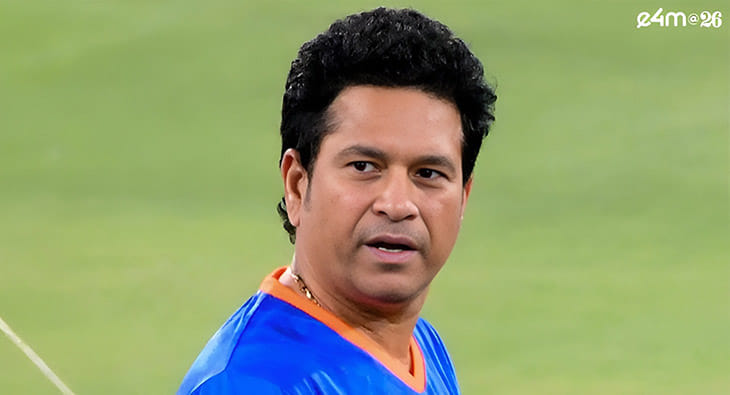

- Sachin Tendulkar, celebrated as the "God of Cricket," turns 53 today, with his brand remaining strong over a decade after his retirement due to its foundation on reliability, consistency, and character rather than just performance.
- Unlike typical performance-led brands that fade when their core activity diminishes, Brand Sachin has outlived the need for ongoing validation, maintaining trust and commercial value without aggressive reinvention or visibility efforts.
- Tendulkar's brand evolution from excellence in cricket to a symbol of trust and dependability highlights the importance of character in brand longevity, contrasting with the common belief that brands require constant input to remain relevant.
- The article raises a critical question for brand-building: whether to create brands that rely on continuous performance or those that can sustain value independently of ongoing achievements.
The God of Cricket turns 53 today.
While we celebrate Sachin Tendulkar, the cricketing legend, it may be worth pausing to acknowledge something else, Sachin Tendulkar: the enduring brand.
Most brands weaken when performance stops. And yet, over a decade after retirement, his brand continues to hold strong on trust, recall, and commercial value.
So, what exactly is sustaining Brand Sachin today?
For most performance-led brands, performance is not just an input, it is the engine. Brands fade when performance fades. Athletes lose form. Actors have flops. Founders step away. The brand has nothing new to anchor itself to once that engine slows down. It has to find a new source of energy. The usual routes: reinvention, visibility, or narrative.
Sachin’s brand has done something more unusual. It hasn’t replaced performance with something else. It has simply outlived the need for it. He hasn’t played for over a decade. There is no current performance, no new on-field validation. And yet, the brand continues to command trust, recall, and endorsement value across categories.
This is not just nostalgia at work. Nostalgia alone rarely sustains commercial relevance at this scale, for this long. The answer lies in how the brand was built in the first place. Sachin was never a personality brand built on flamboyance or constant reinvention. His brand was built on reliability, consistency, discipline, and a certain groundedness. He stood for doing the job well, repeatedly, without noise.
Over time, these attributes moved beyond performance and became associated with character. And that shift is critical. Performance is time-bound. Character is not. A brand built only on what it does remains tied to the duration of doing. A brand built on what it represents can outlive the act itself. Sachin’s brand moved from being about excellence in cricket to becoming a shorthand for trust and dependability.
His brand has remained remarkably relevant even after retirement. There might be another significant factor contributing to that. He has made no visible attempt to reinvent, no aggressive push for relevance, no shift into trend-driven spaces. If anything, he has been restrained. And that restraint matters. Because many brands, once the core engine slows down, try to compensate by amping up visibility. More appearances, more opinions, more noise. In doing so, they often dilute the very meaning that made them valuable. Sachin has largely avoided that trap.
Which brings us to a broader point.
In modern marketing, we are conditioned to believe that brands need constant input to remain relevant. Fresh campaigns, new positioning, continuous visibility. The assumption is simple: if you stop feeding the brand, it starts to fade.
But Brand Sachin challenges that assumption.
It suggests that beyond a certain point, brand-building is not about continuous input, but about what has already been accumulated. Decades of consistent behaviour and clear meaning can create accumulated equity that does not need to be constantly revalidated.
There are very few brands that operate in this zone. Apple comes somewhat close. For Apple, consistency of product philosophy and design has built a level of trust that carries forward even between product cycles. But even Apple still relies on ongoing performance.
Sachin doesn’t.
There is no new output. No new proof being added. And yet, the brand continues to function. Still standing tall as an endorser, as a symbol, as a shorthand for trust.
That is the difference between a brand that needs to keep proving itself, and a brand that has already proven enough. Most brands operate in the first category. They are only as strong as their last campaign, last product, last performance. Which is why they remain trapped in cycles of constant visibility. Very few make the transition to the second.
For brands, this raises a more pertinent question.
Are we building brands that need to keep performing to stay relevant? Or are we building brands that can eventually outlive the need to perform?
Because the real test of brand-building is whether it continues to hold value when performance is no longer in play.
Read more news about Marketing News, Advertising News, PR and Corporate Communication News, Digital News, People Movement News
For more updates, be socially connected with us onInstagram, LinkedIn, Twitter, Facebook, YouTube & Google News