Another click in the wall
Guest Column: Sankalp Mehrotra, Ex-VP of Monetization at Flipkart, shares his perspective on the scale of retail/commerce media globally, while debunking some myths about the retail media industry
 by
by
Published: Sep 18, 2024 9:23 AM | 7 min read
 Follow Us

As I step in to write after a long time, I’m reminded that 'all in all, you’re just another brick in the wall'. Each piece of writing on a subject is always a small, yet perhaps a meaningful part of a larger narrative. I’m excited to contribute once again.
‘Another Click In The Wall’ is my perspective on the digital industry. I hope to make this a regular column where I’ll draw on my experience and learnings to cast a future course in all things digital. In this edition, I’ll talk about the scale of retail/commerce media globally, in India, and also try to debunk some myths.
Hitting the right notes - Retail media could be a $2-2.5 billion industry in ‘24 in India
Retail media is now the gold standard on how brands and sellers can interact with customers. For all the right reasons; the availability of first-party data in a privacy-compliant manner, the vast reach, the ability to hyperpersonalize communication and reach the customers at the point of purchase… It's no surprise that retail media spends are growing disproportionately, across geographies.
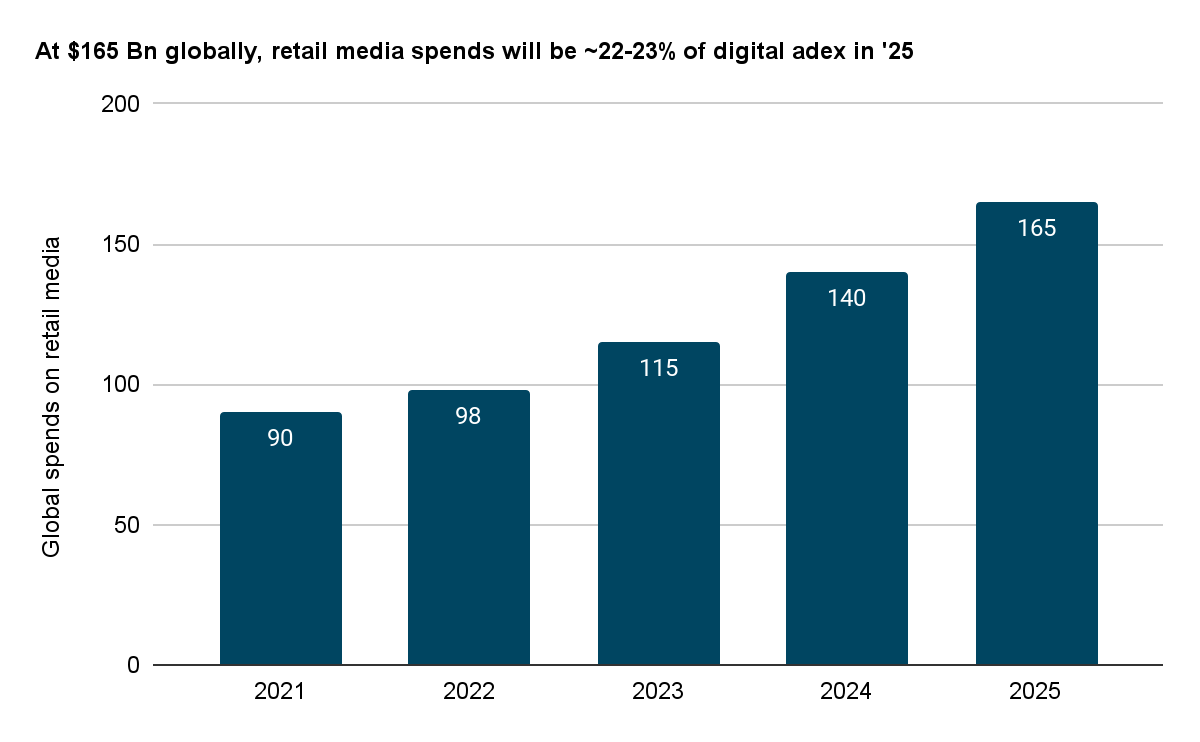
*Source - eMarketer. All spends in USD billions.
Closer home, we’re witnessing a similar growth trajectory. Retail media is now going through its phase two of its evolution (Phase 1 - Early adoption, 2. Growing stickiness, 3. Massification). Across leading platforms, advertising brands outnumber non-advertising ones. Non-endemic brands, especially in BFSI, Auto etc., also advertise now given the intersection of their products and platform customers, catapulting investments.
Commerce spends should breach $2-2.5 Bn in 2024, making it 22-25% of digital AdEx. For context, this could be equivalent to all digital video spends in India. Need we say more?
Discordant notes in the retail media symphony
Despite the success, many marketers and practitioners still question if this growth is sustainable? The questions could stem from multiple factors - a lack of know-how, limited execution capabilities and also structure rigidity in organisations.
Will address a few oft-heard themes in my discussions with brands/agencies and more. And look at what data from the US says about these assertions.
- Retail media is only for lower-funnel marketing
Not quite. The collapse of shopping funnels is real. Consumers' discovery to purchase on single destinations is now the norm. In such a scenario, brands, both incumbents and insurgents, can ill afford to lose out on brand building. Platforms today provide a suite of services like Video, Display, Sampling and robust reportage/insights to make these investments engaging and measurable.
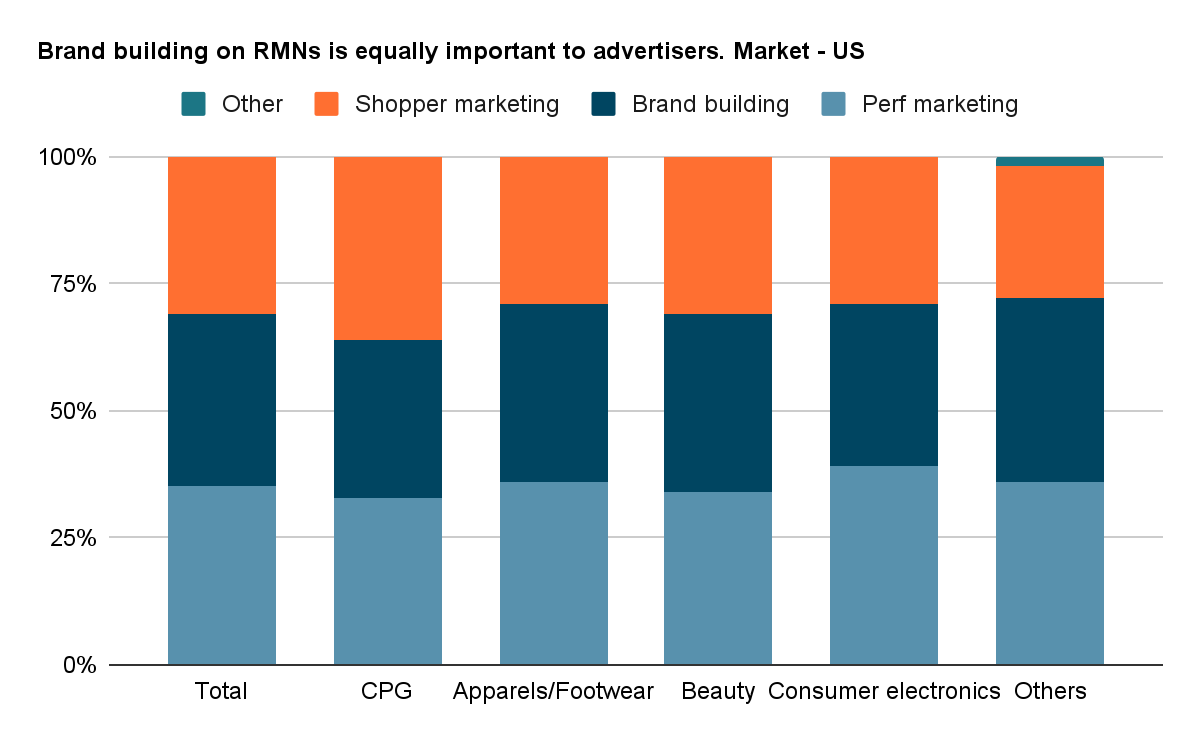
N = 188             n = 52         n = 42              n = 31     n = 12 n = 51
*Source - McKinsey and Company research. Market - US. Q: Looking ahead to the next 12-24 months, what % of spending on retail media do you anticipate targeting at achieving the following objectives. Retail Media network survey, 2022.
The above chart shows the clear acknowledgement from brands, across verticals, on the wide role that retail media needs to play to fulfil various marketing objectives.
Leading platforms like Flipkart have close to 250 mn MAUs* - an audience scale large enough for any brand, across any category. It's a matter of time - RMNs (Retail media networks) in India will be essaying a much larger role than just being just bottom-of-the-funnel, performance channels.
*Quoted from the last known estimate
- Source of funds
There are very loud voices on commerce spending being only and only ‘trade dollars’. And that limits media practitioners from exerting influence. False. A few years ago this might’ve been partially correct; markets like the US have already gone through an evolution where a budgetary surge has been necessitated purely by the completeness of portfolio and performance benefits that RMNs deliver.
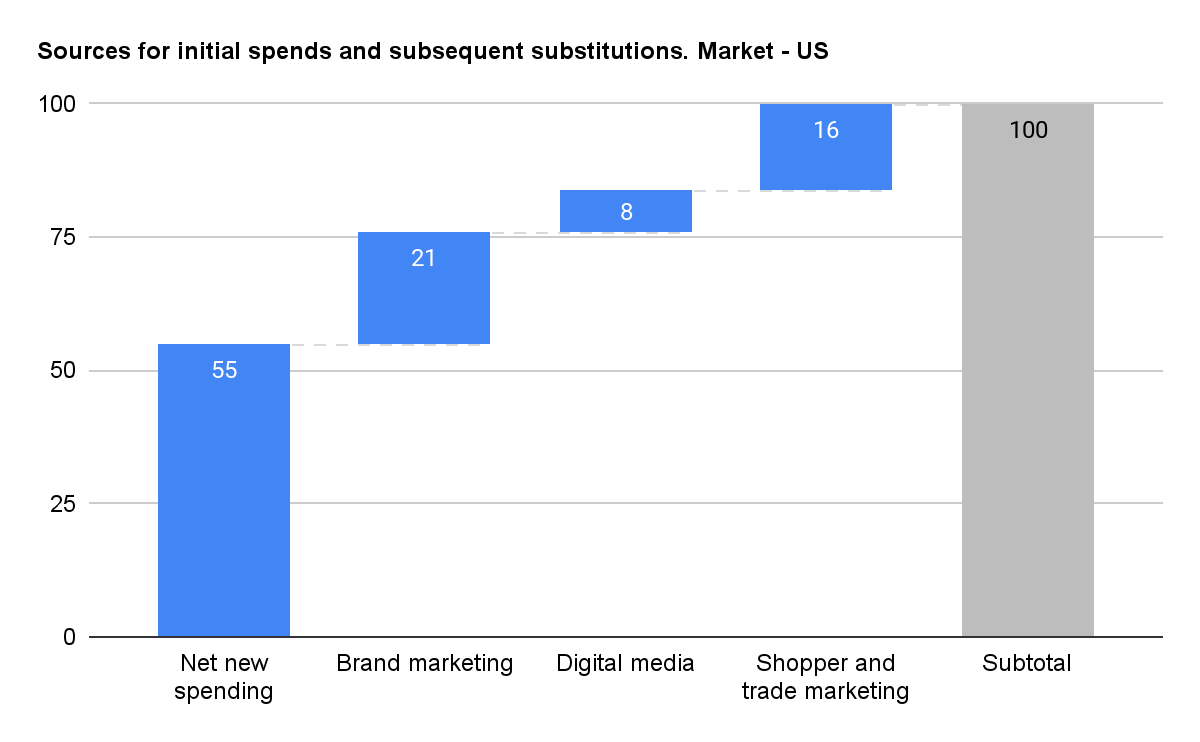
*Source - McKinsey and Company research. Market - US. Q1: Where did the initial spending on retail media come from? Possible answers - Net new spends, Substitution. Q2: From which sources did the substitution happen? Possible answers - Existing trade budgets, existing shopper marketing budgets, sponsorship budgets, brand TV, other mass media, digital media budgets. Retail Media network survey, 2022.
Large brands have already redefined organisation structures to ensure singular ownership of budgets. For insurgent brands and sellers, platforms deliver 50-70% of the business and thus budget allocations also follow a similar pattern. With 22% - 25% digital AdEx share, it’ll soon be contingent on all brands to have a cohesive vs a distributed media budget outflow to deliver marketing goals.
- Retail media platforms are expensive
Unfounded. All media channels can be unpacked on two axes - The number of audiences and the engagement that they deliver.
Cheaper access (data) has meant close to a billion AIUs in India already, with numbers set to increase. Gateway platforms like video, social etc get nearly all of these audiences spending time and thus they are ahead on axis one i.e. reach, by a country mile.
A large chunk of these audiences, however, struggle with affordability.
Making the 200-250 million people on product commerce the most valuable segment for most verticals. Ads on commerce platforms also aid discovery vs being deterrents on the viewing experience. The high ad relevance and low ad loads result in better ROAS.
RMNs thus end up being more efficient; not expensive.
Encore
Besides having the advantages of scale, first-party data, insights, and the ability to match customers to SKUs in a privacy-compliant manner; large platforms are also becoming very important research destinations.
Flipkart gets 2-3x the number of hits on its smartphone pages than all phones sold. Online + offline put together! While time spent and media spends are rarely symmetrical, the value that platforms today deliver for brands go far beyond their ROAS on ads. Making a case for substantially higher investments.
In the next couple of months, a lot more first-party data owners like banks, payment gateways, auto and many more could lend themselves to creating retail advertising destinations. Chase recently launched Chase Media Solutions, its new digital media business, providing brands with the ability to connect directly with the financial institution’s 80 million customers. PayPal announced plans to create a new advertising platform rooted in transaction data generated by its nearly 400 million active accounts.
Retail media is creating far-reaching implications for advertisers, publishers, ad technology providers, agencies and the retailers themselves. In time, a large number of impressions sold could be linked to SKU sales thereby changing the digital advertising paradigm. All practitioners need to lean in and do that now. Organisations need to redesign, hire, train and innovate to make the most of the opportunity at hand.
More soon. Till then, keep listening to Pink Floyd. Leaving you with a trivia on them - Did you know that their name originated from two blues musicians, Pink Anderson and Floyd Council? Roger Waters and Syd Barrett chose the name as a nod to their musical influences, blending the two names to create "Pink Floyd”.
Disclaimer: The views expressed here are solely those of the author and do not in any way represent the views of exchange4media.com.
Read more news about Marketing News, Advertising News, PR and Corporate Communication News, Digital News, People Movement News
For more updates, be socially connected with us onInstagram, LinkedIn, Twitter, Facebook, YouTube & Google News