‘AI is not eating auto jobs; it’s transforming the auto industry'
At e4m Auto Marketing Summit 2025highlighting how AI-driven personalization and immersive customer experiences are reshaping brand engagement
 by
by
Published: Feb 20, 2025 7:11 PM | 5 min read
 Follow Us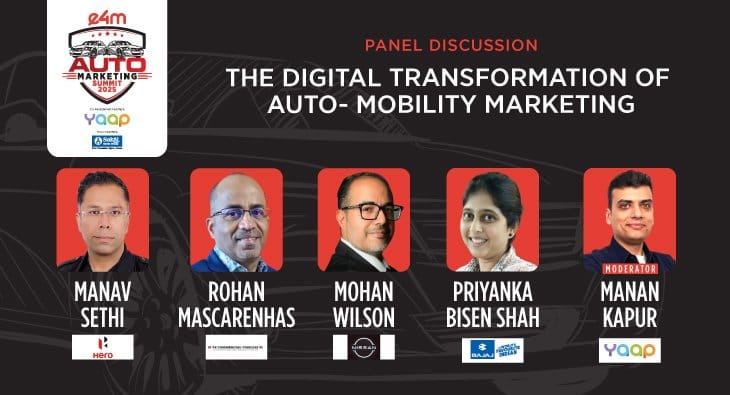

The inaugural session of the e4m Auto Marketing Summit 2025 featured a panel discussion on the digital transformation of auto mobility marketing, highlighting how AI-driven personalization and immersive customer experiences are reshaping brand engagement.
Moderated by Manan Kapur, Sr. Partner at YAAP, the panel included Priyanka Bisen Shah, Head of Digital Marketing at Bajaj Auto Ltd., and Rohan Mascarenhas, Head - Brand & Marketing Communication at VE Commercial Vehicles Ltd.
Shah emphasized AI’s evolving role in marketing, stating, “Using AI to its fullest potential is still a mystery as we continue to learn and evolve. It's like peeling an endless onion.” She shared insights into Bajaj Auto’s AI-driven campaign for the NS400Z launch, where an AI chatbot generated personalized ads featuring users riding the motorcycle. This innovative approach significantly boosted engagement compared to traditional video ads.
Discussing regional customization, she highlighted how she used AI to identify product feature preferences across different markets, adapting campaigns accordingly. She stressed the importance of first-party data, explaining how the brand leverages predictive modeling to identify potential upgraders. “Why should I waste money reaching an unknown audience when I already have a known one?” Shah noted. Additionally, she touched upon the company’s decision to sell Bajaj Chetak on Amazon and Flipkart, citing the importance of price-sensitive Indian consumers and seamless API integration with dealers for fulfillment.
She also discussed AI-driven personalization in marketing, particularly for Bajaj Chetak, their leading EV brand. “We initially ran an all-India campaign to identify which product features resonated most with different audiences. Using AI, we then conducted secondary research to determine where aspects like space or distance mattered more and created customized regional campaigns accordingly,” she explained.
Mascarenhas further provided insights into the commercial vehicle industry’s approach to AI, explaining how VE Commercial Vehicles is mapping different driver segments to tailor content accordingly. "For small commercial vehicle drivers, infotainment resonates best, while long-haul drivers use digital platforms for trip planning. Fleet owners focus on predictive maintenance,” he said.
VE Commercial Vehicles is leveraging discriminative AI to identify these unique audience behaviors and push tailored content at the right stage of the purchase funnel. "The next step is using this data to push the right content at the right time, depending on where they are in the funnel," Mascarenhas added.
He acknowledged challenges in AI-driven language translation for technical terms and emphasized the need for human oversight in marketing automation.
Mascarenhas also underscored AI’s role in refining service networks, ensuring predictive diagnostics and real-time assistance. “By analyzing breakdown patterns, we can ensure the right number of dealerships, service vans, and roadside assistance points where they’re needed most.” He also highlighted VE Commercial Vehicles’ use of AR to assist mechanics in remote locations with repair guidance.
On influencer marketing, Shah acknowledged a shift in industry strategy, moving from automotive-specific creators to a more diverse mix. “People trust recommendations more when they hear them from someone else rather than the brand itself,” she said, emphasizing that influencers play a key role in building awareness and credibility.
Mascarenhas highlighted the rise of truck driver influencers, some with over 2.5 million followers, and their growing impact on commercial vehicle marketing. "No matter how much marketing jargon we push, the comprehension and trust levels among drivers remain limited. But when the message comes from one of their own, it is instantly more relatable."
However, balancing brand objectives with influencer creativity remains a challenge. "Influencers are loyal to their followers, and they create content that resonates with their audience. It’s always a tightrope walk—balancing brand messaging while allowing influencers creative freedom,” Mascarenhas said.
Mascarenhas also discussed emerging technologies like AR and VR in after-sales service. "If a mechanic is unsure how to replace a gearbox, they can simply scan the part and instantly access a step-by-step instructional video on their phone." He highlighted how predictive diagnostics help optimize service networks, ensuring better availability of roadside assistance and repair services.
He also shared how predictive AI is optimizing service networks. “By analyzing breakdown patterns and service issues, we can predict high-demand routes and ensure we have the right number of dealerships, service vans, and roadside assistance points where they are needed most,” he added.
Both Shah and Mascarenhas addressed concerns about AI replacing human jobs in marketing. Shah dismissed fears of job losses, stating, “AI is not eating jobs; it is transforming them. The only ones who will feel left behind are those who fail to upskill. Just like the internet and computers changed workplaces, AI will redefine roles rather than eliminate them.”
Mascarenhas reinforced the need for strategic AI adoption. “AI is a tool, not a magic wand. We shouldn’t rush to create an ‘AI campaign’ just for the sake of it. The key is to adopt AI strategically,” he concluded.
Read more news about Marketing News, Advertising News, PR and Corporate Communication News, Digital News, People Movement News
For more updates, be socially connected with us onInstagram, LinkedIn, Twitter, Facebook, YouTube & Google News