‘Agile marketing demands speed collaboration and a mindset shift’
At India Brand Conclave 2025, industry leaders highlighted the need for real-time collaboration, empowered teams, and a shift from perfection to speed
 by
by
Published: Feb 1, 2025 8:26 AM | 7 min read
 Follow Us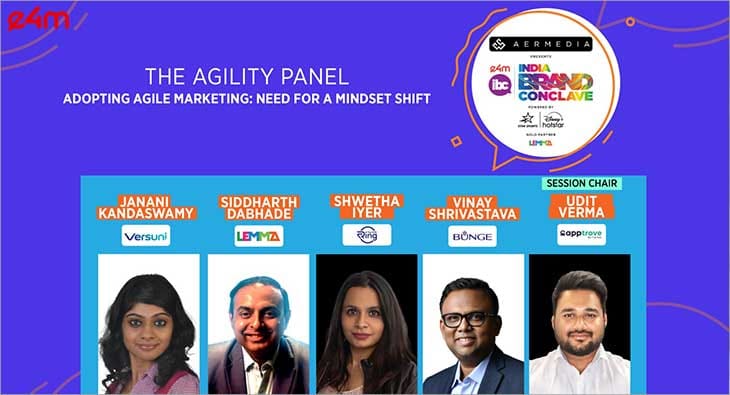

At the India Brand Conclave 2025, marketing leaders discussed the evolving role of agility in modern marketing. The ‘Agility Panel’ explored how businesses are shifting from traditional models to a more dynamic, real-time approach to enhance engagement and drive better results.
The panellists were Janani Kandaswamy, Head of Marketing – Preethi Kitchen Appliances, Versuni; Siddharth Dabhade, Chief Business Officer, Lemma Technologies; Shwetha Iyer, SVP and Head of Marketing, Kissht; and Vinay Shrivastava, Vice President & B2C Head, Bunge India. The session was chaired by Udit Verma, Co-Founder & CMO, Trackier.
Kandaswamy opened the discussion by outlining how agile marketing has transformed conventional marketing practices. “What marketers are generally used to in traditional industries is the whole broadcast approach, which follows a conventional waterfall model—single messaging and one-way communication,” she explained. “Agile marketing has changed this by making it more conversational, interactive, and experiential. It’s no longer just purchase-led; we now gain a holistic view of consumer behaviour and transactions, which is becoming increasingly important.”
Dabhade highlighted how programmatic digital out-of-home (DOOH) has introduced agility into a traditionally impact-driven medium. “Out-of-home has always been great for brand awareness and new launches,” he said. “What we have done is connect out-of-home with digital full-funnel marketing, allowing brands to drive conversions and ROI.”
He elaborated on how this integration enables real-time campaign adjustments. “You can tweak creatives instantly based on macro trends like weather or sports scores. The element of digital and programmatic brings agility in a powerful way, letting marketers refine campaigns in real-time.”
Breaking down agile marketing into two key aspects, Iyer brought a fintech perspective “One is internal agility—how fast we move as a marketing team. The second is external go-to-market speed—how quickly we reach the customer,” she said. “Both are interconnected. Internal agility depends on collaboration, in-house teams, and rapid execution, while external speed depends on market factors like compliance and regulatory changes, which in fintech can happen overnight.”
She also shared how her company has structured its marketing for agility. “To improve internal agility, we’ve eliminated agency partners in most areas—sorry to my agency colleagues in the audience!” she quipped. “This decision has helped us react faster. While we do work with agencies in some streams, most of our work happens in-house, ensuring close collaboration with product and technology teams.”
Agility in marketing is no longer optional. Shrivastava highlighted this perspective, “It’s a necessity, like roti, kapda, and makaan.”
“If you want to build a strong, fast-growing business, agility in marketing is one of the key ingredients.” He shared how his company is leveraging real-time consumer insights to stay ahead. “We’ve moved away from large-scale quantitative market research and now focus more on consumer immersions and social listening. Our brand teams actively participate in these immersions, getting firsthand insights from consumers.”
He also discussed how decision-making structures play a role in agility. “We’ve put in place a decision-making framework that clearly defines who can make what decisions,” he said. “Rather than every decision reaching the top, teams are empowered at different levels. This allows us to be more responsive and efficient.”
Agile Marketing as a Response to Evolving Consumer Needs
Next the panel explored how agile marketing helps brands respond to evolving consumer needs with Kandaswamy illustrating this through the lens of the consumer durables industry.
“In the home appliance sector, marketing operates at both B2B and B2C levels,” she explained. “While we can create consumer desire, the funnel often becomes leaky at the retail level due to factors like retailer relationships or product availability.”
She emphasized the importance of a unified consumer view to address this challenge. “You need to predispose consumers to your brand at every stage of their decision journey, not just through TV or digital ads. In our company, we collect first-party data from multiple touchpoints—our in-store promoters, our service centers with 50,000 monthly visits, and our D2C website. The key is integrating this data to get a single, holistic view of the consumer. That way, we can influence their decision before they even enter a store, ensuring they don’t get converted by another brand’s dealer or promoter. The faster we do this, the better our ROI and conversion rates.”
Challenges in Adopting Agile Marketing for B2B Companies
For B2B organizations, agility presents a different set of challenges. Dabhade noted that agility must align with a company’s business model. “For us, LinkedIn and industry events are major channels. The key focus is maintaining a real-time, unified view of our B2B sales pipeline. We collect insights from sales and marketing channels, ensuring we’re constantly adapting to the changing needs of the market.”
When asked about leveraging review platforms like G2 and Capterra, Dabhade clarified that their approach is different. “We don’t use review platforms, but after every campaign, we go back to clients to understand their experience with us. Since our solution not only drives awareness but also delivers ROI, gathering this feedback is crucial.”
He acknowledged that data consolidation remains a significant challenge for large organizations. “With active marketing and sales teams, ensuring all data is integrated to inform the next quarter’s strategy is critical. Thanks to digitization and AI, we can now do this much faster, but it remains an ongoing challenge for all large organizations handling multiple data sources.”
Agile Marketing in B2C as a Key Ingredient for Success
Agility is not category-specific but rather a mindset built on three essential pillars: clarity of thought, empowered teams, and continuous progression.
“Eliminating subjectivity in decision-making is key,” Shrivastava explained. “A well-defined brand book ensures every aspect of branding is clear and objective, reducing unnecessary debates. Additionally, empowered teams with a structured decision-making framework prevent bottlenecks, enabling faster responses without centralizing every decision.”
He also stressed the need for constant evolution. “In today’s fast-changing environment, brands can’t afford to wait for quarterly reviews to make adjustments. Agility means iterating and evolving every day rather than relying on rigid long-term plans.”
Aligning Agile Marketing with Product Development
The discussion also featured Iyer’s insights on integrating marketing with product development, emphasizing the importance of collaboration and breaking down traditional corporate silos.
“One way to achieve this is by maintaining close communication between marketing, product, and technology teams,” she said. “At our company, we don’t rely on emails and waiting for responses. Instead, we conduct real-time discussions via Slack and participate in daily stand-ups with the product team.”
Iyer noted that involving marketing in product sprint meetings allows for immediate updates on changes that impact communication, such as app store updates, website modifications, or customer messaging.
Another crucial factor is avoiding leadership bottlenecks. “Empowered teams must be able to make decisions independently. If a leader is unavailable, the workflow should not stall,” she asserted.
Finally, Iyer challenged the obsession with perfection in marketing. “Sometimes, striving for the perfect creative, copy, or campaign delays speed to market. Instead, we focus on quick ideation—creating multiple versions of an asset in an hour and making a decision rather than spending an entire day on a single piece of communication. The key is to maintain user-centricity while optimizing for speed.”
This approach ensures that both marketing and product teams remain aligned, agile, and responsive to changing consumer needs.
Read more news about Marketing News, Advertising News, PR and Corporate Communication News, Digital News, People Movement News
For more updates, be socially connected with us onInstagram, LinkedIn, Twitter, Facebook, YouTube & Google News