You can’t not play in the AI space today: Phanimohan Kalagara, Gracenote by Nielsen
Phanimohan Kalagara, Global CTO of Gracenote, speaks on leveraging AI-driven metadata to revolutionize media discovery, contextual advertising, and global content personalization
 by
by
Published: Apr 21, 2025 8:47 AM | 6 min read
 Follow Us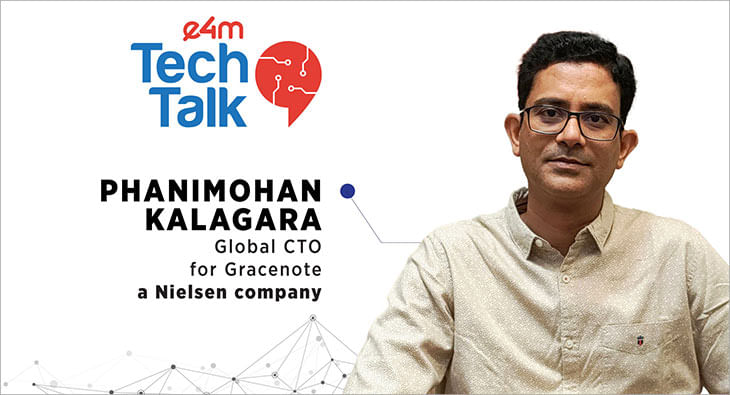

Phanimohan Kalagara, Global CTO of Gracenote—a Nielsen company—believes media discovery is undergoing a seismic transformation. In a wide-ranging conversation, he detailed how Gracenote is shaping the global content ecosystem, using AI to tame fragmentation, and powering everything from smart TVs to car infotainment systems.
“We pretty much are the leader today that is actually powering media discovery across the globe,” Kalagara said. “In North America, the penetration of the Gracenote ID is probably close to 90% or higher. It has become the standard ID through which all discovery today happens.”
Though largely invisible to consumers, Gracenote’s metadata engine underpins how viewers navigate and discover content across platforms—TVs, mobile devices, podcasts, streaming apps, and even in vehicles. The Gracenote ID acts as a universal identifier that connects content creators, aggregators, and platforms, allowing seamless media interaction across ecosystems. “Even most of the auto players rely on Gracenote to power their infotainment experiences,” Kalagara added.
Taming Fragmentation with AI and Deep Metadata
The company, having been acquired by Nielsen in 2017, is now solving far more complex problems, especially in the era of content overload. As streaming platforms proliferate and the average viewer is faced with too many options, Gracenote is working to reduce fragmentation and enable quicker, smarter discovery.
Kalagara outlined a three-pronged approach. The first layer is the metadata model itself. “Imagine you’re on a Firestick or Roku or a Samsung Smart TV. The number of streaming channels is exploding. But with Gracenote, all these providers can talk to each other using a shared ID and rich metadata—titles, images, descriptions, everything.” This universality creates a foundational layer that enables discovery across platforms.
The second layer is powered by AI, which helps Gracenote scale its metadata capabilities across regions, formats, and languages. “We’re in so many countries, with so many languages, so much content. AI helps us move from unstructured to structured data efficiently,” Kalagara said. “Translations, grammar, inappropriate content detection—AI makes it scalable and precise.” He noted that AI tools play a key role in everything from spelling and formatting to image validation and moderation.
The third, and most ambitious, layer involves deep semantic understanding of the content itself. “Eventually, the best way to understand media is to go into the media itself,” Kalagara said. Gracenote is developing technology to identify metadata at a scene or chapter level, moving beyond episode-level or program-level metadata. “There is data in the content at a scene level that really can start powering that much more usefulness for the ecosystem.”
The Future of Contextual Advertising and FAST Channels
This level of granularity opens up new frontiers for contextual advertising and commerce. As Kalagara explained, “Think about a moment of elation in a sports match—perfect time for a car ad. Or object recognition in a drama—suddenly the shirt the actor’s wearing becomes shoppable.” This is already being explored on platforms like TikTok and other short-form media ecosystems. Gracenote’s ambition is to bring such capabilities to long-form and traditional content as well.
With the rise of FAST (Free Ad-Supported Streaming TV) channels and connected TV, speed and scalability have become critical. Kalagara noted that while traditional TV systems were designed to onboard new channels every few months, CTV ecosystems are adding new channels every day. “We needed to shorten the period it takes to onboard new channels, enrich their metadata, and make them discoverable. AI helps us keep up.”
On the measurement side, Gracenote continues to work closely with parent company Nielsen. Kalagara pointed to the recent partnership between Nielsen and JioCinema, which is measuring IPL viewership in real time. “This kind of credibility helps bring confidence back to advertisers. Combine that with our contextual metadata, and suddenly you're opening up highly precise ad targeting at scale.”
Solving for India, and the World
Localization is another major focus, especially in diverse markets like India. Kalagara acknowledged that India presents a unique challenge: “India isn’t one market—it’s many. The diversity of languages and dialects is staggering.” Interestingly, similar challenges exist in Europe. “For example, in Belgium, you need to know when to use Flemish and when to use Dutch. These local sensitivities matter.”
To navigate this, Gracenote is blending global tech infrastructure with local cultural fluency. “Your global platform must be flexible enough to accommodate local nuances. That’s what allows us to win in Asia and Europe,” Kalagara said. The company uses a mix of advanced natural language processing tools and human-in-the-loop systems to ensure high-quality localization and metadata tagging.
The AI Arms Race—and the Case for Metadata Mastery
Kalagara also weighed in on the rapid evolution of large language models (LLMs), noting the industry’s breakneck pace. Asked which LLM he prefers—Anthropic, Gemini, GPT—he offered a pragmatic take: “I’ve learned not to have a favorite. Your favorite today might be outdated next week. The pace of innovation is ridiculous.” With AI leaderboard rankings changing constantly, Gracenote is investing in a flexible framework that allows it to plug in the best-performing model at any given moment. “That’s what actually becomes very important. Leaders like us need to create frameworks that allow us to evolve with the ecosystem.”
When it comes to defining metadata itself, Kalagara drew a distinction between media and other industries. “Most companies work with transactional data—factual, structured, fast-moving. But in media, you deal with creative data, descriptive data, historical linkages, and emotional resonance. It’s messy. But when normalized correctly, it becomes incredibly powerful.”
According to him, Gracenote’s metadata architecture blends factual data with creative and descriptive elements, offering flexibility across different geographies and content ecosystems. “The same program might be packed as a certain set of episodes in one country, and differently in another,” he said. “Our data has to allow for all of this. That’s part of the complexity—and value—we bring.”
Kalagara also pointed to advancements in computer vision as a major bet for Gracenote. “Computer vision today powers self-driving cars. The same technology is going to power the future of media in a manner that is going to be super rich,” he said.
For Kalagara and Gracenote, the future isn’t just about helping users find what to watch—it’s about understanding content at its most granular level, and using that understanding to fuel smarter recommendations, sharper targeting, and more meaningful engagement.
Read more news about Digital Media, Internet Advertising, Marketing News, Television Media, Radio Media
For more updates, be socially connected with us onInstagram, LinkedIn, Twitter, Facebook, YouTube & Google News