We’re helping build the India technology story, brick by brick: Sumit Sonal, Qualcomm
In this edition of TechTalk, Sumit Sonal, Head of Marketing at Qualcomm India, shares how the company is shaping its brand presence
 by
by
Published: Jun 13, 2025 9:14 AM | 6 min read
 Follow Us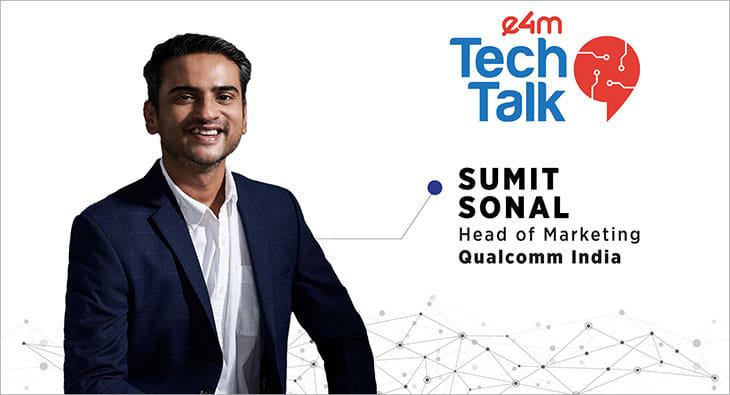

In a wide-ranging conversation with exchange4media as part of the ongoing TechTalk series, Sumit Sonal, Head of Marketing at Qualcomm India, shares his journey through India’s consumer tech landscape and how Qualcomm is shaping its brand presence in a rapidly evolving, AI-first, device-forward world.
Speaking to exchange4media, Sonal dives deep into Snapdragon’s transformation from a behind-the-scenes component to a household brand name, reveals key strategies that drive Qualcomm’s consumer and B2B storytelling, and offers insights into how on-device AI is changing the marketing and tech game.
Sonal, who joined Qualcomm about a year and a half ago, has had a storied journey through some of India’s most prominent tech and consumer brands. “I started my career in 2010 as a media planner,” he says. “My first job was with Intel, back in the desktop days when Core2Duo was being launched.” Following that, he worked with Harman (overseeing brands like JBL and AKG), then moved to Myntra where he helped build brands like Roadster, HRX and Wrogn. At Xiaomi, he was part of Manu Jain’s core marketing team before taking a sabbatical and eventually joining Qualcomm.
Central to Qualcomm’s India strategy, according to Sonal, is the twin branding approach of Qualcomm and Snapdragon. “There are two brands in India which we lead with. Qualcomm remains the mothership. The consumer-facing brand is, of course, Snapdragon. So, we are building both the brands together,” he explains.
The brand’s growing visibility is underpinned by a strong physical presence across India’s tech hubs, from Bangalore to Hyderabad, Noida and Chennai, with thousands of employees. “We have our own design center here. So the idea is, how do we localize our efforts into the India market? That is something which we are leading with,” says Sonal.
While Snapdragon powers premium smartphones across manufacturers, Sonal is quick to note that their ambitions go far beyond the mobile screen. “We are building big on automotive. For example, the latest Mahindra electric launches are actually powered by Snapdragon.” He adds that India sold over four million passenger vehicles in 2024 for the first time, indicating rapid premiumization.
The compute category is another growth area. “We’re now bringing in the same performance in the compute segment. We have partners like Asus, Acer, Dell already onboarded to use Snapdragon-based chipsets.”
XR is where Qualcomm is pushing hard. “You must have seen the latest launch: the Ray-Ban Meta glasses. It was a tri-party collaboration between Meta, Luxottica and Snapdragon. These are places where Snapdragon has a direct connect to consumers.”
For a company primarily known for what’s inside the box, making that brand visible outside the packaging is a challenge Sonal embraces. “At the end of the day, we are a component manufacturer. So you can't touch the brand, you can't see the brand. But everything which you do on your favorite devices is actually powered by Snapdragon.”
Yet, awareness numbers suggest the brand is breaking through. “We ran a quick brand study very recently. At a brand preference level, when I say the word Snapdragon, we’re at 82% in the India market. In terms of brand awareness, we’re at 76%. And we’ve now pushed our closest competition below 10% brand preference.”
Sonal credits this to both marketing innovation and a commitment to localised storytelling. “You must have seen a lot of international brands just do a copy-paste job in the India market, right? We don’t do that,” he says. He cites their recent Snapdragon Zones launched in Croma stores as an example. “You’ve never seen a Snapdragon branded table in Croma. Never before.”
That localisation extends to language and content. “I cannot be a distant brand. I cannot be an American brand trying to educate or come closer to my Indian customer. I have to talk the same language as my customer.”
Much of this strategy is enabled by what Qualcomm calls its Snapdragon Insiders community. “We have almost 20 lakh insiders in the India market. These are people who’ve seen the brand grow and become part of their lives.” He adds, “People do not buy from brands anymore. People buy from other people.”
Another vector for their storytelling is co-marketing with OEMs. “The more closely we work with our OEM partners, whether it be Samsung or iQOO, they are also now very well capable of pushing the same narrative inside their larger consumer base.”
Of course, AI looms large over any conversation in the tech space. Qualcomm is betting heavily on on-device AI, rather than relying on cloud-based computation. “We are basically pitching that AI capabilities now need to lie inside your mobile phone, inside your computer, instead of relying completely on the cloud,” says Sonal. “Why is it important? Especially in the India context—privacy and latency. There are still pockets of this country where connectivity is a challenge.”
The company is integrating AI across form factors, from smartphones to cars. “We’re building use cases like live translation, personalization, and road safety. For example, can the car customize itself based on who’s driving—whether it’s you or your wife?”
When it comes to large language models and generative AI, Qualcomm is building flexibility into its stack. “We work very closely with Google's team on Gemini. We also work closely with the ChatGPT team. It’s completely on our OEM partners which LLM they want to play with. We reduce that workload.”
Sonal points to recent case studies that reflect this philosophy. “Last year, we developed a specific chip with Xiaomi to enable a ₹8000 5G phone in India. At IMC, even before the product launched, we did a first look reveal. We had 1.3 lakh people in three days.”
He adds, “We also took Royal Enfield, the first Indian automotive player, to CES this time. Their first electric bike, Flying Flea, is powered by our chipset 2290. The entire bike was shipped to Vegas and displayed at our CES booth.”
Sonal believes Qualcomm’s edge lies in this hybrid capability: deep tech paired with high-impact marketing. “When you work with us, you don’t only get the finest chipset. You get the right marketing support for a successful product launch.”
Looking ahead, Sonal is optimistic. “Things will continue to evolve in the next few years. But as a team, are we ready? Yes. Are our partners benefitting from this readiness? One hundred percent, yes.”
As the conversation winds down, Sonal reiterates Qualcomm’s mission in India. “We’re here not just to sell chipsets, but to build the India technology story—brick by brick.”
Read more news about Digital Media, Internet Advertising, Marketing News, Television Media, Radio Media
For more updates, be socially connected with us onInstagram, LinkedIn, Twitter, Facebook, YouTube & Google News