Programmatic needs to move beyond impressions to intent & signals: Hemant Arora
Hemant Arora, VP – Global Ad Business, Truecaller, was speaking at the e4m Real Time Programmatic Advertising Conference 2026
 by
by
Published: Oct 6, 2026 4:56 PM | 5 min read
 Follow Us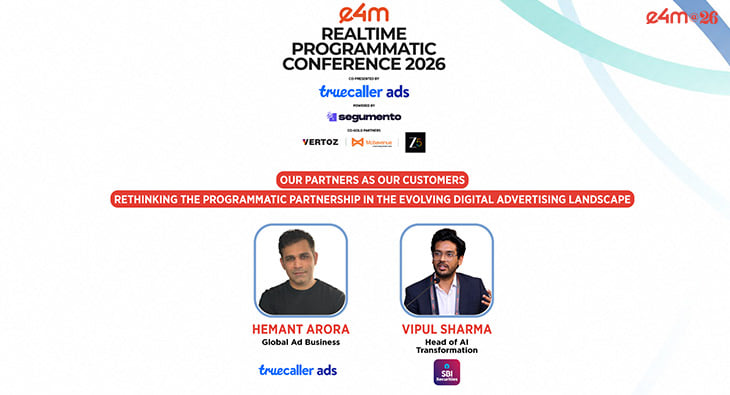

- Hemant Arora, VP of Global Ad Business at Truecaller, emphasized the need for programmatic advertising to focus on understanding consumer intent and context, rather than solely on impressions and audience data, during the e4m Real Time Programmatic Advertising Conference 2026.
- Arora highlighted the importance of distinguishing between data and signals, stating that signals provide deeper insights into consumer intent and behavior, which can enhance the value of impressions in advertising.
- He called for greater transparency in measurement between platforms and programmatic partners, advocating for continuous assessment of consumer behavior to improve advertising effectiveness.
- Arora discussed the integration of AI in Truecaller’s advertising operations, stressing the importance of maintaining consumer trust and personalization, rather than reducing individuals to mere data points or targets.
Programmatic advertising needs to move beyond the traditional focus on impressions and audience data, with publishers and platforms increasingly required to understand the intent and context behind consumer actions, said Hemant Arora, VP – Global Ad Business, Truecaller, at the e4m Real Time Programmatic Advertising Conference 2026.
Speaking at a session titled ‘Our Partners as Our Customers: Rethinking the Programmatic Partnership in the Evolving Digital Advertising Landscape’, Arora said the value of an impression cannot be assessed in isolation and depends heavily on the context in which it occurs.
Truecaller currently has half a billion users globally and processes 10 billion+ calls a day, while serving approximately six billion impressions daily, Arora said. At this scale, he argued, understanding the signals around an interaction becomes as important as measuring the impression itself.
“People talk about impressions, and then we talk about how the value of each impression changes with the context that it is in,” Arora said.
He described Truecaller’s “after-call moment” as a distinct advertising environment, where users interact within what the company positions as a trust-based communication environment. For Arora, the larger opportunity for the programmatic ecosystem lies in understanding what happens around an impression rather than treating every impression as an identical unit of inventory.
“It's become really, really important to understand what is really going on behind each of those impression partners. And I think that's why this topic is so brilliant, which is, you know, our partners as our customers,” he said.
From data points to signals
A key distinction Arora drew during the discussion was between data and signals. While data can provide demographic or numerical information, signals can offer a better understanding of consumer intent, he said.
“Data is the numeric value. I think signals is more in terms of understanding,” Arora said.
Using a phone call as an example, he explained that a call typically involves an intent, followed by an action. That intent could be commercial or emotional, while the action after the call can provide another indication of what the consumer was trying to do.
“The movement is very simple. It's intent, call, action,” he said, adding that developing these signals is an ongoing process rather than something with a fixed endpoint.
Arora also challenged the conventional interpretation of certain consumer actions. A disconnected or blocked call, for instance, may conventionally be viewed as a low-value interaction. But he argued that it could indicate a highly valuable audience.
“If you turn this entire thing around, the people who are disconnecting their call are probably the most premium audiences to be able to reach to,” he said. Such users could be in meetings or otherwise engaged, meaning their decision to disconnect may itself reveal something about their current intent and context.
Measurement becomes central to the partnership
For Arora, the relationship between platforms and programmatic partners also needs to involve greater transparency around measurement.
He said Truecaller works with its programmatic partners to understand what they are buying, the traffic and intent signals they are looking for, and how buying behaviour changes in real time.
Measurement, he added, cannot remain a one-time exercise because consumer behaviour changes across the purchase funnel, time of day and seasonal periods.
“Measurement is a very, very key part. And measurement is also a consistent science. There is no finish line over there,” Arora said.
He compared the process to a retailer providing sizes on clothes rather than making customers try products randomly, arguing that publishers and platforms need to make it easier for advertisers to understand whether their campaigns are working.
AI enters the auction and optimisation layer
Arora also outlined three areas where AI is being integrated into Truecaller’s advertising business.
The first is its recommendation suite, which is being used for performance. The second involves bridging the gap between the required cost per action and the platform itself. The third is the auction layer, where AI is being used in a dynamic equation involving fill and price.
“That dynamic equation in real time [works] between fill and the price, given the time of the day, time of the week, time of the month, time of the year, the market and the formats,” Arora said.
However, Arora said the use of AI should not result in consumers being reduced to data points or targets. He argued that the industry needs to distinguish between how advertisers internally define audiences and how consumers experience those interactions.
“As a consumer, I would hate to be known as a data point for any company,” he said. “I don't think I ever want to be called a target anywhere.”
According to Arora, targeting should remain an internal mechanism for identifying potential demand, while the consumer-facing outcome should be personalisation rather than a feeling of being tracked or hunted.
Trust remains the underlying currency
The conversation also touched on Truecaller’s broader focus on spam and scam protection. Arora said the company’s advertising business ultimately operates on the same foundation as its consumer proposition: trust.
“Trust is a manifestation,” Arora said, arguing that the environment around advertising needs to be built on trust if brands expect consumers to engage with their messages.
He pointed to Truecaller’s Family Protect feature and its recently launched Scam Checker as examples of how the platform is expanding its role from identifying spam calls to creating a broader trust layer for communication.
For the programmatic industry, Arora’s larger argument was that the next stage of advertising infrastructure will not be defined only by more automation or more impressions. It will depend on how effectively platforms, advertisers and technology partners interpret signals, measure outcomes and preserve consumer trust while doing so.
Read more news about Digital Media, Internet Advertising, Marketing News, Television Media, Radio Media
For more updates, be socially connected with us onInstagram, LinkedIn, Twitter, Facebook, YouTube & Google News
