‘Programmatic advertising set to capture 30-40% of traditional media budgets by 2027’
At e4m Real-Time Programmatic Advertising Conference 2025, experts discuss evolving landscape of e-commerce marketing
 by
by
Published: Sep 19, 2025 7:07 PM | 5 min read
 Follow Us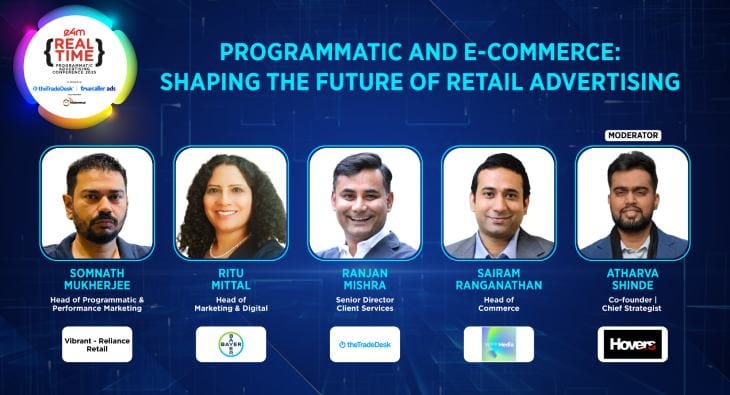

Industry leaders Somnath Mukherjee (Vibrant - Reliance Retail), Ritu Mittal (Bayer), Ranjan Mishra (The Trade Desk), and Sairam Ranganathan (WPP Media) gathered at the e4m Real-Time Programmatic Advertising Conference 2025 to discuss the evolving landscape of e-commerce marketing, predicting significant shifts in media budget allocation and consumer targeting strategies over the next three years.
Somnath Mukherjee, Head of Programmatic and Performance Marketing at Vibrant - Reliance Retail, revealed that programmatic advertising has already captured 15-20% of traditional media budgets in 2023-24, with projections showing this could reach 30-40% within the next two to three years.
"More and more budgets from print, TV, that we don't have a unique measurable factor, are being shifted to programmatic, thanks to the quick turnaround, the DCOs, the real-time management, the measurement, the multiple-touch attributions," Mukherjee explained during the panel discussion moderated by Atharva Shinde, Co-Founder and Chief Strategist at Hovers.
The growth trajectory varies significantly across industries, with fashion, retail, and particularly healthcare showing the most dramatic adoption rates.
Ritu Mittal, Head of Marketing and Digital at Bayer, emphasized that programmatic adoption is fundamentally driven by changing consumer behavior patterns. Within healthcare, she noted distinct differences across product categories.
"Nutrition, specifically nutraceuticals and derma is a space which has seen a lot more online shopping behavior versus pain and allergy categories," Mittal observed. "These categories see consumers not just purchasing but also doing their discovery on digital platforms, identifying new brands, learning about formulations, and then making choices."
This consumer shift toward online discovery and purchasing has created more accurate data signals, enabling sharper audience targeting and improved conversion rates for brands willing to invest in programmatic solutions.
Sairam Ranganathan, Head of Commerce at WPP Media, highlighted the superior performance of campaigns that integrate first-party data with programmatic advertising. When brands overlay their proprietary customer data on standard third-party demand-side platforms (DSPs), the results show measurable improvements in both media metrics and brand lift studies.
"We are seeing the second level of delta when we superimpose first-party data because we know what these users are, we know some of their attributes, and if we are able to customize the communication and personalize it," Ranganathan explained.
The integration focuses on three key data layers: purchasing behavior signals, brand affinity attributes, and engagement history with brand destinations or experiences.
Ranjan Mishra, Senior Director of Client Services at The Trade Desk, positioned retail data as the most deterministic signal available to marketers, particularly in the absence of robust first-party data collection.
"The best signal is the customer's data signal, because that's the best behavior that you can find about a customer," Mishra stated, referencing insights from The Trade Desk's CEO Jeff Green. "In the diverse India market, particularly for CPG brands, retail data becomes the next best deterministic signal available."
Mishra emphasized that programmatic advertising's value extends beyond traditional bottom-funnel, ROAS-based campaigns, advocating for performance measurement across all funnel stages and channels to achieve true incrementality.
The panel identified the rapid growth of quick commerce as a significant driver for programmatic advertising adoption. Mukherjee explained how real-time optimization capabilities make programmatic particularly effective for instant delivery scenarios.
"Programmatic allows the user to be touched across multiple points, multiple different modes of communication, and we can optimize on a real-time basis," he said. "We use huge e-commerce first-party data for precise targeting - user viewing history, browsing history, wish lists, and cart contents."
This real-time capability enables brands to target consumers based on immediate intent signals, such as items in wish lists or shopping carts, leading to higher conversion rates for quick commerce platforms.
The discussion revealed ongoing challenges with attribution modeling as e-commerce customer journeys become increasingly complex across multiple touchpoints - from retail visits to website browsing, mobile apps, and offline purchases.
Mishra criticized over-reliance on last-click attribution models, arguing for more comprehensive measurement approaches. "You need to be in the hearts and minds of people who are going to make that purchase. It's always a zigzag journey for all consumers, and it's important to identify all these signals."
Ranganathan added that WPP Media has developed measurement frameworks for omni-channel brands that can attribute the offline impact of online advertising investments, providing ROI calculations across both digital and traditional retail channels.
D2C Brands Face Unique Programmatic Opportunities
The panel addressed the specific challenges facing direct-to-consumer brands in adopting programmatic advertising. While many D2C brands initially focus on Meta and Google advertising due to competition and budget constraints, Ranganathan suggested a phased approach to programmatic adoption.
"The first phase is about completely saturating what they can do from a digital standpoint, understanding the correlation between brand building and performance," he explained. Brands typically transition to programmatic and omni-channel approaches after hitting saturation points in traditional digital channels, often accelerating from an 12-18 month timeline to just 5-6 months.
Looking toward emerging formats, the panel discussed the underutilization of catalog-based native advertising and dynamic creative optimization (DCO) in e-commerce. These formats combine real-time inventory data with location-based targeting to create more relevant ad experiences.
The discussion highlighted the need for brands to move beyond simple interest-based targeting toward in-market audience identification, enabling more precise customer acquisition strategies. The experts agreed that the future of programmatic advertising lies in the convergence of multiple marketing functions, moving away from rigid funnel distinctions toward integrated measurement and optimization approaches.
As Mittal concluded, "This is complementing the basic brand building, not replacing it. None of this is a replacement for building the brand for the future. It's about complementing each other, not working in isolation."
The panel's insights suggest that e-commerce brands investing in programmatic advertising infrastructure today will be best positioned to capitalize on the continued shift of marketing budgets away from traditional media channels over the coming years.
Read more news about Digital Media, Internet Advertising, Marketing News, Television Media, Radio Media
For more updates, be socially connected with us onInstagram, LinkedIn, Twitter, Facebook, YouTube & Google News
