What does the new world of work demand from communicators?
Indeed’s Saumitra Chand on how AI is reshaping hiring and comms strategies, building reputation, employer brand, fixing agency-client relationships and preparing communicators for AI-led future
 by
by
Published: Oct 6, 2026 12:10 PM | 11 min read
 Follow Us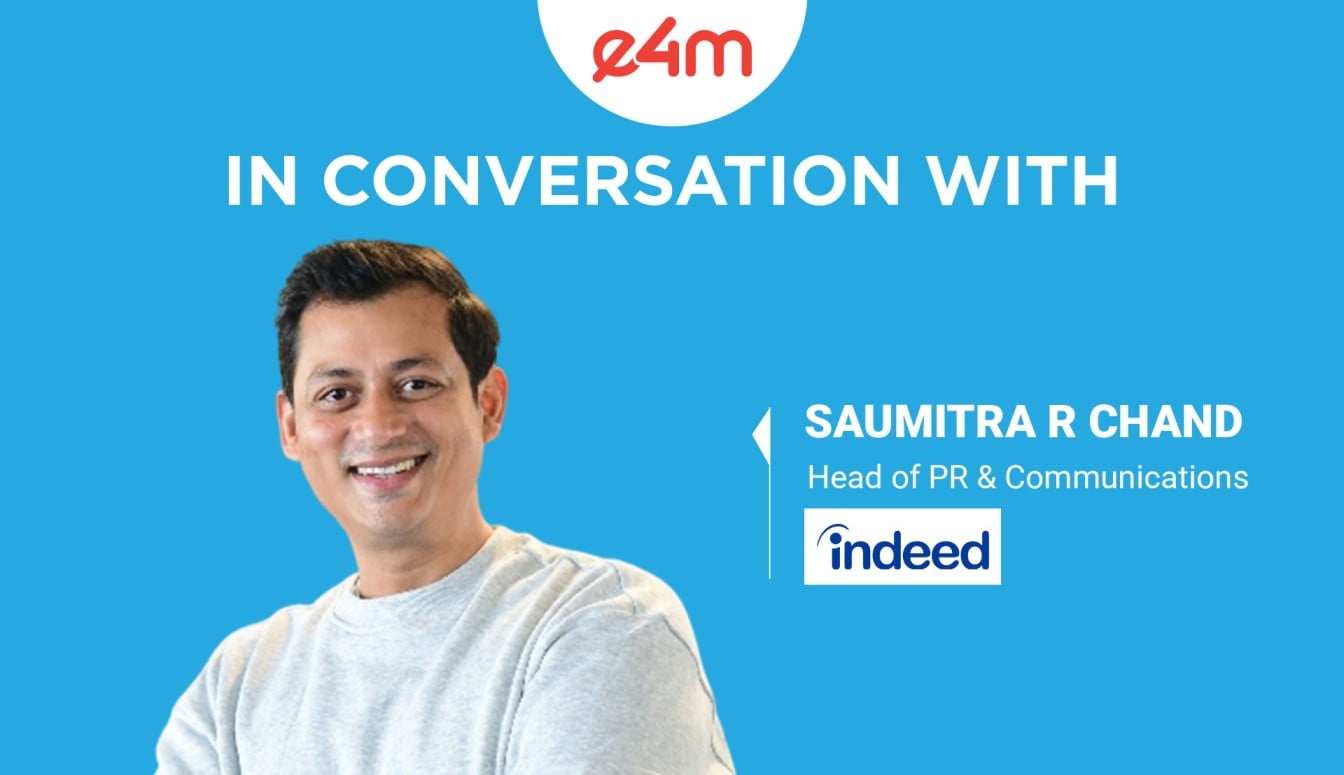

- The demand for AI-related skills in India is rising, with 14% of job postings mentioning AI in January 2026, up from 8.9% the previous year, while 46% of employers report faster hiring processes.
- Communications leaders are now expected to engage earlier in business discussions, focusing on building corporate reputation through genuine employee experiences rather than polished campaigns.
- The role of communications is evolving to include strategic thinking and understanding the business environment, with an emphasis on building trust and reputation as tangible assets.
- Younger communicators bring technological comfort and a willingness to challenge norms, but often lack a deep understanding of business complexities, highlighting the need for broader contextual knowledge in the profession.
The conversation around AI has shifted from future of work. It is already changing what companies hire for, what employees worry about and how candidates decide where they want to work. In January 2026, 14% of job postings in India mentioned AI, up from 8.9% a year earlier. At the same time, 46% of Indian employers said their hiring processes were moving faster than they were a year ago.
For communications leaders, this shift makes the job considerably more complicated. Employer brand can no longer be built through polished campaigns alone, while corporate reputation increasingly depends on what employees, candidates and communities experience, and say, about an organisation.
With Indeed sitting at the intersection of jobs, talent and workplace conversations, Saumitra Chand, Head of PR & Communications – India and Singapore, Indeed, brings a ringside view of how AI is reshaping hiring, skills and expectations and what that means for communicators.
In a conversation with e4m, Chand talks about why communicators are increasingly expected to be business advisers, why communications capital has to be built before a crisis, and why employer brand needs to start with employee experience rather than campaigns. He also weighs in on how agency-client relationships need to evolve, what younger communicators often miss about business, how AI will change communications, future of the industry, and more.
Excerpts:
Your work at Indeed sits at the intersection of communications, careers and the future of work. With AI changing jobs, skills and employer expectations, how do you approach communications in a business where employer brand, workplace conversations, talent and trust are closely interconnected?
That's what makes working in this space particularly interesting. Work is changing, but it's also incredibly personal. AI, skills, job security, pay and career progression aren't abstract business topics for people, they directly affect their lives.
So for me, the starting point is always to understand what is genuinely happening in the world of work and where we can contribute something meaningful to that conversation.
At Indeed, we have access to a unique perspective through our data, our platform. The challenge is not simply to talk about what Indeed is doing. It is to use those insights to help people better understand what is changing around them.
When it comes to corporate reputation, I don't think there is one magic playbook. But there are a few principles I strongly believe in. First, have something meaningful to say. Second, make sure your actions support your narrative. Third, be consistent. And finally, don't try to control every conversation about your company.
The last one is increasingly important. Reputation today is shaped by many voices, including employees, customers, former employees and communities. Communication has to listen as much as it speaks.
Over the course of your career, what is the biggest shift you have seen in the role of communications? What does the business expect from communicators today that it didn’t a decade ago?
A decade ago, in many organisations, communications would often be brought in towards the end: "Here's what we're doing, now help us tell the story." Today, the expectation is increasingly that communicators should be part of the conversation much earlier.
Businesses expect us to understand the external environment, anticipate stakeholder reactions, identify risks and opportunities, and sometimes challenge decisions before they become public.
The other major shift is measurement. We can't just say, "We got great coverage" and leave it there. Leaders increasingly want to understand what communications are actually contributing to the business. Is it building trust? Is it changing perception? Is it supporting talent attraction, customer confidence or market positioning?
I also think the speed of the world has changed dramatically. A company's reputation can now be shaped by a social media conversation just as much as a carefully planned corporate announcement.
So communicators today need to be part strategist, part storyteller and part business adviser. You need to understand the business well enough to know when to communicate, what not to communicate and, sometimes, when the organisation itself needs to change before communications can solve the problem.
In an environment where companies are under constant scrutiny, is communications capital becoming a business asset? And how should organisations actively build it rather than reach for it only during a crisis?
Absolutely. I think trust and reputation are becoming increasingly tangible business assets, even if they don't always show up neatly on a balance sheet.
The interesting thing about communications capital is that you can't really build it overnight when something goes wrong. If your first meaningful conversation with your stakeholders happens during a crisis, you are already starting from a difficult position.
Organisations need to build that capital consistently. That means communicating even when you don't have a big announcement. It means having a clear point of view, being transparent where possible and building genuine relationships with employees, customers, media and other stakeholders.
But there is also an important distinction here: you cannot communicate your way into trust if the underlying experience doesn't support it. Reputation is ultimately the sum of what people experience and what they hear about you.
The role of communications, therefore, is partly to help the organisation understand those gaps early. If there is a disconnect between what a company says and what people experience, that eventually becomes a reputation issue.
The companies that handle crises well are usually not the ones with the best crisis playbook sitting in a folder. They are the ones that have built enough credibility before the crisis that people are willing to give them a hearing when something goes wrong.
Having experienced both sides of the agency-client relationship, how do you think it needs to evolve? What do brands need from agencies today beyond media relations and execution?
I do think the relationship needs to evolve. Brands today don't just need agencies that execute briefs. They need partners who understand the business well enough to challenge the brief in the first place.
Media relations will always remain important, but the communications environment has become far more complex. Agencies need to bring stronger strategic thinking, audience intelligence, creative storytelling, data and an understanding of the broader cultural and business environment.
I personally value agencies that can tell me, "This isn't the right story," or, "There is a better opportunity here." That's far more valuable than simply agreeing with everything a client says.
At the same time, clients also need to change how they work with agencies. You can't expect an agency to act like a strategic partner if you only bring them in at the execution stage and don't give them enough context about the business.
The best agency relationships, in my experience, feel less transactional. There is clarity about the business objective, honesty on both sides and a shared understanding that not every piece of work needs to look like a traditional PR campaign.
The real value increasingly comes from bringing together different perspectives to solve a business or reputation challenge, not just getting more coverage.
What are younger employees demanding from corporate communication that organisations are still failing to understand?
Employees are now among the most influential voices a company has. They are on social media, online communities they are talking to their networks and they are shaping how others perceive their organisations, often in ways that no communications team can fully control.
That doesn't mean companies should try to control employee conversations. In fact, that would probably be counterproductive. The focus should be on creating an environment where people are well-informed, trusted and comfortable raising concerns.
A strong external reputation that is completely disconnected from the internal reality will eventually fall apart. So, yes, internal communication isn't just an employee engagement function anymore. It is very much a reputation function.
What is your playbook to build an effective corporate reputation? Is “employer brand” itself due for a reset?
For too long, employer branding has sometimes been treated as a marketing exercise, beautiful campaigns, office photographs and statements about culture.
People are becoming much more discerning. They want to know: What is it actually like to work here? How are people treated? Do leaders do what they say? Are there opportunities to learn and grow?
Employer brand, therefore, can't just be something the communications or HR team creates. It is the lived experience of employees. Communications can help articulate that experience, but it cannot manufacture it.
AI is rapidly changing how information is created, consumed and discovered. How do you see it reshaping the communications function, and what skills will become more valuable for communicators?
AI is going to change communications quite significantly, but I don't think the biggest impact will simply be that it helps us write faster. Yes, it will make many aspects of our work more efficient. Research, monitoring, summarising information and creating first drafts can all become faster.
But that also means the baseline is changing. If everyone has access to the same tools and can produce decent content in seconds, then the real differentiator becomes judgment. Knowing what matters, what doesn't, what is credible, what could create risk and what genuinely deserves a point of view will become much more valuable.
I also think communications professionals will need to become better at understanding how information itself is changing. People are increasingly discovering information through AI-powered search, social platforms, creators and communities, not just traditional media. So the skill set will have to evolve. Strategic thinking, curiosity, data literacy, audience understanding and the ability to exercise sound judgment will become even more important.
Ironically, I think the rise of AI will make the human side of communications more valuable, not less. Empathy, relationships, intuition and understanding context are things that cannot simply be automated away.
What are you seeing in young communicators that the industry should pay attention to? And what are they entering the profession completely unprepared for?
There is a lot that is encouraging about younger communicators. They are naturally comfortable with technology, they understand digital culture instinctively and they are often less constrained by the traditional boundaries of PR, marketing, content and social media. That is a real advantage because the communications profession is becoming much less siloed.
I also think younger professionals are more willing to question established ways of working. Sometimes that can be uncomfortable, but the industry needs that challenge. Where I think many people enter the profession unprepared is in understanding how businesses actually work.
Communications can look very exciting from the outside, you see campaigns, media stories and social media moments. But a significant part of the job is understanding complex businesses, navigating multiple stakeholders, managing ambiguity and sometimes dealing with situations where there isn't an obvious answer.
I also think there is a danger in focusing too heavily on tools and tactics too early. Knowing how to create content is useful, but understanding why a business needs to communicate something, who needs to hear it and what outcome you are trying to achieve is much more important.
My advice to young communicators would be to become genuinely curious about the world beyond communications. Understand business, technology, economics, politics and culture. The more context you have, the better communicator you will become.
You began in radio, moved into PR, then worked with Ola during the early years of India’s platform economy, and have spent nearly a decade at Indeed. How did you come across communications? How has moving across such different ecosystems shaped your understanding of what makes communication actually work?
I came into communications almost by accident and over time found myself working across very different, young, entrepreneurial, transformative and ambitious businesses and industries.
What that journey taught me is that communication only really works when you understand the person on the other side. Radio taught me about audiences, communications taught me about relevance and credibility, and working in fast-changing businesses taught me to be comfortable with ambiguity.
The medium keeps changing, but that part hasn't changed for me: know your audience, have something worth saying, and don't make it sound like a press release.
Looking ahead, what do you think will fundamentally change the communications profession over the next five years, and what do you personally want to be building, learning or exploring in this next phase of your journey?
I think the next five years are going to make communications a lot more interesting. AI will change how we create and consume information, the boundaries between PR, marketing, content and reputation will continue to blur, and I think communicators will have to be much closer to the business than they have traditionally been.
It is important to stay curious and spend more time exploring the intersection of communications, technology, careers and the future of work. And honestly, I don't have a perfectly mapped-out five-year plan. I quite like that. Some of the most interesting parts of my career so far weren't things I had planned years in advance.
If I can keep doing work that challenges me, keep meeting interesting people, stay useful to the people I work with and still be excited to get up and go to work, I'd consider that a pretty good next chapter.
Read more news about PR and Corporate Communication News, Internet Advertising, Marketing News, Digital Media News, People Movement News
For more updates, be socially connected with us onInstagram, LinkedIn, Twitter, Facebook YouTube & Google News
