Sarah Gideon & her journey of purpose & mastering the art of communications
In this feature, Sarah Gideon, VP, Corp Comm & CSR, Flipkart talks about her evolution as a communicator in India’s fast-changing communications ecosystem and trends that will transform the industry
 by
by
Published: Nov 3, 2025 1:41 PM | 11 min read
 Follow Us

Behind every great brand story is a team that unites people, purpose, and growth. Sarah Gideon - Vice President - Corporate Communications and CSR at Flipkart, leads a team that manages communications for one of India’s leading e-commerce companies, communicating stories that reflect its people, partners, and purpose.
With over two decades of experience in steering global communication campaigns, her professional journey is a masterclass in adaptability and leadership. She leads with a rare combination of strategic foresight and human insight. Today, her evolution from a passionate communicator to a strategic leader mirrors the transformation of the communications landscape itself.
In this feature, we explore Sarah Gideon’s journey, how she entered the industry, the transformation she has witnessed, her approach to crisis communication, how she tailors strategies to connect across India’s vast cultural spectrum, the emerging trends that will transform the industry, and the key lessons that young professionals should adapt to thrive, and more.
Excerpts:
How did you start in the communication industry and what inspired you to enter it?
I began my career in the corporate sector, starting in banking and subsequently moving into merchandising. These early professional experiences provided me with a strong foundation in business operations and helped shape my understanding of diverse industries before I discovered my true calling in communications. A friend told me about a PR agency called 20:20 Media, which managed communication and public relations for technology companies in India. I joined them as a management trainee, and that’s how my journey in the communication industry began.
I decided to stay in the profession because I genuinely enjoyed the work and found myself surrounded by like-minded people who were on the same wavelength. Finding a workplace where you can connect and engage with people like that is a real win. Over time, as I gained more exposure to different companies and experiences, my interest in the field grew. And, I’ve remained and grown within the industry ever since.
You have worked in various industries, how did these experiences help you grow as a communications leader?
Early in my career, when I was with an agency, I handled several technology clients, including Intel, which in 2004 was at the forefront of innovation, Google, Canon, and many more. Thereafter, I worked at Infosys for over a decade, leading global communication mandates. This exposure to working in technology, IT services, and e-commerce taught me the importance of simplifying complex, jargon-heavy concepts and communicating them in a clear, engaging, and easily consumable manner for diverse audiences.
Over time, moving into consumer-focused roles like my current position at Flipkart, which encompasses technology and consumer engagement, has deepened my appreciation of how technology impacts people’s lives.
From a leadership perspective, a few personal milestones have also shaped my growth. When my children were born, I became much more focused and efficient with my time, learning how to balance priorities and commitments effectively. As I grew professionally, I learned the importance of building and empowering teams, understanding my function in the larger organizational context, and thinking like a business owner rather than just a communicator.
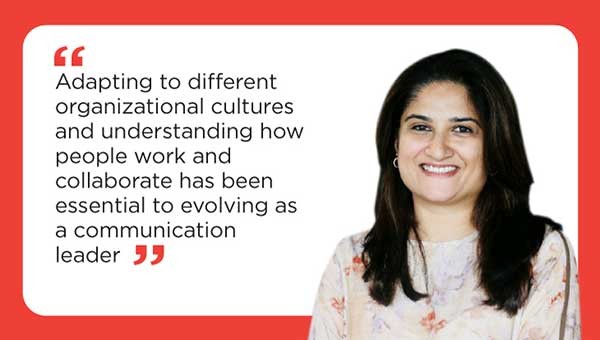
Finally, across every industry and company I’ve worked with, I’ve learned that culture is critical. Adapting to different organizational cultures and understanding how people work and collaborate has been essential to evolving as a communication leader.
Given Flipkart's diverse audience and e-commerce industry nature, how do you tailor your communication strategy to resonate with various cultural and regional sensibilities across India?
There are many “Indias” within India, and each one has different cultural contexts and nuances. Working in the consumer industry, we see this diversity every day. Different times of the year bring different festivals, traditions, and consumer sentiments across regions.
Other than the cultural aspects, there are also other socio-political factors that shape the environment.
As a company, we stay deeply rooted in local insights. Our extensive logistics network across the country, along with colleagues who are experts in specific markets, provides us with valuable on-ground understanding. We also have early warning systems that help us stay informed about emerging developments, allowing us to adapt our communication accordingly.
Regional engagement is a key focus area for us. We recognize that content consumption patterns differ widely across India. However, the digital ecosystem acts as a strong equalizer, enabling us to reach and engage consumers effectively regardless of where the content originates.
So, to stay relevant to our consumers, we emphasize localization, whether it’s through collaborating with nano-influencers, partnering with regional publications, or creating market-specific content. These efforts ensure our communication resonates authentically with diverse audiences across the country.
What is your favourite campaign for Flipkart from a regional perspective?
One of my favorite campaigns from a regional perspective would be “Minutes that move India,” which we did for Flipkart Minutes, our quick commerce business, shortly after it completed its first year. The campaign was built around consumer insights and understanding what India shops for and how shopping trends differ across regions.
For example, in Delhi, we found that ice cream was one of the most ordered items in the middle of the night, along with a few other interesting products. Insights like these helped us tell engaging, localized stories about consumer behavior across the country. It was a fun and insightful campaign that combined data, storytelling, and regional relevance beautifully.
What major transformations have you seen in the industry?
The two major transformations I would highlight are the speed of communication and the renewed importance of trust in content in this evolving landscape.
When I started, the technology landscape and the way we operated as communicators were completely different. Today, communication is seamless and incredibly fast. The biggest transformation I’ve observed is the speed of response and how quickly issues or crises emerge and evolve has completely changed the way we all work.
In addition, the type of content people consume has evolved. Earlier, traditional media was the main source of truth. Over time, influencers began occupying that space. Now, with the rise of artificial intelligence tools like ChatGPT or Google Gemini, people increasingly search for information online. Interestingly, even those AI tools often draw from authentic, traditional media sources. So, it’s almost come full circle from print and online media to influencers, and now back to trusted media as people seek credibility and try to avoid misinformation.
I look at crisis communications in two ways: short-term crises and long-term crises. Regardless of the nature of the crisis, it’s always important to view it from an organizational perspective rather than treating it solely as a communication or reputation issue. Often, the root of a crisis lies elsewhere in the organization, so it’s essential to approach it holistically.
Experience plays a critical role in understanding which crises require a full-scale response and which ones need to be managed with a measured approach. For short-term crises, the response must be swift and proactive, as these situations often fade as news cycles move on. However, long-term crises, which build up gradually, need deeper structural interventions to resolve.
Over my career, I’ve managed several critical crises, including serious operational incidents, reputational threats to complex corporate challenges. In every situation, I believe the most important aspect is to remain people-centered. The focus must always be on empathy, transparency, and informed decision-making.
A key principle I follow is to never take a crisis lightly, but also to ensure that every action is intentional. The intent to address a crisis may come through decisive action or, at times, through deliberate measured patience depending on what the situation demands.
How do you think AI is taking over the industry?
AI tools are great to use, and people should not be afraid of adopting and using technology because it is only going to enable and enhance their skill sets.
At the same time, interpersonal skills are very critical, especially in communications today. People like to work with people they like, and that human connection will always remain important. So, no matter how much technology evolves, you still have to invest in relationships and interpersonal skills, because that is not going to be replaced by AI.
Moreover, communicators should also start to think of themselves as a business; everyone is ultimately a business. Just like companies do R&D and planning, as an individual professional, you also need to invest in skill development, financial planning, and continuous learning.
AI is one such tool that communicators should invest in to increase their skill set. If you don’t learn to use it, you could potentially lose out on opportunities to add tremendous value. However, by no means is it going to take away from our profession, which is built largely on interpersonal relationships and trust.
Moreover, communicators should leverage AI for tasks like data analysis, personalization, research, and understanding trends, along with applying their judgment to ensure the accuracy of the content and numbers.
Lastly, AI should be viewed as a powerful enabler, and those who learn to use it effectively and invest in it will definitely benefit from it professionally.
What trends or developments are you most excited about and how is Flipkart planning to adapt to those changes?
The communications industry is undergoing a transforming shift. With the rise of the influencer economy, there’s a shift in how much earned content organizations can actually drive. Publications today have limited space, and with the massive amount of information available, cutting through the noise has become more challenging.
At Flipkart, we’ve been leveraging emerging trends, such as the growing use of AI in search and discovery. As people increasingly turn to AI tools and search engines, the true source of information will come from owned media platforms. These are platforms that can directly communicate authentic stories about an organization. For example, when someone searches on Google or interacts with a chat-based AI, the results often highlight owned media content or company-published stories. Hence, continued investment in owned media will be essential for Flipkart.
Another interesting development we’re seeing is the rise of employee advocacy. During our recent Big Billion Day Sale, many employees actively shared what was happening within the company. We saw this as an important opportunity to embrace our employees' authentic voices. We want our employees to become true ambassadors of the organization and share their perspectives transparently to humanize the brand and build trust.
In addition, there’s a noticeable shift in the evolution of content development. Earlier, this might have been a pure marketing function, but now it’s becoming increasingly integrated with communications. We’re seeing more cohesive collaboration between marketing and communications, with elements like paid content, influencer engagement, and campaign development aligned under a unified strategy. This integrated approach helps strengthen brand storytelling and consistency.
Finally, another key area of focus is the use of AI-powered monitoring systems. These systems help us identify emerging issues or trends early and proactively address them. Whether it’s through advanced media tracking or sentiment analysis, AI could enhance the ability to listen, learn, and respond effectively.
What would be your advise to young professionals entering this space?
I think being resilient is something I would emphasize because when you start your career, it can be quite overwhelming. The first year of working is often very challenging since it’s such a major change in your life. If you can grit your teeth and push through those first couple of years, that resilience makes a big difference. So, the simplest advice I’d give to anyone young is “Hang in there, it gets better.” Growth comes with time, and most of the things you’re aiming for will follow.
This is true as you progress through your career as well. It’s never a linear path; there are highs and lows, you need to have the resilience to take it in your stride - while also remembering that you have control over how you show up and what value you add. You must always stay true to yourself.
Read more news about PR and Corporate Communication News, Internet Advertising, Marketing News, Digital Media News, People Movement News
For more updates, be socially connected with us onInstagram, LinkedIn, Twitter, Facebook YouTube & Google News
