New resilience strategies fueling the communications industry growth
Industry leaders reveal how PR professionals can boost industry growth with innovative resilience strategies
 by
by
Published: Oct 27, 2025 7:00 PM | 8 min read
 Follow Us

Stiff deadlines, ever-demanding clients and endless networking challenges. Welcome to the world of PR & Communications - the ‘always-on’ industry, where crises rear their ugly heads at the drop of a hat and keeps professionals and communications on their toes.
But the everyday demands and pressures can often be overwhelming, leaving no room for a ‘switch off’. And before you know it, a quiet burnout creeps in and stress takes the toll.
Against this backdrop, an emerging hope is taking root that provides a kind of shield: resilience strategies. The new wave of resilience strategies is shifting the narrative from ‘perform or perish’ to ‘perform, pause and be at peace’. Not just that, these strategies are also giving professionals the opportunity to set real targets and psychologically safe workplaces.
It is no longer a question of navigating stress and burnout, but how to protect the peace by staying resilient: it is more about relentless balance than grit and toughness. That protection could be the key to thriving in PR’s next chapter.
In today’s feature, we’ve gathered honest resilience ‘Mantras’ from industry leaders, including Arpana Kumar Ahuja, AVP and Head, Corporate brand & communications, Jindal Steel Ltd., Anup Sharma, PR & Strategic Communications Advisor, Akanksha Jain, AVP-Public Relations & Communications, Swiggy, Upasna Dash, Founder & CEO, Jajabor Brand Consultancy Pvt. Ltd., and Shivaram Lakshminarayan, COO, RuderFinn.
Through this special feature, you can discover what recharging truly looks like for PR and communications professionals, understand the key factors that separate thriving professionals from those struggling to keep up, learn how the industry is safeguarding people’s psychological well-being, and pick up non-negotiable boundary-setting practices that you can apply in your own work and fuel your growth.
Excerpts:
What does recharging truly look like for a PR professional, and how do you keep up?
PR as a profession is in an 'always-on' mode and very deadline oriented, which gets taxing. Unfortunately, it cannot be “Offline mode: activated”, Anup Sharma, PR & Strategic Communications Advisor says, defining the industry's inelastic nature.
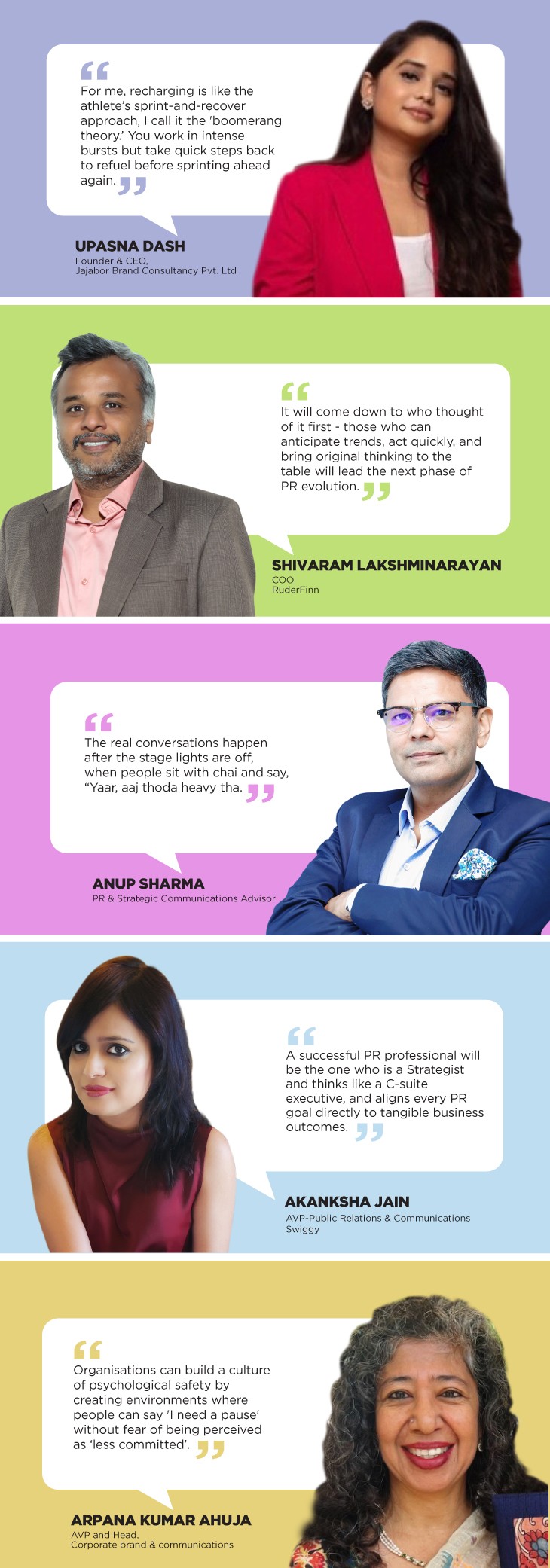
Upasna Dash, Founder & CEO, Jajabor Brand Consultancy Pvt. Ltd. shares her secret by stating, “For me, recharging is like the athlete’s sprint-and-recover approach, I call it the 'boomerang theory.’ You work in intense bursts but take quick steps back to refuel before sprinting ahead again. It could be disconnecting for a day, spending time with loved ones, or traveling.”
Shivaram Lakshminarayan, COO, RuderFinn suggests professionals choose upskilling and learn new trends as a way to refresh. “Recharging today goes beyond stop-refresh—it’s about constantly upgrading yourself. With AI and new tech reshaping communications, staying relevant means learning, unlearning, and experimenting,” he says.
Akanksha Jain, AVP-Public Relations & Communications, Swiggy says recharging means taking time to unwind and refresh your mind. She believes in unplugging occasionally, spending time with loved ones, appreciating life beyond work, and reflecting on important priorities.
Anup Sharma further defines resilience not as being strong all the time, but as bending, breathing, and slowly rising again through daily learning and unlearning. He resets through unfiltered storytelling and the depth of his experiences.
Arpana Kumar Ahuja, AVP and Head, Corporate brand & communications, Jindal Steel Ltd believes in carving time to think without reacting, to read beyond the domain, and to observe the world with curiosity to keep one’s mind elastic in a high-demand profession.
How do you define out-of-the-box thinking, and how can professionals achieve that?
Shivaram Lakshminarayan explains that out-of-the-box thinking isn’t always about wild creativity; it’s about doing the usual things in completely unusual ways. It’s finding new ways to reach your audience – not by speaking louder, but by letting them speak for you.
Akanksha Jain shares an example from the crisis campaign she led at BharatPe. “During the crisis, we decided to own the narrative and ensured that the trust in the brand is not impacted. The CEO gave interviews from time to time to reiterate the focus on business growth. Statements from the brand aimed at ensuring transparency at all times and putting the right narrative across,” she recounts.
Arpana Kumar Ahuja took the bold step of redefining success by not chasing earned media visibility but building brand equity through substance like consistent thought leadership, narrative ownership, and credible storytelling.
Anup Sharma advises professionals to speak like real people, pausing, adding a touch of humor, and including local references, rather than aiming to “sound polished” or overly corporate.
Upasna Dash explained that at Jajabor, she leverages the candid approach of speaking their truth and sharing honest ideas. “It’s like being a doctor, you don’t just say yes to everything; you tell the patient what’s best,” she adds.
In the coming years, what factors will be the key differentiators between a PR professional who is thriving and one who is struggling to keep up?
The ones who keep saying “I know this already” will struggle. The ones who keep asking “What else can I understand here?” will grow, Anup Sharma asserts.
Arpana Kumar Ahuja guides professionals to focus on depth over speed. “The ability to think critically, connect dots across disciplines, and stay authentic amid noise will define relevance,” she emphasizes.
Shivaram Lakshminarayan defines speed, agility, and creativity as key differentiators in the coming years. “It will come down to who thought of it first - those who can anticipate trends, act quickly, and bring original thinking to the table will lead the next phase of PR evolution,” he believes.
Akanksha Jain urges professionals to upskill themselves and become proactive planners and strategists. “PR professionals will need to leverage data to devise interesting storylines, and use social listening tools and analytics to identify trends and showcase impact.”

What are your non-negotiable boundary-setting practices?
Upasna Dash states that boundaries in PR aren’t black and white, but she prioritizes outcome over hours.
Anup Sharma shares his transformation, “Earlier, I used to jump to reply to messages like it’s a fire emergency. Now I take a pause. I tell myself, “Message aaya hai, FIR nahi.”
Arpana Kumar Ahuja says that a rested mind is sharper than a stretched one and urges professionals to follow clarity of purpose and calendar discipline as non-negotiable boundary-setting practices. She guides to draw clear lines for creative recovery, with no guilt about switching off.
Akanksha Jain emphasizes the importance of a digital timeout to let the brain relax. She dedicates time for reading, exercise, and personal hobbies daily, reserves weekends for unwinding unless urgent work arises, and schedules uninterrupted “Deep Work” blocks to focus on critical tasks.
Shivaram Lakshminarayan approaches boundary setting practice by smart delegation and creating balance - knowing how to break down activities, assign ownership, and keep a close eye on outcomes without micromanaging.
How can organisations build cultures of psychological safety?
Anup Sharma points out that real care goes beyond mental health tips; it's shown through daily behavior. “The real conversations happen after the stage lights are off, when people sit with chai and say, “Yaar, aaj thoda heavy tha.” That honesty builds resilience more than any formal HR counselling session,” he underlines.
Akanksha Jain stresses that true psychological safety requires top-led change and moving beyond hustle culture. According to her, key strategies to create that culture could be encouraging time off, promoting work-life balance, and introducing “no-meeting” days for focus and creativity. Together, these practices build a sustainable, collaborative, and supportive workplace culture.
Arpana Kumar Ahuja believes it can only be done by walking the talk. “Not just offering wellness sessions, but creating environments where people can say 'I need a pause' without fear of being perceived as ‘less committed’,” she acknowledges.
“At Jajabor, we have regular 'talk-back' sessions encouraging open feedback, even if it means disagreeing with leadership, including me. We recognize that recharging looks different for everyone; some need solitude, others like to engage. Our role is to support each individual’s needs and foster genuine empathy. Ultimately, trust and openness have to be lived every day, not just written on paper,” Upasna Dash elaborates, explaining how she is redefining physiological safety in her organization.
Shivaram Lakshminarayan emphasizes that mental health support can’t be one-size-fits-all. Recharging might mean time off for some, working on a creative project for others. The focus is on tailored, people-first solutions and a continuous cycle of listening, acting, and reassessing to build real psychological safety.
Today, leaders are prioritizing peace and resilience, making it a central part of the PR playbook. This shift enables professionals to reset, thrive, and drive industry progress with stronger, more impactful storytelling.
Read more news about PR and Corporate Communication News, Internet Advertising, Marketing News, Digital Media News, People Movement News
For more updates, be socially connected with us onInstagram, LinkedIn, Twitter, Facebook YouTube & Google News