Dr. Rajiv Chhibber: The voice bridging policy, purpose in Indian healthcare communications
In this feature, Dr. Rajiv Chhibber talks about his journey as a public policy and communications professional and how communication can become a tool for policy impact and industry growth
 by
by
Published: Oct 31, 2025 12:10 PM | 11 min read
 Follow Us

Great communicators often have a story to tell, and Dr. Rajiv Chhibber’s path connects journalism, communications, public health, and corporate leadership with skill. From starting as a political journalist to moving on to shape healthcare policy and communications in India, he has shown how communication can drive real change.
He is a communicator at heart and a strategist by skill. His professional evolution has created new benchmarks of success in public policy and the communications sector by leading organisation’s success with perception and empathy.
Today, as a senior leader with a leading Indian MedTech company and Joint Forum Coordinator at the Association of Indian Medical Devices (AiMeD), he stands at the forefront of the nation’s evolving healthcare and MedTech ecosystem.
In this feature, we explore Dr Rajiv Chhibber’s journey:
- From his early days in the industry to his leadership in India’s evolving MedTech ecosystem
- The challenges of communicating in the highly nuanced world of public health and medical devices
- Importance of strategic storytelling in influencing regulatory reform
- Shifting tides of India’s healthcare landscape
- Lessons that continue to inspire his mission to make Indian MedTech not just heard, but truly understood on the global stage
Excerpts:
You’ve had such a rich and diverse journey across journalism, communications, and public affairs. How did it all begin for you? And what inspired you to transition from journalism to the communications industry?
My journey began as television journalism in India gained momentum. Fascinated by its influence, I saw it as a platform to inform and inspire.
However, life had a unique plan for me. My father’s posting to the Embassy of India in Washington, D.C., as Minister (Consular) opened a new window of opportunity and exposure. Living in the U.S. during that period was transformative. It broadened my worldview and gave me firsthand insight into how media and communication operated in a global, policy-driven environment.
This led me to pursue my second Master’s degree in Journalism at the University of Maryland, where I specialized in Political Feature Writing. During this time, I also got the opportunity to work with a White House regional newspaper. That experience became a turning point — it taught me not just the art of reporting news, but also the deeper strategic layer of managing news narratives, shaping perception, and understanding the interplay between media, politics, and public communication.
Gradually, I realized that my true interest lay in the broader field of communication — not just storytelling, but managing how stories are received, interpreted, and acted upon. This realization guided my transition from journalism to corporate and public affairs communication.
My time in the U.S. equipped me with invaluable skills — crisis communication, crafting quick yet precise communiqués, and developing politically nuanced messaging strategies. More importantly, it taught me adaptability and resilience — the ability to navigate diverse situations, stakeholders, and cultural contexts while maintaining clarity and integrity in communication. That foundation continues to define my professional journey today — blending journalistic precision with strategic communication thinking.
What challenges have you faced communicating in the public health and medical devices space compared to environmental or development sectors?
Both the public health and medical devices sectors, and the environmental or development domains, are equally intense and complex — but the nature of communication challenges in each is fundamentally different.
In the development and environmental space, the communication focus often revolves around macro issues such as sustainability, climate change, environmental impact, and community development. These are systemic, long-term challenges that require advocacy, awareness, and policy-level engagement. The key lies in simplifying scientific or policy-heavy information into accessible narratives that resonate with the public, policymakers, and media alike, without losing accuracy or nuance.
In contrast, communicating within the healthcare and medical devices space is far more fragmented and dynamic. Health systems, both in India and globally, often operate in silos — between public and private sectors, regulators, providers, and patients — making cohesive communication a major challenge. Add to that the rapid pace of technological advancement, the growing influence of regulatory frameworks, and the constant scrutiny around product safety, ethics, and quality, and the communicator’s role becomes even more demanding. One must balance scientific accuracy with empathy, technical rigor with accessibility, and corporate objectives with public trust.
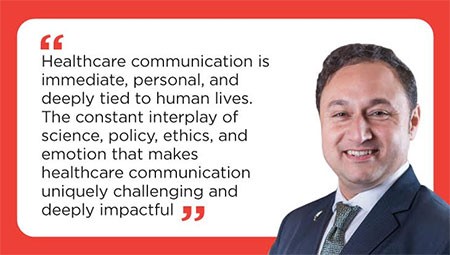
Moreover, the healthcare ecosystem in the Global South presents unique challenges — from disparities in access to healthcare and infrastructure gaps to regulatory transitions and evolving patient expectations. Communicating within this environment requires not just domain knowledge, but also cultural sensitivity, agility, and credibility. Unlike environmental communication, which often focuses on collective responsibility and long-term outcomes, healthcare communication is immediate, personal, and deeply tied to human lives.
Ultimately, while both domains demand integrity and strategic thinking, the health and medical devices space pushes communicators to constantly navigate high-stakes situations — crises, product launches, public health emergencies — where messaging must be both precise and compassionate. It’s this constant interplay of science, policy, ethics, and emotion that makes healthcare communication uniquely challenging and deeply impactful.
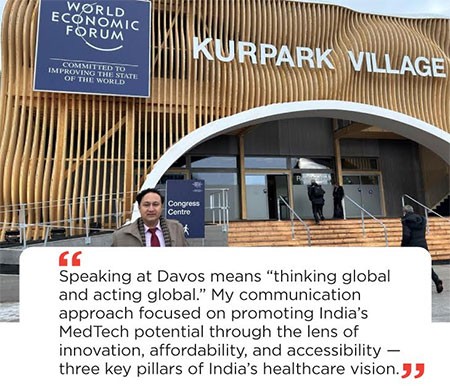
What was your goal as the first MedTech lead to represent the Indian Medical Device Industry at the World Economic Forum (Davos)? How do you leverage strategic communications to shape global health diplomacy and advance the interests of the Indian MedTech industry on an international stage?
The World Economic Forum (WEF) at Davos is a platform of unmatched global stature — a true confluence of governments, business leaders, policymakers, and changemakers. Representing the Indian MedTech industry there was not only a deep honour but also a profound responsibility — as a communicator, as a corporate affairs professional, as an industry advocate, and most importantly, as an Indian. Davos is not just an event; it is a mindset. It teaches you how to expand the boundaries of communication — beyond geography, ideology, and sector — and engage in a form of diplomacy rooted in dialogue, collaboration, and shared purpose.
As the first MedTech lead to represent India at this forum, my goal was twofold — to position India as a credible and capable MedTech hub on the global map, and to create meaningful bridges for collaboration, especially with developed ecosystems like the Swiss MedTech industry. This required a strategic and nuanced approach to communication — one that was visionary yet grounded, assertive yet empathetic.
Speaking at Davos means “thinking global and acting global.” Every participant becomes an ambassador, not only of their organization or sector, but also of their nation’s aspirations and values. My communication approach focused on promoting India’s MedTech potential through the lens of innovation, affordability, and accessibility — three key pillars of India’s healthcare vision.
Strategic communication at such a high-level forum is about shaping narratives that align national goals with global health priorities. It involves articulating a message that is not merely promotional, but diplomatic — fostering trust, collaboration, and co-creation. For the Indian MedTech sector, this meant highlighting our growing manufacturing capability, regulatory maturity, and the sector’s alignment with India’s 2047 Viksit Bharat mission. It also meant positioning India not just as a market, but as a partner in global health innovation and sustainability.
In your view, what are some of the regulatory or legislative roadblocks currently impeding innovation in the Indian MedTech ecosystem?
India’s MedTech ecosystem has evolved remarkably over the past decade, but regulatory and legislative frameworks have not always kept pace with the sector’s rapid innovation.
A key challenge is the fragmented regulatory structure — multiple agencies oversee standards, pricing, quality, and approvals, often leading to overlap and confusion. The lack of a unified, MedTech-specific framework creates uncertainty, especially for startups trying to navigate compliance.
Another issue is the absence of distinct regulations for medical devices and pharmaceuticals. Since these sectors differ in how products are developed, tested, and deployed, treating them under similar rules restricts device innovation.
Another roadblock lies in the slow pace of policy harmonization with global standards and the limited incentivization of R&D and domestic manufacturing in high-end medical technologies. Issues such as complex import dependencies, inconsistent state-level implementation, and lengthy approval processes often delay market access for new technologies.
To truly unlock India’s MedTech potential, the focus must shift toward creating a transparent, predictable, and innovation-friendly regulatory ecosystem — one that supports startups, encourages collaboration with academia and global partners, and ensures patient safety without stifling creativity. A forward-looking, agile regulatory approach will be key to positioning India as a global MedTech innovation hub.
What trends or shifts are you seeing in the healthcare and medical technology sector that communicators must prepare for?
The healthcare and medical technology sector is undergoing a transformative shift driven by digitalization, patient empowerment, and the convergence of technology with care delivery. We’re witnessing a move from product-centric to solution-centric narratives, where data, AI, and connected health systems are redefining the way healthcare is delivered and perceived.
For corporate communicators like us, this means adapting to a world where storytelling is no longer just about devices or treatments, but about outcomes, access, and human/patient impact. Communicating the role of technology in improving patient journeys and democratizing healthcare will be central to future engagement strategies.
- Communication meets policy and purpose
Another major shift is the increasing intersection of healthcare with public policy, sustainability, and global health diplomacy. The post-pandemic world has heightened awareness about health equity, local manufacturing, and supply chain resilience — making ESG-driven communication more critical than ever. In this evolving ecosystem, the role of a corporate communicator in MedTech has expanded significantly — they are no longer just brand custodians but have also become the blue-eyed government affairs and policy communicators. Today’s communicator must understand regulatory frameworks, engage with policymakers, and contribute to shaping healthcare discourse at both national and global levels. This blending of communication with policy advocacy ensures that the MedTech narrative aligns seamlessly with national priorities like Atmanirbhar Bharat and the government’s broader health and innovation agenda.
- Navigating the digital and social shift
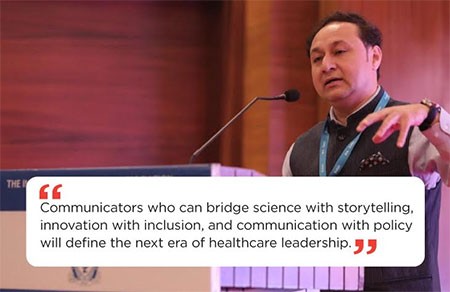
Finally, the rise of real-time communication, social media advocacy, and digital health influencers has made the information environment more dynamic — and at times, more volatile. Communicators must be agile in managing misinformation, navigating crises, and building trust through transparency and authenticity. As patient voices grow stronger and data becomes the new currency, the future of MedTech communication will rest on credibility, empathy, and the ability to humanize technology. Those who can bridge science with storytelling, innovation with inclusion, and communication with policy will define the next era of healthcare leadership.
After an extensive journey across industries, what are the areas you’re exploring next?
The future, as I always say, is never known — it is constantly being written. My move into the healthcare and MedTech space wasn’t something I planned, it grew out of personal experiences that ended up shaping my professional path.
Over the past 21 years, and especially in the last 15, this field has become my canvas to bring together communication, strategy, and policy. Now, I’m exploring how public health communication can better connect with technology, policy advocacy, and global health diplomacy.
I’m currently working with the Government on shaping Free Trade Agreements and global economic relations, which gives me a front-row seat to how communication influences policy at scale.
Since finishing my Master’s in 2001, I’ve seen the communicator’s role evolve far beyond media relations. Today, it’s about understanding digital ecosystems, data, and stakeholder networks and how all of that drives governance, regulation, innovation, and even profitability.
What key lessons would you pass on to aspiring professionals in the communications field?
In today’s interconnected world, communicators do much more than craft messages — they shape narratives that influence policy, manage crises, and respond to rapid global and organizational changes. The modern communicator is a strategist, storyteller, and policy influencer all at once. This demands agility, curiosity, and the ability to blend traditional communication with digital strategy.
For aspiring professionals in this field, my advice is to hone your fundamentals.
- Strengthen your writing, reading (news & views), and verbal communication skills, ideally in more than one language, because India’s next growth story is unfolding in tier-2 and tier-3 cities.
- Be organized, detail-oriented, and consistently dependable under pressure. Most importantly, cultivate adaptability, resilience, and emotional intelligence.
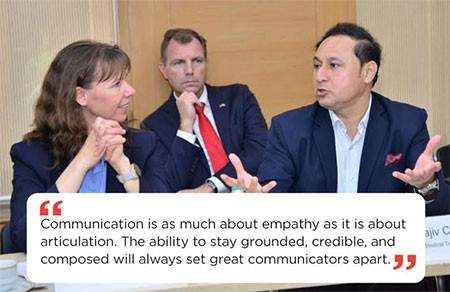
Communications is as much about empathy as it is about articulation — especially when engaging with journalists, policymakers, and the public in high-stakes or sensitive situations. The ability to stay grounded, credible, and composed will always set great communicators apart.
Read more news about PR and Corporate Communication News, Internet Advertising, Marketing News, Digital Media News, People Movement News
For more updates, be socially connected with us onInstagram, LinkedIn, Twitter, Facebook YouTube & Google News