'Communications is about connecting the dots between brand, people, and performance'
Chikita Sobti talks about her win as the Communicator of the year, her journey, and shares learnings from her experience in the comms realm
 by
by
Published: May 16, 2025 3:56 PM | 5 min read
 Follow Us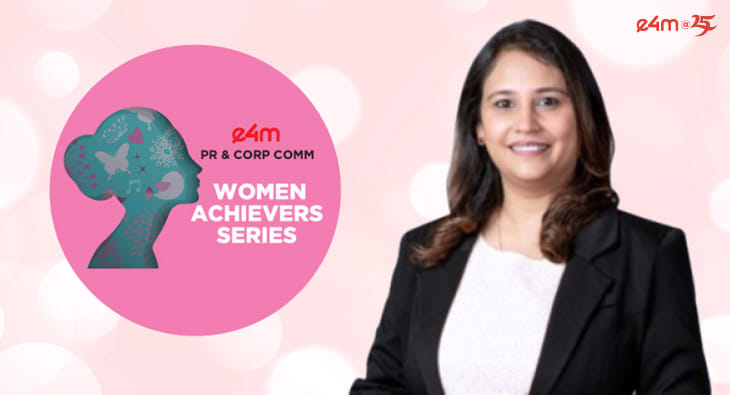

Women have played a huge role in shaping the communications industry, even if their stories haven't always been at front. The industry has several remarkable women whose talent shape our world, often blending empathy with innovation in ways that make communication more real, more inclusive, and more powerful for everyone.
So, to celebrate the spirit of the women leaders who are breaking barriers in the PR and Corp Comm industry, exchange4media launched the 5th edition of e4m Women Achievers' Awards 2024. The awards honoured the remarkable contributions of numerous incredible women leaders, achievers, and trendsetters who have shattered glass ceilings, overcome challenges, and paved the way for a more inclusive and diverse future in the PR and Comms Industry.
In this series, we honour and celebrate the achievements of Chikita Sobti, Head of Communications, Castrol India. She is the proud winner of the ‘Communicator of the year (Corp Comm professional)’ award at the e4m PR & Corp Comm Women Achievers' Awards 2024.
How has your journey been in the communications industry, share your experiences and challenges as a woman leader?
My journey has been layered and fulfilling. I started out as a journalist. This taught me to listen, probe, and craft with purpose. It also taught me to not take any input on face value and research my way to truth. Moving into corporate communications helped me see how stories can drive alignment and impact from the inside out, make people feel seen and heard, and ethically shape the narrative.
I will call myself one of the few lucky women who has had the chance to work with traditionally inclusive brands.
As a woman leader, I’ve navigated the usual paradoxes—being told to speak up, but not too much; to lead, but not appear too ambitious. Over time, I’ve stopped trying to meet external expectations and instead focused on building trust, staying authentic, and letting my work speak. That’s been the biggest shift—and the biggest strength.
What shifts and transformations have you observed for women in the workplace over the last few decades, and what do you think still needs improvement?
There’s more awareness, and that’s a start. Workplaces are more open to conversations around inclusion, and women are increasingly showing up—not just in the room, but at the table.
But the playing field isn’t fully level yet. We are still usually the first or the only. I feel that a lot of progress still hinges on individual effort, not structural support. What we need now is consistency: in policies, in sponsorship, and in how organisations back women through life and career stages—not just in principle, but in practice.
What are the most important skills and qualities that women leaders need to succeed in the PR and comms industry?
Listening. The ability to tune into what’s said, unsaid, and implied—across stakeholders, teams, and the public. Also, clarity. We live in a noisy world, and the ability to simplify and stay strategic is crucial.
Beyond that, it’s about showing up with intent, being empathetic, decisive, and resilient. Communications is often the first to respond in a crisis and the last to get credit in calm. You have to lead without waiting for applause.
What suggestions would you give to companies who want to attract and retain more women in leadership positions?
I am of the thought that women fall behind in the game because their responsibilities are scattered. It is never about excelling in either work or in personal life. You have to be good at everything.
In a world where balance is becoming a luxury, companies should look at providing just that in order to attract more women in the workforce, not just in leadership position. Give them the assurance that the organisation is with them in the long run and will be supportive of their goals in a 360-degree manner.
And then build retention, which is again a smart balance of perks and culture. Start by asking better questions—not just “how many” but “how supported,” “how visible,” “how heard.” Create real mentorship opportunities, make flexibility aspirational—not a compromise, and make space for different leadership styles.
Not every leader has to be loud to be effective.
What advice would you offer to young women who are starting their careers in the communications industry?
I have 2 pieces of advice –
Understand the business. Communications isn’t just about creativity. It is about connecting the dots between brand, people, and performance. The business relies on you to help it tell the message effectively. It is difficult to do that if your basics are not correct.
Don’t edit yourself too early. It’s okay to not have all the answers. Stay curious, stay grounded, and don’t mistake silence for lack of impact because some of the strongest communications happen without a mic.
Lastly, how do you feel as a winner of the 5th edition e4m PR & Corp Comm Women Achievers Awards 2024?
It’s a lovely reminder that the work matters. That clarity, consistency, and care do get noticed. But more than a personal win, I see it as a moment to celebrate everyone in communications who quietly holds the fabric together.
Read more news about PR and Corporate Communication News, Internet Advertising, Marketing News, Digital Media News, People Movement News
For more updates, be socially connected with us onInstagram, LinkedIn, Twitter, Facebook YouTube & Google News