‘Challenging the Established Truths: A Blueprint for communications revolution’
e4m PR & Corp Comms 40 under 40 winner, Pragati Tiwari highlights the importance of pioneering a future where communications expertise is both accessible and accountable
 by
by
Published: Sep 2, 2025 4:09 PM | 4 min read
 Follow Us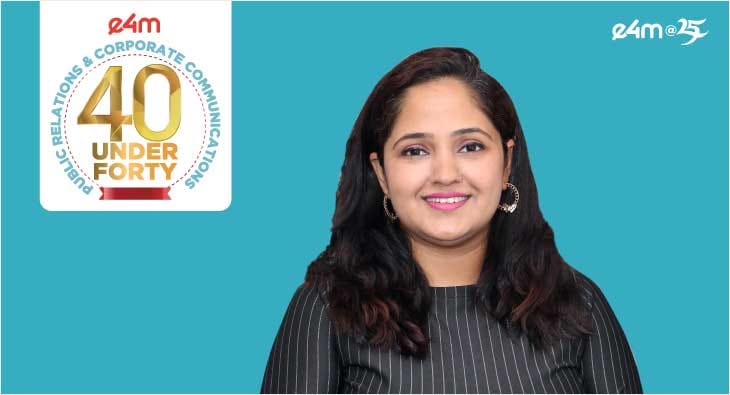

The role of a PR & communications professionals has become more critical in today’s dynamic world.
Today, we feature Pragati Tiwari, Partner – Executive Leadership Team, Astrum and the proud recipient of e4m PR & Corp Comm 40 under 40 awards 2024. She opens up about what the recognition means to her, the remarkable moments that shaped her journey, a rare, behind-the-scenes look at the mindset, values, strategies that define success in today's communications industry, and the personal and professional lessons she has gathered in her career till now.
Excerpts:
How do you feel being part of this renowned list of 40 under 40 leaders?
It's profoundly humbling to see your name among such remarkable change-makers! For me, this recognition is not just a personal achievement but also a reflection of the extraordinary support ecosystem that I have.
I have been very fortunate with mentors who transformed my raw ambition, gave it direction and structure. The two mentors I must mention are Ashwani Singla and Sharada Adhikari Sharma at Astrum – their imprints are all over this honour, making it as much their achievement as it is mine.
What are the top 3 skills you believe are essential in today's professional landscape?
Here are the principles that drive the bedrock of foundational skills:
There is predictability in how people behave: Behind every action, there is human psychology! How do people process information? What can they relate to? Guides how they will behave and potentially what trends will get created. Psychological decadence isn't just about understanding audiences, it's about anticipating responses.
Words are important, the emotions they evoke – even more important: We exist in an unprecedented attention deficit economy where genuine connection remains scarce. People rarely remember specific messages. But they never forget how you made them feel. The art lies in adapting stories across diverse formats while maintaining their emotional core and authenticity.
Technology can change, what humans need from tech remains same: Beyond mere technical literacy, tomorrow's leaders possess an almost preternatural sense of how digital ecosystems evolve. The professionals who thrive can detect emerging patterns early. While interfaces constantly transform, the human needs driving them remain remarkably consistent.
What emerging trends or technologies do you believe will shape your industry in the next 5–10 years?
The future of public relations lies in mastering the trifecta of data science, social science, and neuroscience—a convergence that Astrum has already pioneered over the last decade.
Trust will become everything in our tech-native world. As deepfakes and digital fraud proliferate, brands must be prepared to anticipate and protect their customers and audiences. Staying on the sidelines isn't an option anymore. This drives the second trend—from "The world is our oyster" to micro-communities or "tribes," as we call them, which will become the cornerstone of decision-making. Here, the trifecta helps decode what resonates authentically with each community.
Lastly, technology delivers scale and agility through AI-powered content creation, real-time monitoring, and instant distribution. But everyone will have access to similar tech tools. It is human insight that will create distinction. While algorithms can amplify messages, only human understanding of psychology, behaviour, and cultural nuances can create the trust-building narratives that cut through digital noise and connect with real people.
How do you define leadership in the modern workplace?
For me, leadership isn't a position conferred by organisational charts—its permission granted by people who trust you to guide them somewhere meaningful. In today's workplace, this means cultivating psychological safety, where employees feel secure enough to take risks without fear of failure. At Astrum, we believe that while no mistake should be repeated, avoiding errors entirely stifles innovation.
The most effective modern leaders I’ve observed focus less on giving answers and more on asking powerful questions that unlock collective intelligence. Removing barriers to collaboration rather than centralising control is thus their deliverable.
What are your future plans? What's one lesson you want to pass on?
We recently celebrated Astrum's 10th anniversary, marking a significant milestone in our journey. My commitment is to elevate the quality of the work we are known for, while further enriching our company culture. We have cultivated a truly unique environment—home to talented, multi-disciplinary, like-minded professionals passionate about making a difference. Although our achievements are remarkable, our journey is ongoing.
As we look to the next decade, we plan to invest in NextGen leaders, expand into new markets, introduce innovative services, and deepen our focus on vital 21st-century skills. Our goal is both organic and inorganic growth, driving continuous evolution.
From my experience, the most valuable lesson is simple: “Test what you know.” In a field filled with assumptions, rigorous testing of ideas is transformative. It turns industry noise into a reliable compass, shifting your role from practitioner to pioneer and continuously advancing the field of communications.
Read more news about PR and Corporate Communication News, Internet Advertising, Marketing News, Digital Media News, People Movement News
For more updates, be socially connected with us onInstagram, LinkedIn, Twitter, Facebook YouTube & Google News