AI will accelerate communication, but can’t replace moral judgement: Jaijit Bhattacharya
At e4m PR and Corp Comm 30 Under 30 Summit 2025, Jaijit Bhattacharya, Founder and President of the Centre for Digital Economy Policy Research, spoke on why machines can’t replace human thinking
 by
by
Published: Dec 15, 2025 4:10 PM | 5 min read
 Follow Us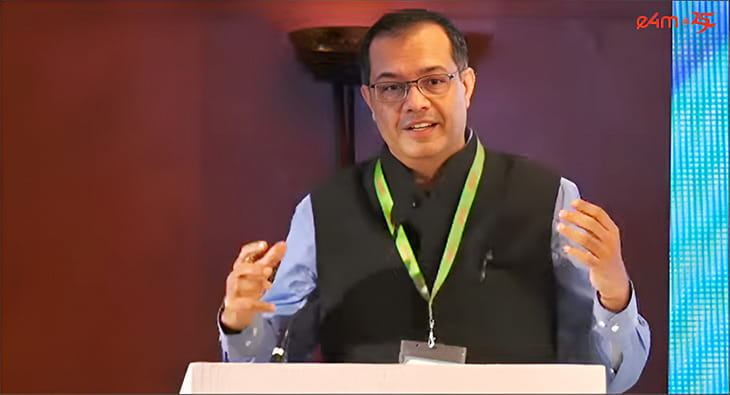

As artificial intelligence rapidly embeds itself into newsrooms, brand strategy and public relations workflows, Jaijit Bhattacharya, Founder and President of the Centre for Digital Economy Policy Research, offered a grounded counterpoint to the growing belief that machines can replace human thinking.
Speaking at e4m PR and Corp Comm 30 Under 30 Summit 2025, his argument was not anti-AI. Instead, it was a warning against treating AI outputs as neutral or objective without examining the human reasoning that feeds into them.
The Delhi pollution narrative and the problem with partial truth
Bhattacharya rooted his point referring to Delhi’s winter pollution, where a visible layer of smog often sits alongside pleasant weather, he highlighted how data can be technically accurate yet deeply misleading.
Bhattacharya illustrated this with a real-time example from Delhi’s winter pollution. On a morning that felt unusually pleasant, with a noticeable chill in the air, the city was still wrapped in heavy smog. Yet the dominant narrative, he pointed out, continues to cite agricultural pollution as contributing only 16 percent to the city’s annual pollution levels.
The flaw, according to him, lies not in the data but in how it is presented. “The pollution happens only four months, why are we dividing it by 12 months?”
To underline the danger of such logic, he pushed it to an extreme comparison. “With that context, the nuclear bomb in Hiroshima and Nagasaki was almost like a Diwali pataka if you divide it by 75–80 years, right?”
The point, Bhattacharya stressed, is that distortion does not require artificial intelligence. It is often a product of human framing and selective interpretation.
Why AI still cannot replace human reasoning
According to Bhattacharya, this is precisely why humans continue to play a central role in public relations, policy communication and narrative building. AI can generate content at speed, but it cannot yet grasp social complexity, political consequences or ethical trade-offs.
“There is a lot of role that humans continue to have in PR, in communication, and so on and so forth,” he said.
This limitation becomes more visible as AI systems are increasingly used to summarise, simplify and amplify narratives at scale.
Explaining what the idea of singularity could mean in practical terms, Bhattacharya described a future where AI reads emotional and physiological signals through connected devices like smartwatches and rings.
“I want to sell Pepsi to you or some other nice cola drink to you and I would like to figure out what really excites you,” he said. “Your smartwatch tells me your heart rate has gone up because you like bright light or you like nice music.”
AI, he explained, can then instantly create positive emotional associations. “I can actually give you a personalized nice music along with the coke or whatever drink to have an associative cognition which is positive for you.”
This personalization, he said, will be continuous. “I can capture you in a 360-degree environment on a continuous basis.”
While the capability is powerful, Bhattacharya emphasised that it raises serious questions about influence, consent and ethics.
Communication has always evolved, not erased itself
To place AI in perspective, Bhattacharya traced the evolution of communication itself. “You would have seen those cave paintings, right? That was communication,” he said, moving through writing, Ashoka’s stone edicts, paper, computing and the internet.
Each new medium expanded reach but did not eliminate the previous one. “Stone you can’t move around. Paper came in and you could move the papers around,” he explained.
Even today, older forms remain relevant. “Have you noticed that outside of this hotel, it’s still written on stone what’s the name of this hotel?” he said. “That basically means that nothing has been left.”
AI, he argued, will operate across all these layers simultaneously, rather than replacing them.
When human intelligence solves what AI cannot
Bhattacharya illustrated AI’s current limits through a policy communication case involving auto rickshaw drivers impacted by the rise of e-commerce. As consumers shifted to platforms like Blinkit, Zepto, Amazon and Flipkart, auto drivers began losing rides at scale.
The eventual solution involved repositioning autos as last-mile delivery partners, a move that required regulatory redesign and political sensitivity.
“Would AI have figured that out? No, I doubt, not at least in today’s technology,” he said.
The challenge, he explained, involved state versus central power, enforcement risks and the possibility of exploitation. These are variables AI does not yet understand.
Machines talking to machines
Bhattacharya warned that communication is increasingly becoming machine-to-machine. Search engines now summarise content written by bots for users who rarely read beyond the headline.
“There are bots speaking on this side, there’s bots speaking at your side and then you’re getting the summary,” he said.
As the cost of PR approaches zero, content volume will explode. “Can the human mind process that?” he asked, noting that personalization will soon extend beyond messaging into production itself.
Despite AI’s ability to accelerate and scale communication, Bhattacharya ended on a cautionary note. “AI will accelerate communication, it’ll amplify narratives,” he said, but it cannot replace moral judgement.
“Thinking will still be yours,” he added. “At the end of the day it’ll be your decision, your wisdom.”
In an environment flooded with automated content and algorithm-driven influence, he argued that trust will matter more than data or reach. “In an AI saturated world, the scariest resource in my view will not be data or content but it’ll be trust,” Bhattacharya said. “Trust is built by humans, it’s not between machines.”
Read more news about PR and Corporate Communication News, Internet Advertising, Marketing News, Digital Media News, People Movement News
For more updates, be socially connected with us onInstagram, LinkedIn, Twitter, Facebook YouTube & Google News