We need to embrace change and run at the same speed: Uday Shankar
Uday Shankar, Vice Chairman of JioStar, engaged in a conversation with Gaurav Banerjee, Managing Director and CEO of SPNI on the future of Indian media at CII Big Picture Summit
 by
by
Published: Dec 2, 2025 9:24 AM | 7 min read
 Follow Us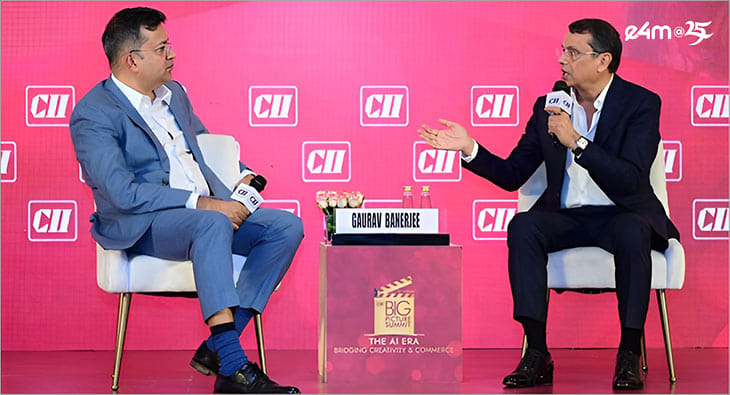

“We are limited by our own imagination.” With this sharp and sweeping assessment of the Indian media industry, Uday Shankar, Vice Chairman of JioStar, set the tone for a wide-ranging conversation on the future of content, talent, risk taking and industry reinvention.
Shankar was speaking with Gaurav Banerjee, Managing Director and CEO of SPNI, during the PowerTalk session on ‘Building M&E Titans: The Uday Shankar School of Leadership’ on day one of the CII Big Picture Summit held in Mumbai on Monday.
Over the next hour, Shankar revisited decisions that transformed Indian television, decoded the stagnation he believes grips parts of the industry today and articulated the restless curiosity that continues to drive him. The session moved through pivotal themes shaping the media landscape, from content consumption patterns and industry inertia to talent philosophy, investor confidence and AI led reinvention.
Where is the hope and the next big opportunity?
Banerjee began by asking where Shankar sees hope in an industry grappling with slowing advertising, uncertainty over the future of television and the uneven pace of streaming growth. “Where is the next big opportunity for the media in India?” he asked.
Shankar responded with conviction that the Indian media sector is far from running out of steam. “I remain very optimistic, very excited about the future of the industry,” he said, adding that the real challenge begins with how the industry defines itself. For Shankar, the core function of media remains simple: to create and deliver compelling content that captures consumer attention. And that attention, he stressed, has never been higher.
He argued that people today live in a constant state of content consumption - at bus stops, in reception areas, while waiting to board flights. “Now, we have chosen to artificially constrain our own industry. That is our problem,” he said. The opportunity, he insisted, lies in imagination. “Our industry’s prospects and potential are limited by our own imagination and our ability and our desire to experiment and re-engage with the consumers.”
Shankar pointed to streaming giants and technology media companies as examples of relentless reinvention. Meanwhile, traditional television, he warned, has boxed itself into rigid formats and outdated frameworks. “It is not the state of the industry. It is how we have chosen to play. The game has changed.”
Moving beyond distribution and redefining what content companies do
Banerjee then revisited an argument Shankar has long championed: that media companies must think of themselves as storytellers rather than distributors tethered to screens. “Are you asking us again to redefine ourselves and think of captivating audiences as the core?” he asked.
“Absolutely,” Shankar replied. To illustrate his point, he used a striking metaphor: “We ordered a large number of coffins. And there are not enough dead people we can find. So we keep looking for somebody to die and put the guy in the coffin.” Media companies, he argued, are waiting for old models to collapse instead of reinventing new ones.
He described the resistance he faced when Star first started exploring streaming—at a time when data was prohibitively expensive and WiFi nearly non-existent. Yet he persisted because he believed that creators should follow consumers, not devices. “Everything in between is temporary,” he said.
Shankar contrasted the constraints of early TV news, where broadcasters waited all day for viewers to come home, with today’s freedom to reach audiences instantly. The next leap, he predicted, will move beyond mobile phones altogether, possibly toward wearables and ambient screens. The real hurdle, he argued, is not distribution but mindset. “We have created these artificial barriers, and that is what is holding us back.”
How do leaders prepare teams for a future without precedent
Banerjee then shifted to leadership, asking Shankar how teams can prepare for a world that doesn’t yet exist. “You couldn’t have known how to build streaming out of a TV network because nobody had done it,” he said.
Shankar’s answer was simple: you cannot prepare for the future, only prepare yourself. “You need to be nimble and open minded and ready to seize the opportunity,” he said. What matters is not skills, which he believes become outdated, but the ability to keep acquiring new ones.
He recalled the cumbersome processes of early TV production, from bulky recorders to restrictive editing studios. Today, the same work happens on a mobile phone. “If you were trained to be an editor on those huge devices, and you did not progress with time, you are out of fashion,” he said. What survives is adaptability.
“So, the world will keep changing, but you need to be prepared to embrace that change and run at the same speed.” His advice: “Do not get fixated on picking a skill.”
How do you bring trust and big ideas to large investors
Banerjee asked about another leadership challenge—convincing big investors to bet on big ideas.
“You need to have great ideas. And you need to have the conviction to die for those ideas,” Shankar replied. But conviction alone is not enough. The first building block, he said, is people. “The first thing I do is to look for who is the best person to do that project.”
He warned against limiting talent searches to familiar circles or internal teams. Media, he argued, is being disrupted by forces far beyond traditional creative talent—technology, business strategy, marketing and branding. “We have not done a great job of going to the big wide world and picking the best talent,” he said.
The Uday Shankar method of finding talent
Banerjee pressed further: “What is the Uday Shankar method? How do you find talent?”
“The first thing is you have to know what you do not have,” Shankar said. He looks for specialists, people with exceptional strength in a specific vertical rather than well rounded profiles. “Give me a person who has 100 per cent in one subject. And maybe the person has failed in every other subject.”
Such experts, he said, elevate discussion, challenge norms and push organisations forward—even if they are difficult personalities. “When you put together 10, 15, 20, 30 such people, you have got all verticals covered.”
Where does your risk appetite come from
Banerjee next touched on Shankar’s appetite for risk. “Where does this come from?” he asked.
“Life is about experiments and innovation. And if experiments are not failing, then you are not experimenting,” Shankar said. Success, he argued, is built on a deep foundation of failures—failures people conveniently forget. “I have been blessed to have had people who have shown faith in my failure,” he said.
This led Banerjee to one of the boldest decisions of Shankar’s career: Satyamev Jayate. Why did he take such a risky bet at the height of Star Plus’s dominance?
“There is an innate restlessness in me,” Shankar said. Star Plus was leading the market, but he wanted to disrupt entertainment itself. “I believe you should experiment when you are very strong,” he said, because fear of risk is lower.
Satyamev Jayate broke every rule: tone, packaging, marketing, format, even it's morning time slot. “If somebody had asked me back then, would it be successful? I had no idea,” he admitted. But he pursued it because the idea pushed the boundaries of what entertainment could be. “All my successes have come from this commitment to disrupt the status quo.”
Finally, Banerjee asked: “What are you restless about today?”
Shankar said he remains obsessed with elevating live cricket production, but his bigger excitement now is AI. “I am feeling incredibly excited about what AI can do,” he said. AI, he believes, can democratise creativity by overcoming barriers of talent shortages, production capacity and high costs. “Oh, you are not finding great talent? Alright, I will create someone,” he said.
Artificial intelligence, for him, represents a liberation, a way to expand storytelling without being constrained by human or financial limitations. “Why should we not get excited about it?” he asked. “My mind is on how to do this to excite our viewers more and more.”
Read more news about Television Media, Digital Media, Advertising India, Marketing News, PR and Corporate Communication News
For more updates, be socially connected with us onInstagram, LinkedIn, Twitter, Facebook YouTube & Google News
