Over 1,000 job cuts & counting: Pink slip panic hits M&E industry
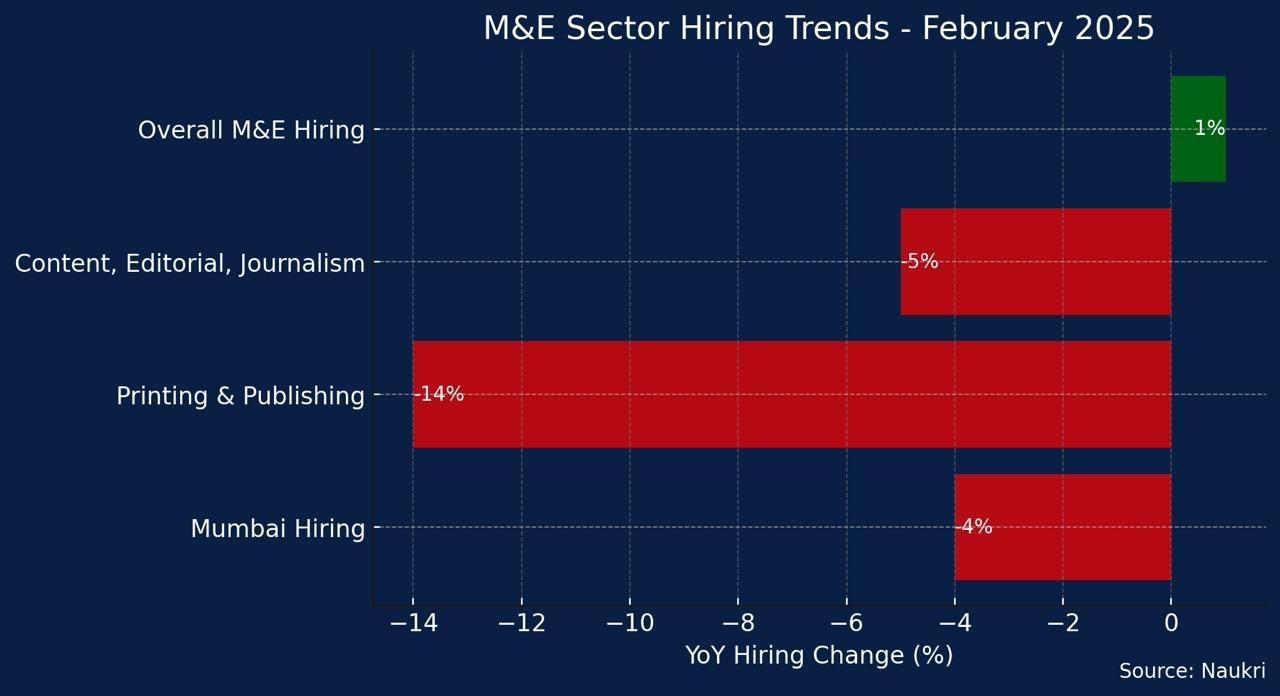
In February 2025 alone, the sector saw only 1% year-on-year growth in hiring. The Content, Editorial and Journalism segment witnessed a 5% decline
 by
by
Published: Mar 13, 2025 9:25 AM | 8 min read
 Follow Us

The Media & Entertainment (M&E) sector is witnessing a wave of job cuts — and it is only mid-March. Nearly 1,000 employees across content, tech, ad sales, and administrative departments are already facing layoffs. Industry leaders cite declining revenues, cost rationalization, and efforts to reduce redundancies as the reasons for the layoffs.
The layoffs aren’t limited to smaller firms — major networks are handing out pink slips too. Experts warn that if 2024 was bad, 2025 could be worse.
The biggest blow so far has come from JioStar, the media giant formed from the merger of Reliance and Disney, which is set to axe nearly 600 roles across the country. The layoffs will affect staff from both Reliance and Star as the newly merged powerhouse restructures to streamline operations and eliminate overlapping roles. Other big companies, like Google and Meta, too are laying off employees.
According to Rajneesh Singh, CEO, Simpli Group (former Group Head HR- TV18 Ltd), the market is witnessing consolidation, where bigger players merge, which naturally results in layoffs and restructuring. This consolidation phase is set to continue, he added.
Additionally, several smaller media networks across languages are quietly cutting staff as well. While the exact number is difficult to pin down due to silent terminations, HR and hiring experts estimate the number of layoffs has already hit 1,000, with strong indications that this figure could double by the end of the year.
Hiring drought signals tough times
According to the latest data from Naukri, the outlook for M&E hiring is bleak. In February 2025 alone, the sector saw only 1% year-on-year growth in hiring. The Content, Editorial, and Journalism segment witnessed a 5% decline, while the Printing & Publishing sector reported a sharp 14% dip. City-wise, Mumbai, a key M&E hub, experienced a 4% drop in hiring during the same period.
“There's a lot of restructuring happening, which is inevitably leading to job cuts in various sectors, particularly in the M&E space. While I wouldn't say the impact is significantly higher, it has been consistent throughout the year,” said Singh.
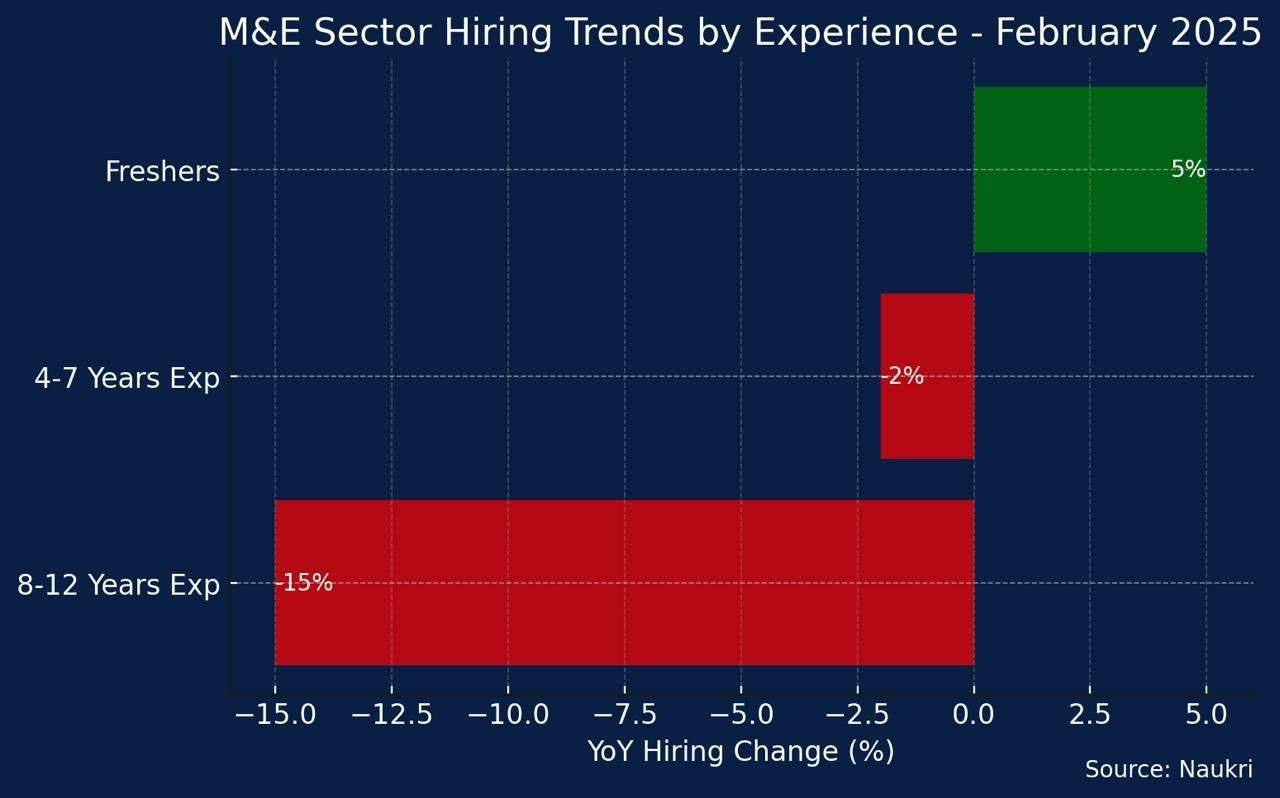
Breaking it down by experience levels, fresher hiring in the M&E sector saw a 5% rise YoY in February. However, hiring for those with 4-7 years of experience declined by 2%, and the 8-12-year experience bracket faced the steepest fall, with hiring plummeting by 15%.
Singh mentioned employers are hesitant to commit, so, while they’re actively interviewing candidates, they aren’t closing those positions. This uncertainty is impacting not only campus placements but also lateral hiring. For experienced professionals in the 4-7 and 7-15-year range, companies are evaluating every position carefully, questioning if they can manage without filling that role.
Lokesh Nigam, CEO, Konverz AI, mentioned, “This is a classical problem across industries, not just M&E. Mid-level talent (10–15 years of experience) struggles because the skill requirements have shifted towards digital and AI. People who haven’t kept up with these changes are finding it harder to stay relevant. Companies are more inclined to bring in people with fresh, current skills, even if it means sunsetting older ones.”
Layoffs mirror business downturn
Speaking of declines, the firing trend is directly linked to business numbers. Especially those in the traditional media set-up.
For instance, Times Internet Limited (TIL), which asked about 200 of its employees to leave, recorded a total loss of Rs 199.31 crore during the period 2023-24. The ad revenue from online and digital platforms stood at Rs 690.73 crore, reflecting a slight decline of 2.7% compared to Rs 709.73 crore in 2022-23.
TIL is not alone. The Quint recorded an operating loss of Rs 30 lakh and net loss of Rs 4.51 crore in Q2 of FY25 in the same quarter that it laid off several employees as part of a restructuring exercise. With layoffs, The Quint was later able to narrow its losses in subsequent quarters.
These are just some of the examples. There are other organisations whose numbers do not exactly portray a growth trajectory.
Traditional media struggles as digital surges
The TV business and most other traditional media like print and radio have been significantly impacted by the rise of digital platforms- a trend that's no longer news. However, the gap in growth has been widening, as reflected in recent data.
According to the dentsu-e4m Digital Advertising Report, in 2024, television AdEx declined by 5.95%, print by 6.02%, and radio by 7.44% compared to 2023. In stark contrast, Digital AdEx grew by 21.05% during the same period.
The 2025 edition of the report highlights that television's share shrank from 32% in 2023 to 28% in 2024, with a further dip to 24% projected by 2025. Print media followed a similar downward trend, dropping from 20% to 17% by 2024, with expectations of hitting 15% in 2025.
Nigam explained, for print media, the struggle is different — they are grappling with the shift to quick, on-the-go news and 24/7 availability of information. AI is another factor impacting jobs in print media, as it can replace both creative and operational roles.
“Television has been the biggest loser to internet-based content. There are more content creators than ever, even at an individual level, but organized TV players are losing the hook they had 10–15 years ago. Jobs will likely diminish in television for a while, but they will grow on the internet-based content side,” he added.
Meanwhile, radio, which maintained a steady 2% share in 2024, is anticipated to decline to just 1% by the end of 2025.
Why are tech companies firing?
If Digital AdEx is growing, then why are tech companies still firing?
The technology sector, which witnessed a hiring boom during the pandemic, continues to see workforce reductions.While some call it rationalizing, others attribute it to different factors.
Metarecently laid off over 3,000 employees (globally), roughly 5% of its workforce. Meanwhile, Google has initiated voluntary buyouts in select divisions, signaling ongoing restructuring efforts.
In an internal memo to employees, Mark Zuckerberg wrote:
“Meta is working on building some of the most important technologies in the world — AI, glasses as the next computing platform, and the future of social media. This is going to be an intense year, and I want to make sure we have the best people on our teams. I've decided to raise the bar on performance management and move out low-performers faster.
“We typically manage out people who aren't meeting expectations over the course of a year, but now we're going to do more extensive performance-based cuts during this cycle — with the intention of backfilling these roles in 2025.”
The rise of AI has been a significant factor behind these shifts — not just in tech companies but across media functions as well.
As per Nigam, AI is democratizing content creation. For example, Sam Altman recently tweeted about a new AI tool capable of generating fiction and other creative writing.
“Tools like these can produce work that sounds original, but it’s not truly original. The impact on jobs is significant as these tools reduce the need for specialized skills, which can lead to job losses or recalibrated compensation. The M&E industry already has relatively low pay, and more AI-based work could intensify this issue,” he added.
Severance relief: JioStar sets a benchmark amid layoffs
JioStar has announced what sources describe as one of the best severance packages offered by any Indian company, providing substantial financial support for those impacted.
Affected employees are set to receive up to 15 months' salary as severance, with a minimum payout of 9 months' salary. Additionally, employees who haven't completed five years of service will receive gratuity on a pro-rata basis.
Wherever possible, JioStar is also exploring ways to absorb impacted employees into other Reliance Group companies, particularly within tech teams, to minimize job losses within the broader organization.Unfortunately, such generous severance policies are not common industry-wide, leaving many displaced workers without comparable support.
Global media layoffs show no signs of slowing down
Media layoffs are clearly not confined to India. According to the Press Gazette, job cuts in the journalism industry in the U.K. and U.S. slowed in February 2025 compared to January 2025. More than 900 journalism jobs were cut in January, while February saw around 210 job losses.
Among the hardest-hit media companies in January were The Washington Post, The Wall Street Journal, Dotdash Meredith, BBC World Service, Mail titles in the U.K., CNN, NBC News, and Forbes.
In February, layoffs continued at MSNBC, the Los Angeles Times (via voluntary buyouts), and New York Public Radio.
The way ahead
While it’s a challenging solution, SIngh believes job seekers should start considering becoming job creators. Given the current landscape, relying solely on traditional employment options may not be sustainable.
“Unfortunately, we aren’t seeing significant new investments or emerging companies that would otherwise drive hiring. The M&E sector appears stagnant, and I don’t foresee an upward trend anytime soon. The key is to look beyond M&E and broaden career possibilities — that’s becoming increasingly evident,” he mentioned.
Nigam highlighted that in 2025, print is likely to remain stable, digital will continue to grow, and the rest of the sectors (like cinema and production) will see more skill replacement rather than stable hiring patterns. The industry will evolve, but the need for adaptability and constant skill upgrading will be crucial.
Read more news about Television Media, Digital Media, Advertising India, Marketing News, PR and Corporate Communication News
For more updates, be socially connected with us onInstagram, LinkedIn, Twitter, Facebook YouTube & Google News