In an age of digital noise, Rajeev Jain says TV News still delivers
At e4m NewsNext Summit 2025, DS Group’s Rajeev Jain makes a compelling case for television, large screens, and the growing promise of Connected TV
 by
by
Published: Dec 13, 2025 5:46 PM | 4 min read
 Follow Us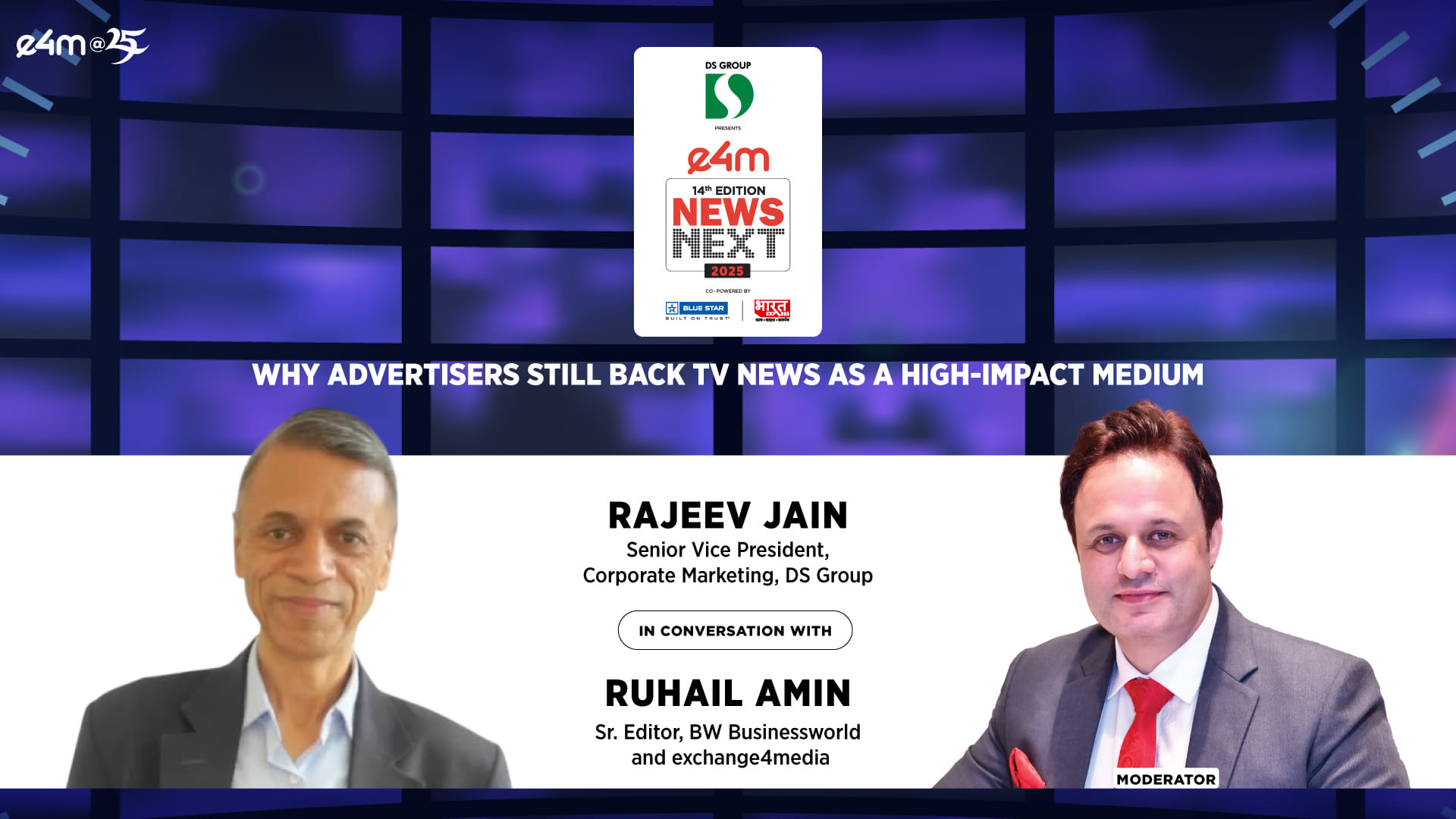

At the 14th edition of NewsNext 2025, hosted by exchange4media, one of the most debated questions in the media ecosystem took centre stage: Is TV news still relevant for advertisers in a digital-first world?
The answer, as it turned out, was a confident and well-reasoned yes.
In a candid and insightful conversation with Ruhail Amin, Senior Editor, BW Businessworld and exchange4media, Rajeev Jain, Senior Vice President,Corporate Marketing, DS Group, unpacked why brands continue to invest heavily in TV news despite the surge of digital platforms like YouTube, social media, and OTT.
TV News: Not Ending, Just Evolving
Kicking off the discussion, Jain addressed the often-repeated narrative that “TV news is dying.” While acknowledging that consumer behaviour has changed rapidly, especially post-COVID he argued that news consumption today is multi-screen, not mono-platform.
“News today is consumed everywhere on mobile phones, laptops, TVs, and even CTV. Each screen has its own role,” Jain said, adding that while digital dominates daytime snacking, television still owns the evening attention window, when viewers are relaxed and open to deeper analysis and context.This, he noted, is where TV news continues to shine offering depth, perspective, and a more immersive experience than fleeting mobile notifications.
From a marketer’s lens, Jain emphasised that advertising is not just about visibility but about relationship-building.“Showing the brand is just the top of the funnel. The real job is to build trust, consideration, and eventually purchase,” he explained.Large-screen television, according to him, plays a critical role in establishing that emotional and sensorial connection something smaller screens often struggle to deliver.
The Numbers Tell a Story
Jain acknowledged the undeniable rise of digital advertising, pointing out that digital ad spends in India touched approximately ₹50,000–55,000 crore as of early 2025 surpassing TV and print combined. Yet, he was quick to add that reach and impact are two very different metrics.With nearly 900 million TV viewers, television still offers unparalleled scale. For brands like DS Group with a diverse portfolio including Pulse Candy, Catch Spices, Pass Pass, Silver Pulse, dairy products, and luxury retail TV news continues to be a powerful environment for brand storytelling.
Addressing perceptions around news being a “male-dominated” genre, Jain clarified that while men may skew slightly higher towards news, India’s single-TV household culture ensures shared viewing. Women may prefer GECs or movies, but they remain equally exposed to news advertising making TV news relevant for both genders.For DS Group, this translates into strategic placements across news for brands targeting everyone from Gen Z to homemakers.
CTV: Where the Future Is
One of the most compelling moments of the session came when Jain spoke about Connected TV (CTV) , a medium he described as the perfect blend of digital precision and television impact.
“CTV gives me the best of both worlds, precise targeting like digital, and the immersive power of a large screen,” he said.While linear TV continues to deliver scale and reach, CTV is fast emerging as a high-impact, low-wastage solution, especially for well-defined consumer segments. Jain admitted that while CTV still faces challenges around measurement and scale, its growth trajectory is undeniable.
Content Over Clutter
In an age of content overload, Jain highlighted the growing importance of contextual advertising, moment marketing, and in-show integrations especially on TV news.“Consumers may not always want ads, but they always want content. The trick is to embed the brand seamlessly into what they are already watching,” he noted, citing election coverage and major national events as high-impact opportunities for brand integration.
A standout example was DS Group’s portfolio ad, aired exclusively on news channels. Despite not being used across other genres, the campaign delivered high recall and strong brand lift reinforcing the credibility and impact of news as an advertising environment.
On the Hindi versus English news debate, Jain was clear: language follows the audience. With India’s vast rural, Tier 2, and Tier 3 population more comfortable in vernacular languages, Hindi and regional news channels are gaining a larger share of advertising budgets. English news, while influential, caters to a more niche audience.
What Lies Ahead for TV News Advertising
Looking forward, Jain predicted a balanced media mix rather than a dramatic shift away from television. While budgets may tilt increasingly towards CTV and digital, linear TV will continue to play a crucial role in delivering incremental reach.“The share of the pie will change, but every medium adds value,” he said, concluding that brands will continue to invest across mobile, linear TV, and CTV, optimising each for its unique strength.
As the session wrapped up, one thing was clear: TV news is not fading, it's adapting, evolving, and still turning heads in the advertiser ecosystem. And with CTV stepping into the spotlight, the future of news advertising looks anything but boring.
Read more news about Television Media, Digital Media, Advertising India, Marketing News, PR and Corporate Communication News
For more updates, be socially connected with us onInstagram, LinkedIn, Twitter, Facebook YouTube & Google News