Efforts made by conventional media needs to be suitably compensated: Ashwini Vaishnaw
Vaishnaw said this while addressing a gathering on the occasion of National Press Day Celebration 2024
 by
by
Published: Nov 18, 2024 9:19 AM | 6 min read
 Follow Us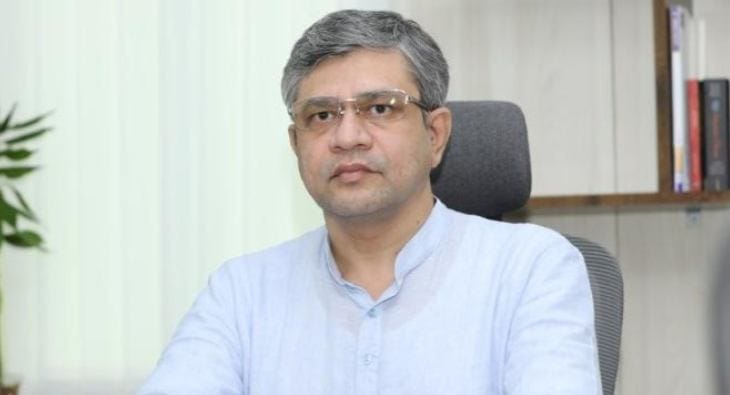

The efforts made by the conventional media in creating content needs to be suitably compensated, Union Minister Ashwini Vaishnaw has said.
Vaishnaw was addressing a gathering on the occasion of National Press Day Celebration 2024.
Delivering a speech on ‘The Changing Nature of Press’, he said, “This is also the day to acknowledge the changes in the world of press and media, and also the time to understand the new challenges that our society is facing in the world of media and press.”
He began by remembering the contribution of the press in the nation’s struggle for freedom from the oppressive forces, and recounted two such instances in India’s history. First was the long-drawn battle to achieve freedom from British rule, he said.
“The press played a very major role in our struggle, and the second was the fight to preserve our well-fought democracy from the dark years of emergency imposed by the Congress government. We must not forget these struggles because history has the tendency to repeat itself, and those who forget history are bound to face the same challenges again and again. This is why the Indian government, led by Prime Minister Narendra Modi ji, has decided to observe June 25 as the Constitution Murder Day,” said Vaishnaw.
He further emphasized on the role of media and press in preserving Indian democracy, and especially in India, which has a very vibrant press. “Our press and media have opinions across the spectrum. Some are very strong, some are very centrist, and our country, the mother of democracy, houses as many as 35,000 registered daily news channels.”
There are thousands of news channels and a rapidly expanding digital ecosystem, which is reaching the crores of citizens via mobile and internet. The investments made in digital infrastructure have propelled India among the top countries with 4G and 5G networks. Along with the spread of networks, India also has the lowest data prices in the world, he explained.
Vaishnaw mentioned, "Along with the vibrancy, along with the diversity of the press, the availability and affordability of digital mediums, media has created new opportunities for media in our country. Now, while this offers many new opportunities, this also offers new challenges for society.”
The first challenge is the challenge of fake news and disinformation, as per him. “The rapid spread of fake news is a big threat, not only to the media, because it undermines trust, but it's also a big threat to democracy. Since the platforms do not verify whatever is posted on those platforms, the false and misleading information can be found in abundance on practically every platform”.
He further stressed upon the fact that, “With our diverse society, we have to be extra careful. Our country has many sensitivities which do not exist in the countries where these platforms originate, whether it is language, whether it is religion, whether it is regional differences, whether it is cultural diversity. We have to be extra careful when we are working in a country as diverse. Therefore, when the circumstances are different, shouldn't there be a different matrix for the platform? Shouldn't there be more responsibility on the platform? This question needs to be debated in our social context.”
According to Vaishnaw, the second challenge is about fair compensation by the platform for content created by conventional media. As we see, consumption of news and consumption of content is rapidly shifting from the conventional modes to the digital media. The traditional media is losing out financially because of this change.
“The investment done in creating a team of journalists, training them, having editorial processes, having methods to check the veracity of news, taking the responsibility for the content, which are huge investments both in terms of time and money, are becoming irrelevant by the day,” he said.
The platforms are having a very unequal edge in terms of the bargaining power they have vis-a-vis the conventional media. This needs to be addressed. The efforts made by the conventional media in creating content needs to be suitably compensated.
The third challenge, Vaishnaw said, is the algorithmic bias evident on the platform. “The platforms are digital mammoths which use algorithms for deciding what needs to be shown to the users. And these algorithms are designed to maximize engagement because engagement defines the revenue for the platform. So, maximizing the engagement becomes the objective for the platform.”
Unfortunately, these algorithms tend to prioritize content which incites strong reactions so that using human psychology, something which creates a strong reaction is what people tend to do. So regardless of the factual accuracy, the platforms and the algorithms in turn have a tendency to show, have a tendency to maximize the content which generates such strong reactions. In a country as diverse as India, misinformation and such algorithmic bias can have serious social consequences, as per Vaishnaw.
He suggested platforms must come up with solutions that account for the impact their systems and the algorithms have on this country.
The fourth challenge is the impact of AI on intellectual property rights. Vaishnaw explained, “We have seen that the creative world is today undergoing a series of evil because of artificial intelligence. The content produced by creators, by musicians, by filmmakers, by writers, by authors, by speech makers, gets digested by the AI models. What happens to the IP rights of the people who have created that? What are the consequences for those original creators? Are they being compensated for their work? Are they being acknowledged for their work?”
Today, the AI models and AI systems are able to generate pieces of music on the basis of a small written note too. And that is all because of the large amount of music data that they have used while getting themselves trained. Under such circumstances in technology, what is the safeguard for the original content creators? This is not just an economic issue. It is an ethical issue, he strongly believes.
The minister ended his address by mentioning that, as pioneers in technologies in many different fields, we have to find solutions which can give us solutions to these major problems faced by our society. And we need to create consensus around this.
We need to have open debate around these challenges. We need to have a lot more discussion about these challenges. And we have to rise above politics because these are the challenges which are affecting the very fabric of our society, he further stated.
He said, “Let us work towards always keeping the nation first, always first. Let us work with a spirit in which the press and the media remain a very strong pillar of a democracy.”
Read more news about Print Media, TV Media, Advertising India, Digital Media, Marketing
For more updates, be socially connected with us onInstagram, LinkedIn, Twitter, Facebook, YouTube & Google News