Why India's top digital leaders say downloads are dead without trust
From fintech to jewellery, digital leaders agree - the web-to-app journey is broken unless brands master trust, community, and long-term value creation
 by
by
Published: Dec 29, 2025 2:23 PM | 6 min read
 Follow Us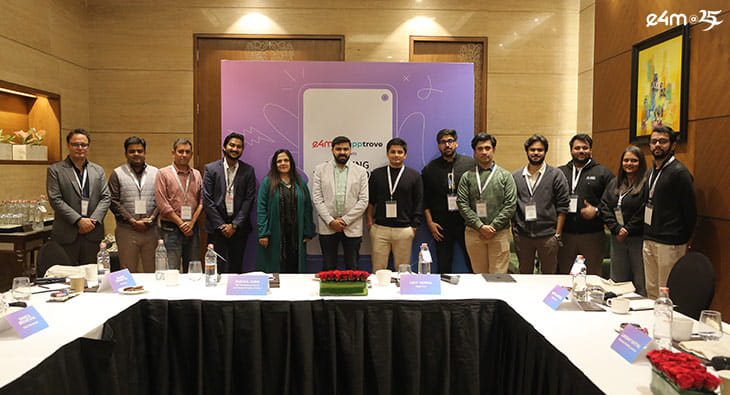

In a closed-door roundtable hosted by e4m in association with Apptrove, some of India's leading growth, product, and marketing heads gathered to tackle a question that troubles every digital brand: how do you turn casual web visitors into loyal app users?
Moderated by Ruhail Amin, Senior Editor at BW Business World and Exchange4Media, the discussion moved far beyond attribution dashboards and install campaigns. It became a candid exploration of trust, behavior, habit formation, and the uncomfortable truth that app downloads today mean very little without long-term value.
Opening the conversation, Amin framed the core dilemma. "We're no longer living in a world of clicks. We're living in a world of continuity. The challenge is not getting someone to download, but making them come back." He described the problem as a crossroads of product thinking, behavioral design, and the never-ending "why download" question that defines modern consumer journeys.
Community before conversion
Vivek Yadav, Co-Founder and CEO of Cosmofeed, explained that his company's journey began as an app-first product but gradually evolved into a web-first acquisition engine with the app acting as the core consumption layer. "For us, community behavior is the biggest growth lever," Yadav said. Every creator milestone (first sale, first thousand followers, first product launch) is designed to be shared instantly across WhatsApp and social platforms. These micro-celebrations trigger organic referrals far more effectively than any paid app install campaign.
Yadav also addressed martech fatigue, an issue plaguing many growth teams. "There is no perfect tool. Whether it's WebEngage, MoEngage, AppsFlyer, or Branch, every platform has gaps. What matters is how well you understand your problem statement and how aggressively you bend the tool to your use case." He noted that the lack of quality support remains the biggest pain point for smaller companies that need guidance the most.
Newsrooms are building ecosystems, not just apps
Rajesh Kumar Pal, Head of Product at ABP News, brought the media publisher's perspective to the table. He revealed that over 90 percent of news users are fly-bys, people who land on one article and never return. Traffic volatility over the last 18 months, driven by platform and algorithm shifts, forced ABP to rethink loyalty entirely. The answer was not just a better mobile app but a multi-platform ecosystem.
"We built a mobile app, connected TV app, and even a car infotainment app," Pal shared. Users who consume across all three platforms have become ABP's most loyal cohort. These power users are now being nudged towards premium experiences such as personalized annual news wrap-ups, interest dashboards, and ad-free environments.
He also spoke about the role of non-news content in driving habit formation. "Astrology, puzzles, and lighter stories make people open the app even when there is no breaking news. That habit formation is everything."
Gen Z won't tolerate friction or broken trust
Ferhan H., VP of Growth at Internshala, made it clear that they don't push the app unless it adds clear value. "Our users are here to find internships and jobs. We remove friction first, conversion later," he said. Internshala cohorts users based on intent (from confused first-year students to job-switching professionals) and offers radically different onboarding flows for each.
Retention is driven through micro-value, not discounts. Peer mentoring, mock AI interviews, company research modules, and interview preparation tools have become habit loops for users. Perhaps the sharpest insight came on reputation. "Gen Z is brutal about trust. One refund story on LinkedIn can become a brand crisis overnight. Online reputation is now a growth metric, not a PR metric."
In BFSI, quality beats volume
Aditya Chitral, Director of Product at Credit Saison, challenged the obsession with mass installs. "We don't want volume. We want the right customer." He explained how micro-signals, such as EMI calculator usage, scroll depth, and product exploration, are stitched together to detect intent even before an app is downloaded. Once that intent is clear, app journeys are personalized emotionally. "You don't show 'Apply for Loan'. You say, 'Your dream car is just five steps away.'"
Trust, he emphasized, is the real product in fintech. "Every confirmation message, every reassurance builds belief. That belief is what keeps people using financial products long after onboarding."
Legacy brands still struggle with the "why download" question
For Shweta Srivastava, Senior Vice President of Digital & Marketing at Usha International, the challenge is structural. Most Usha customers transact on Amazon and Flipkart, rather than on their own platforms. "Our biggest question is still why should a consumer download our app?" she admitted. Beyond extended warranties and service tracking, there is limited perceived value.
Usha today operates on fragmented data: retail partners, service partners, ISP apps, and ecommerce behavior all living in silos. The next big leap, she said, is generative AI-driven creative personalization that can produce cohort-specific content at scale without agency dependency.
Hardware brands must build ecosystems, not just phones
Lakshay Katyal, India Marketing Lead for Premium & Flagship Phones at Motorola Mobility, said smartphone brands are no longer selling hardware. They are selling ecosystems. Motorola doesn't aggressively push its own apps. Instead, it focuses on deep collaboration with Flipkart, identifying NNNO cohorts (users new to networks, online buying, and smartphones).
Drawing from his OPPO and Transsion experience, Katyal shared that bundling accessories and app-only product combinations outperform flat discounts. "Price parity is sacred in hardware. Upselling through bundles is the only real lever."
Jewellery, weddings, and the power of moments
Subir Ghosh, Head of Online Growth at Amama Jewels, explained why the brand enjoys a 43 percent repeat customer rate without heavy discounting. "You don't sell jewellery. You sell moments," he said. Wedding seasons, festive months, and party cycles dictate buying behavior, not marketing calendars.
For Amama, the post-purchase moment is the real conversion opportunity. When a customer receives a product within 24 hours, that emotional high is when cross-sell messages work best. He also highlighted WhatsApp's importance. "Not everyone wants another app. Sometimes WhatsApp is your best retention channel."
From D2C to lifestyle brand
Jitendra Choudhary, Head of D2C & Retail at Anveshan, described how the brand is shifting from being a grocery seller to a lifestyle storyteller. Their app now shows raw material cost breakdowns, live factory views, and transparency dashboards to justify premium pricing. "When users see why your ghee costs three times more, they don't just buy it. They defend your brand."
The attribution blind spot
Pranjal Joshi, Specialist in Media & Sponsorships, pointed out that brands continue to lose visibility between website clicks and app installs. Paid campaigns often show up as organic installs, killing ROI clarity. She called the web-to-app stitching challenge one of the biggest blind spots across automotive, BFSI, and ecommerce.
Belief is the new funnel
Closing the discussion, Ruhail Amin reflected that the industry has outgrown the idea of funnels. "The brands that will win are not the ones with the best dashboards, but the ones that design belief systems."
The roundtable made one thing painfully clear: downloads are no longer a growth metric. Trust, habit, community, and emotional relevance are. And unless brands master these intangibles, the web-to-app journey will remain broken, no matter how sophisticated the tech stack becomes.
Read more news about Marketing News, Advertising News, PR and Corporate Communication News, Digital News, People Movement News
For more updates, be socially connected with us onInstagram, LinkedIn, Twitter, Facebook, YouTube & Google News
