Wellness is a relationship with how we live and what we consume: Gauri Sarin
At the e4m Do Good Awards 2025, Sarin argued that everyday health outcomes could shift drastically if more people began prioritising food, emotion, and lifestyle over prescriptions
 by
by
Published: May 14, 2025 3:46 PM | 4 min read
 Follow Us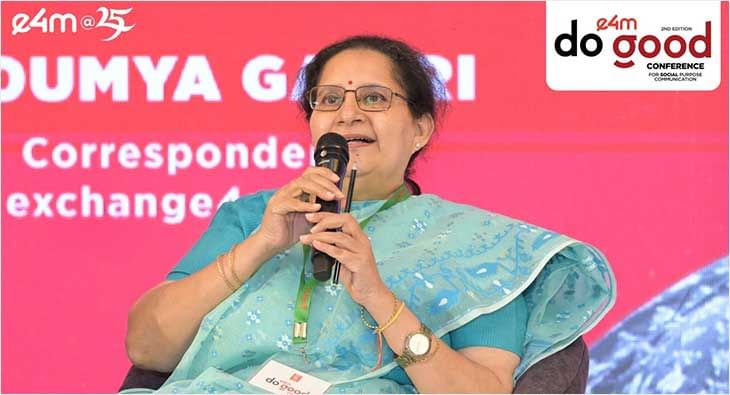

Gauri Sarin, founder of Marketing Model Gurugram, Saahas, and Living Without Medicine, emphasised that reversing chronic illnesses doesn’t always need medicine—it begins with awareness, food, and daily choices.
Speaking at the recently held E4M Do Good Awards 2025, titled Wellness as a Social Movement: Empowering Communities Through Holistic Living, Sarin argued that everyday health outcomes could shift drastically if more people began prioritising food, emotion, and lifestyle over prescriptions.
Sarin, who has worked across urban policy, food systems, and community wellness, shared how the journey began with a rethinking of where wellness really starts—and whom it includes. “You can’t talk about urban life without acknowledging the rural systems that feed it,” she said, pointing to her early work in agricultural policy. “That meant looking at food systems, farmers, and the rural-urban connection with a sharper lens.”
The turning point, she said, came when she noticed people within her own circles recovering from chronic conditions—without relying on medical intervention. “People didn’t wait for experts. They started making changes, then asked how to help others,” Sarin said, describing how the Bhoomi Jain and Living Without Medicine collectives took shape organically through individuals frustrated by a lack of conventional solutions.
At the heart of her message was the idea that food could be therapeutic—if one listened to the body’s signals. “Food became more than comfort—it became a mirror to the body’s deeper needs,” she said, explaining how community workshops helped participants understand how food interacts with mood, energy, and internal systems.
This grassroots movement soon found a scientific ally in functional medicine. “Functional medicine told us what Ayurveda had been saying all along—but in clinical terms,” she told the audience. Sarin pointed out that while functional medicine had Western packaging, it resonated with principles rooted in India’s own heritage. “We were introduced to functional medicine first. And because it came from the West, people took it more seriously—even though its principles weren’t new to us.”
Yet the bigger hurdle wasn’t introducing food as medicine—it was changing mindsets. “The problem wasn’t lack of food. It was lack of access, awareness, and belief,” she said, referring to the tech-enabled platforms her team created to connect Indian farmers with urban buyers. The success of these efforts relied not only on logistics but also on reshaping people’s perception of healing.
Ayurveda eventually became central to the model—not just as a treatment but as a language to decode one’s own biology. “Ayurveda doesn’t wait to cure you. It teaches you not to fall sick in the first place,” Sarin explained.
Her programs included the integration of Vata, Pitta, and Kapha diagnostics into user-friendly community formats, encouraging people to live in tune with their constitution.
Participants in the 12-week Living Without Medicine initiative included those with autoimmune disorders, many of whom had lost hope. But the goal wasn’t medical replacement—it was transformation through habit. “Reversing disease didn’t begin with medicine. It began with paying attention to daily choices,” Sarin noted, adding that their method never promised miracles but built resilience.
The approach has seen visible shifts—not just in health metrics but in how people relate to their own bodies. “We created a program that didn’t treat people as patients but as learners,” she said. “And the moment people understood their own body types, the way they lived started changing without anyone forcing it.”
In her closing note, Sarin positioned wellness not as a commodity, but a commitment. “Wellness is not a product or trend—it’s a relationship with how we live and what we consume,” she said. “We’re not anti-medicine. We’re pro-living—without waiting for a crisis to remind us how.”
Read more news about Marketing News, Advertising News, PR and Corporate Communication News, Digital News, People Movement News
For more updates, be socially connected with us onInstagram, LinkedIn, Twitter, Facebook, YouTube & Google News