The new playbook in tech marketing is being more consumer-centric: Cheil’s Kunal Ghosh
Speaking at Pitch BrandTalk 2025, Kunal Ghosh, DGM – Strategy, India, Cheil SWA Group, unpacked the dramatic shifts now reshaping tech marketing
 by
by
Published: Nov 22, 2025 7:18 PM | 8 min read
 Follow Us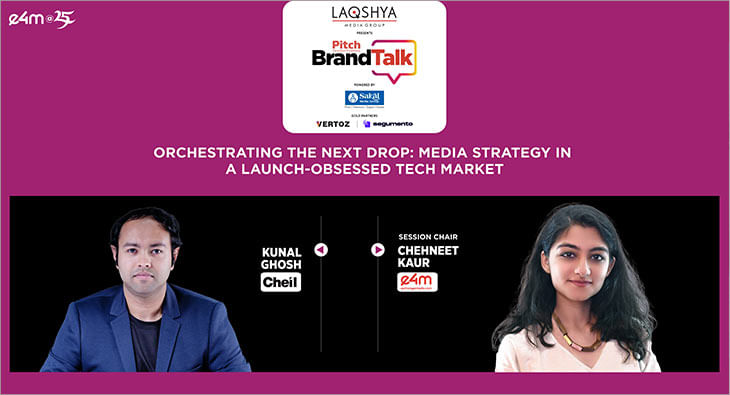

At Pitch BrandTalk 2025, Kunal Ghosh, DGM – Strategy, India, Cheil SWA Group, outlined the dramatic shifts reshaping tech marketing in a fireside conversation. Over a wide-ranging discussion, he detailed how Creators, Gen Alpha behaviour, a new way of looking at Consumer Segments and Agency Model Reinvention are going to rewrite the playbook for brands.
Ghosh began by explaining how the battle that major tech brands are fighting today is a “battle of the middle” in which building consideration for their product lines and moving potential consumer towards intent and purchase decision stage is a bigger task then just simply raising awareness through new launches.
In this “messy middle” as he calls it, the consumer is exploring and evaluating her options. A more “always-on, round-the-year” sort of presence building across multiple touchpoints of Discovery and Influence is what brands need to do than merely focusing on big launches, he added.
Speaking of the key media touchpoints that build consideration, he emphasized on the expanding role of influencers and creators in technology categories, noting that every major research study today reinforces “how big a role influencers and creators play in terms of leading to an informed decision.”
He attributed this to three factors: amplification, authenticity and advocacy. On amplification, he said, “When you have onboarded a Creator or Influencer who happens to have millions of followers, obviously they end up becoming a default media vehicle for you.” However, Authenticity, he emphasised, matters even more than scale. “People, who genuinely believe that this Creator has a credible voice and stands for something, are more likely to believe in them as opposed to any brand saying the same thing.”
He cited a tech launch in which a creator introduced a product feature through a sneaker-led demonstration. “All that this popular gamer had to do was use the new device’s feature to look up details on the sneaker he was wearing. Within hours we got unprecedented amount of reach and engagement on the content. Quite literally a new feature’s unique use case got established by virtue of him introducing it to his sneaker fandom.”
Ghosh added that creators today also drive belief through deeper associations, including equity in brands. “Influencers are getting a stake in brands. Obviously, people are more likely to believe that if a popular and credible name has created a brand and put their name on it, the product must be genuine.”
Cheil, he said, is now exploring deeper niches. “We are experimenting a lot with regional creators and creators who have very specific fandoms, or cater to specific tastes and niches. From “fame to micro-fame” is how I would pitch it.”
On Gen Alpha, Ghosh stressed that brands must avoid conventional targeting approaches. “Them being kids, I’d rather not say the word target. The way I would say it is how do we appeal to them (as brands), how do we nurture, how do we build communities along with them.” He described the cohort as fundamentally distinct and uniquely tech-fluent. “They’re starkly different from the previous generations. Being tech natives who are born into it, they know way more than you and me. Even as a tech marketer, I think they would probably know more about technology than me.”
He also noted their highly visual orientation and early aesthetic maturity, adding, “Throughout the day, they have too much immersion into content and into gaming, which makes them aesthetically very developed and demanding from an early age.”
A significant behavioural shift he highlighted was that Gen Alpha may not always be device-first. “Though it’s quite early to point it out with certainty, but they showing signals of being OS or UI first. They have higher affinity with apps, specifically with native apps in the devices they use. If a tech brand has built better synergy with them through the experience of the native apps or the UI, chances are they would stick to that ecosystem for longer”, something that he pointed out is significantly different from how Gen Z have traditionally looked at tech devices in which “the pizzaz of a new device, the looks, the design and how all of it adds to their status or self-expression, have always mattered more”.
The future Alpha consumers’ tastes, he said, will be hyper-specific. “Fandoms and subcultures are going to get even more sharp and get more finicky in taste. It won’t be sneakerheads anymore; it will be a particular kind of sneaker that brings few of them together.” The craze for anime and Korean or Japanese content is one such instance of how niche fandoms are forming.
When asked about unpredictable competitive drops and constant category rivalry in tech, Ghosh argued that the traditional launch-to-launch approach is not the only way to look at it. “While that product cycle-based model of marketing still gets followed for big launches, there’s a newer playbook in tech marketing, which is a bit more CX-led, more consumer-centric.”
Instead of focusing squarely on launch cycles, he said brands must understand the consumer’s need-state and reason for buying a new device. “A person looking for a new device is probably doing so because the screen of the last one is almost damaged, or maybe they have gotten a promotion at work, or maybe because it’s Diwali. Will they really care whether your brand launched a phone in January or in September? Or will they expect the brand to be present where they are looking when they are looking?” The key to marketing success for tech brands is to get considered in the evaluation and validation stages of the future buyers, who are passively exploring their next device for a long duration.
Apart from the usual behavioural or attitudinal consumer data, he said Cheil has been looking into these consumer “need profiles” to map real purchase motivations, which in turn offers a clear journey-led view of the future buyer. “You have to strategize how to meaningfully reach them at the exact stage of the purchase journey they are in and appeal to their need in a contextually relevant way.” The agency has built a framework comprising seven “moments of impact” that helps strategize the different kinds of brand interventions needed across journey stages.
On creativity, content velocity and the shifting discovery landscape, Ghosh pointed out that AI-led conversational search behaviour is reshaping how consumers evaluate brands. “The way a person goes to an LLM now and asks something like, ‘what is the best gaming phone’, redefines the entire landscape.” Commerce, too, has evolved. “In the earlier days we used to think there’s a bifurcation of what gets sold where, but nowadays there is quick commerce selling devices like phones as well.” He said constant shifts in content formats and consumption patterns have further complicated planning. “The whole content ecosystem is continuously changing. Formats are getting shorter but the same audience watches hours of OTT, and you can’t always predict what might just catch on with your consumers.”
This complexity, Ghosh said, is why Cheil has adopted a “business-connected approach.” He explained, “Let’s not look at marketing only function or touchpoint-wise, rather focus on what exactly the consumer needs in order to move ahead in their journey towards a decision. Let’s plan around that.”
To enable this, the agency is investing in end-to-end connected capabilities. Ghosh hinted at them focusing on AI-Marketing capabilities, building strong Data and Analytics capabilities in-house, further investments in Influencer Marketing, and their high-quality Content production vertical, to adapt to the changing marketing landscape of today.
He believes the agency model itself will be redefined. “It’s not going to be the agency-we-used-to-know. It is going to be a new paradigm in which there is Communications adapted to the new media landscape, but also Capabilities built around new tech and platforms from the ground-up, and also there will be Consulting practices that add value to the client business. Tying all of these together is still Creativity as the central driving force.”
He said clients today expect direct answers for their big concerns. “The expectation is real business-value addition. They are asking us what should they do to take their business into the future. Do not just respond to a brief because sometimes there is no brief. In this state of flux if your client is wondering ‘how to get discovered by a consumer who is asking LLMs for product recommendations’, then they are not really expecting campaigns, they are asking you to solve business problems”. He concluded that “It is a rewiring of the entire landscape, and the future of agencies is going to be business-connected.”
Read more news about Marketing News, Advertising News, PR and Corporate Communication News, Digital News, People Movement News
For more updates, be socially connected with us onInstagram, LinkedIn, Twitter, Facebook, YouTube & Google News
