The Future of Entertainment: Harit Nagpal on media’s digital evolution
At e4m India Brand Conclave 2025, Harit Nagpal, MD & CEO of Tata Play, took part in an insightful conversation with Dr. Annurag Batra, Chairman & Editor-in-Chief of BW Businessworld-e4m
 by
by
Published: Jan 30, 2025 10:38 AM | 5 min read
 Follow Us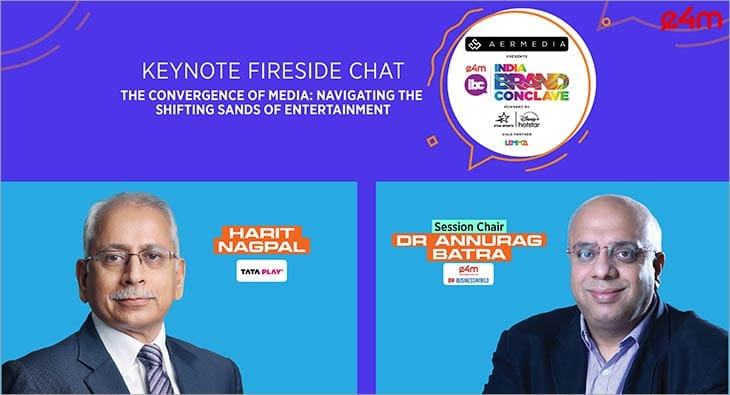

At the e4m India Brand Conclave 2025 in Mumbai, a fireside chat unfolded on The Convergence of Media: Navigating the Shifting Sands of Entertainment. Moderated by Dr. Annurag Batra, Chairman & Editor-in-Chief of BW Businessworld & exchange4media, the discussion featured Harit Nagpal, MD & CEO of Tata Play, offering deep insights into how India's media landscape is evolving amidst digital disruption.
Kicking off the conversation, Dr. Batra asked Nagpal about the most significant shifts in media and business over the past decade. Nagpal, a seasoned industry leader, dismissed the idea that everything has changed while reinforcing that fundamental human behaviors remain the same. “People say change is happening every month, every week. But the core needs of human beings have not changed. Dopamine and oxytocin still drive us. The opportunities have changed, the choices have changed, but the triggers remain the same.”
To illustrate, he likened the transformation of media consumption to how travel to Goa has evolved. Decades ago, visiting the coastal paradise meant a long and tedious journey, with limited flight and road options. Today, travelers can choose from multiple airlines, expressways, or even a cruise. “The reason for going to Goa hasn’t changed, only the means to get there have expanded,” he explained. The same holds true for media—entertainment consumption remains essential, but the platforms and modes of access have multiplied.
A key question in the discussion was the much-debated fate of television in an era dominated by OTT platforms. While many industry observers have speculated about the decline of traditional TV, Nagpal firmly countered the notion. “TV is not dying. Of the 300 million homes in India, 120 million still haven’t bought their first television. There are families who can’t yet afford a ₹6,000 TV. This isn’t an either-or market, it’s an ‘and’ market. Everything will grow.”
He backed his argument with numbers, pointing out that India’s pay-TV industry generates ₹70,000 crores annually, with ₹35,000 crores coming from subscriptions and ₹25,000 crores from advertising. In comparison, all subscription-driven OTT platforms combined contribute only ₹5,000-6,000 crores, while YouTube alone accounts for ₹12,000-13,000 crores in ad revenue. “Despite all the disruption, pay-TV still makes far more money than OTT today,” he stated.
Discussing digital adoption, Nagpal highlighted the massive shift in consumer behavior within Tata Play’s ecosystem. Six years ago, only 15% of Tata Play subscribers recharged online, while today, that number has jumped to 82%. Customer service calls, once at 140,000 per day, have dropped to 35,000, as digital self-service options have taken over. He stressed that rural and urban users alike are embracing digital, with 65% of Tata Play’s subscribers coming from India’s six lakh villages.
Dr. Batra steered the conversation towards Tata Play Binge, the company’s OTT aggregation platform, and its role in simplifying content discovery. Nagpal explained that while consumers today have access to a vast array of content across multiple apps, the paradox of choice often leads to frustration. “Most of us spend half the evening searching for what to watch and the other half watching something we’re not fully satisfied with,” he quipped.
Binge, he elaborated, was created to solve this challenge by consolidating multiple OTT platforms into a single interface. Instead of browsing through numerous apps, users can access content categorized by genre, language, and preferences, reducing decision fatigue. “If you want to watch Tamil drama, just select ‘Entertainment,’ ‘Tamil,’ and you’ll instantly see eight options playing drama at that moment,” he explained.
On the future of OTT, Nagpal acknowledged its growth but cautioned against overestimating its immediate impact. “OTT is growing, but it won’t surpass TV in our lifetime. Right now, 500 million people in India watch OTT, but 90% of them do so for free. Of the remaining 50 million, half are consuming content bundled with telecom or banking services. Only four to five million actually pay for more than four apps. That’s the real market today.”
The conversation then turned to Nagpal’s now-viral LinkedIn post, which read, “Don’t build careers, rent people.” The post sparked widespread debate, with media outlets seizing on the phrase without delving into its deeper message. “People read only the first line and wrote full articles on it,” he remarked, amused by the controversy. Clarifying his stance, he explained that employees today are not bound to lifelong careers at one company. “This isn’t their first job, and they won’t retire here. But if you let them bring their own ideas, let them be and do what they couldn’t in their previous job, they’ll grow, and in turn, they’ll help the organization grow.”
He expressed surprise at how the media misinterpreted his words, yet found validation in how industry professionals resonated with the full message. “Over 300,000 people read the post on LinkedIn, and 3,000 liked it. On Reddit, someone even called it lunacy, which I take as a compliment—I guess I’ve made it as an influencer,” he laughed.
As the discussion wrapped up, Dr. Batra reflected on Nagpal’s perspective on adaptation and resilience, themes he had explored in his book Adapt to Thrive, Not Just Survive. He invited Nagpal to share one final takeaway for the audience. The Tata Play CEO reiterated the importance of differentiation in business. “Disruption is an overused word. The real game is differentiation. Every business is commoditized; everyone has access to the same technology, content, and distribution. The only way to stand out is by making your service easier, simpler, and more useful.”
The fireside chat concluded with a clear message: while entertainment platforms continue to evolve, the fundamentals of human engagement remain unchanged. Whether through television, OTT, or an aggregated model like Tata Play Binge, the industry’s future lies in enhancing accessibility, simplifying choices, and creating seamless consumer experiences.
Read more news about Marketing News, Advertising News, PR and Corporate Communication News, Digital News, People Movement News
For more updates, be socially connected with us onInstagram, LinkedIn, Twitter, Facebook, YouTube & Google News