‘Q-commerce is not competition, but an extension’
The session featured Bharat Sethi (Founder, Rage Coffee), Aman Jain (CEO, Doodhvale Farms), Ankur Bhatia (Founder, Jimmy’s Brand) and Sahil Dharia (Founder & CEO, Soothe Healthcare)
 by
by
Published: Sep 4, 2025 11:45 AM | 3 min read
 Follow Us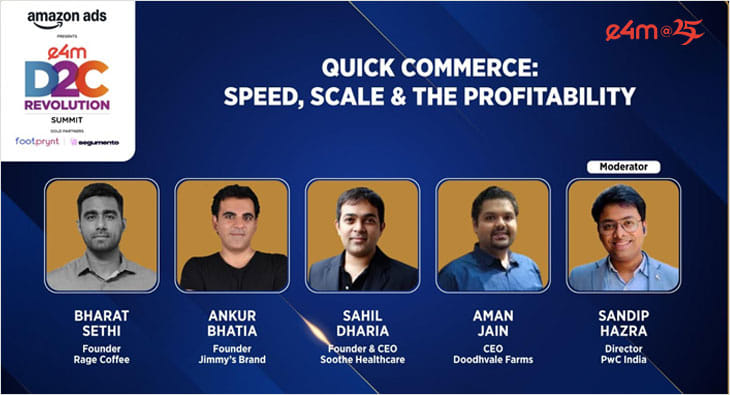

At the e4m D2C Revolution Summit 2025, a panel on “Quick Commerce: Speed, Scale & Profitability” brought together leading founders and industry voices to decode the fast-evolving space.
Moderated by Sandip Hazra, Director, PwC India, the session featured Bharat Sethi (Founder, Rage Coffee), Aman Jain (CEO, Doodhvale Farms), Ankur Bhatia (Founder, Jimmy’s Brand) and Sahil Dharia (Founder & CEO, Soothe Healthcare).
Opening the discussion, Hazra described quick commerce as “e-commerce 4.0,” calling it an “offline emulation of online business” where speed mirrors offline shopping experiences.
Bharat Sethi, whose Rage Coffee was among the earliest coffee brands on Grofers in 2019, said, "We were the first challenger coffee player on these platforms. In our minds, we’ve always been an omni-channel brand, the brand is bigger than the channel. Quick commerce has now become 50% of F&B e-commerce. The habits stuck, but it was hard to predict post-COVID. We’re riding the journey as it evolves.”
Aman Jain highlighted how consumer behaviour led Doodhvale Farms to embrace q-commerce, “Our core thesis was always about controlling customer experience for quality and margins. But consumers became much more restless and impulsive. In just six to seven months, 30-40% of our business now comes from q-commerce, while our D2C business took four years to reach its current scale. For us, it is not competition but an extension of our business.”
Sahil Dharia stressed that categories like OTC and sanitary products see q-commerce as a visibility enhancer rather than a speed-only play:
“We exist to solve two things, better quality products for Indian needs and aggressive penetration in a market where only 30% women use sanitary products. Bulk of our revenue is offline, but q-commerce has given visibility 360 degrees. It has grown rapidly for us, but I don’t think the 10–15 minutes delivery metric will remain relevant. It’s a cool innovation, but ultimately speed is not the primary driver of purchase decisions.”
Ankur Bhatia of Jimmy’s Brand explained how q-commerce created a category boost:
“When we started, there was no category called mixers. Quick commerce gave it recognition and rapid growth. Mixers is now the fastest growing beverage category on q-commerce. The fact that it can come to you in 10 minutes has exploded the category. It’s not just about margins, q-commerce allows startups to compete head-on with global giants. Somewhere last year, my household became 99% Blinkit without realizing it.”
On profitability and unit economics, the panel agreed that challenges remain. Sethi underlined that “transfer of capital has happened from one channel to another” and that for established brands with consumer bases, unit economics align better with platforms. Jain broke it down simply: “You spend to be available, to be visible, and to drive conversion. Each stage needs optimisation over time to break even and make money.”
Dharia argued that general trade remains the most profitable: “Very few sanitary pads are bought in an emergency. GT is by far more efficient, but q-commerce adds visibility. The 15-minute party trick will fade, and sanity will prevail.”
Bhatia countered with optimism: “Why should we assume habits in metros won’t spread to tier twos? We’re at the beginning of the explosion of quick commerce.”
Closing the session, Hazra noted industry data: “Q-commerce in India is already 20% of e-commerce - a $12 billion economy within three years. With India’s retail projected to touch $1 trillion, q-commerce could grow to $200 billion, driven by population density and shifting consumer habits.”
Read more news about Marketing News, Advertising News, PR and Corporate Communication News, Digital News, People Movement News
For more updates, be socially connected with us onInstagram, LinkedIn, Twitter, Facebook, YouTube & Google News