How DoDOOH is transforming clinics into communication hubs
At e4m Health & Wellness Marketing Awards 2025, Akshith Saddi (Director) & Sudheendra Chokkasamudra (Chief Revenue Officer) from DoDOOH deliberated on 'Point of Care: Awareness and Branding'
 by
by
Published: Jul 26, 2025 11:32 AM | 6 min read
 Follow Us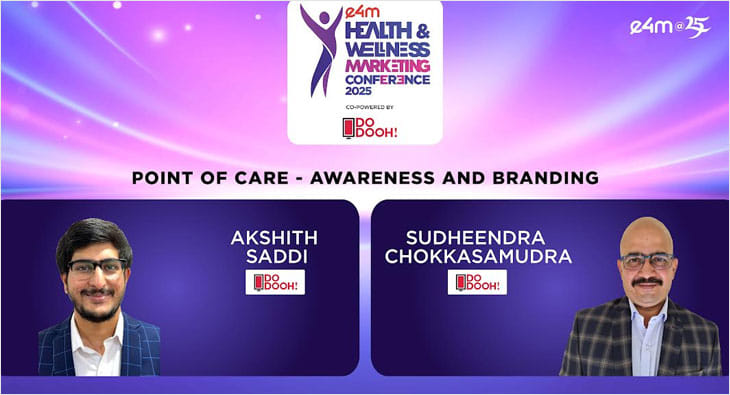

At the e4m Health & Wellness Marketing Awards 2025, a standout session led by Akshith Saddi (Director) and Sudheendra Chokkasamudra (Chief Revenue Officer) from DoDOOH explored how clinics are being reimagined as high-impact communication spaces for health and wellness messaging.
In a session titled 'Point of Care: Awareness and Branding', the duo showcased how DoDOOH’s platform is using technology, storytelling, and doctor-validated content to drive real-time health education in the very settings where patients are most attentive.
“We believe that content is lapped up when it is presented to people at the right place and at the right time as well,” said Sudheendra, opening the session. “And there is no better place to showcase content about health than in clinics where there are people waiting patiently for their turn to meet the doctor.”
The waiting period in outpatient departments is often considered wasted time. DoDOOH sees this as a powerful moment for education and behaviour change. From explaining symptoms of diabetes and PCOS to tips on posture, screen time in kids, and vaccination schedules, the content spans a wide range of day-to-day health concerns. “Why should patients only take back a prescription? Why not some awareness that stays with them longer?” Sudheendra posed.
DoDOOH has already created over 360 hours of original, doctor-approved content across six Indian languages. These videos are specifically designed for clinics catering to general physicians, paediatricians, and gynaecologists. “There are seven or eight content creators in our company working on this full time. All of this is obviously doctor-approved,” he added. The content is tailored to remain fresh, with the team ensuring that 85 percent of what appears on-screen is unique to avoid fatigue.
Akshith Saddi then took the audience through the inspiration behind the platform. His observation came while working in pharmaceutical supply chain management, where he noticed how fragmented and indirect healthcare decision-making often is. “In most other aspects of life, you are the decision maker. But when it comes to healthcare, it is a collective effort,” he said. “There’s the doctor diagnosing, then a pharmacist suggesting an alternative, then a caregiver being the support system. There are multiple stakeholders and multiple influencers in this journey.”
He also highlighted the shortcomings of conventional communication formats in healthcare. “Traditional pharma relied on leave-behind literature such as pamphlets and brochures in healthcare facilities. But that usually resulted in information overload or came at the wrong time,” he said.
This led him to explore more ambient, non-intrusive forms of communication. He began noticing digital screens in public spaces like airports, malls, lift lobbies and started thinking about whether this medium could be adapted to healthcare. “It seemed like an advertising medium where multiple advertisers could share space and time and still advertise effectively without being too intrusive,” Akshith said.
The idea started taking shape when he asked himself two key questions: When is the consumer’s mindset most receptive? And what kind of content would the consumer actually want to watch at that moment? The answer pointed directly to clinics.
“Healthcare practitioners and healthcare facilities are people and places that we happen to trust. So what better place to put out health and wellness related content than a patient waiting area?” he explained. But the challenge was in crafting the right kind of content which is easy to understand, yet scientific, simple yet approved.
The screens, he said, are not just ad platforms but “a comprehensive health and wellness awareness and branding medium.” While the operational and technical challenges were resolved over time, the team placed a premium on relevance, accuracy, and trust. “We received a fairly positive response when we started onboarding healthcare facilities. It wasn’t overwhelming, but people appreciated the novelty and saw the value.”
The rollout plan includes nearly a thousand screens across seven cities, focusing on clinics with specialties in internal medicine, gynaecology, and paediatrics. “That’s where the mindset of a patient is still open to consuming content. They are not severely ill, but still attentive,” said Sudheendra. “We should be live by the 15th of August with most of the screens.”
The session was elevated by the presence of Srinivas Lanka, a pharmaceutical industry veteran and DoDOOH’s mentor. He shared insights from decades of experience building both brands and institutions. “I have built a lot of brands in this country like Combiflam, Taxidermy and mentored people who have built companies like Alkem, Aurobindo, Sun Pharma,” he said.
Mr. Lanka spoke about how important timely communication is in healthcare. “Molecules will heal, but communication really builds confidence,” he said. He recalled how in earlier years, he used to send printed postcards announcing conjunctivitis outbreaks so doctors would stock the right medication in advance. “The captive audience at the doctors, half an hour, one hour, one and a half hours, it’s all a waste of time. Why can’t we use it for education?” he asked.
What excited him about DoDOOH was how the platform used technology to bridge that gap intelligently. “Akshit came with the idea that he wants to do something at the clinic and make it AI-enabled so the right content goes to the right doctor at the right setting. The advertiser will have 30 to 40 percent time and the rest will be very good, patient-relevant content,” he explained.
The power of trust, he said, was central to this initiative. “We get a clinic as a trustable medium. The doctor blesses it, the patient trusts it, and the brand gets visibility that does not feel intrusive.”
Mr. Lanka stressed that while reach is important, impact is far more critical. “We reach a lot of people through billboards and signboards, but the impact is not there. Here, we have enormous impact and proximity to the pharmacy, which allows for real action.”
“This is a dream come true in my life,” he said, endorsing the idea whole-heartedly. He praised the effort it took to build a new technology platform, one not seen in any part of the world. “It is not easy to develop a technology which is not there. This team worked for one and a half years on patented technologies and new concepts. I want you to appreciate this new medium that is coming into this country.”
He ended with a clear call to action for the industry: “I am sure Akshit and many more Akshit-type companies will give extraordinary value to patient education. And also, it will give extraordinary opportunities to the brands.”
DoDOOH’s point-of-care communication platform brings together technology, trust, and timing to create a new kind of brand engagement, one that educates patients, empowers them with information, and allows brands to speak at the most relevant and trusted moment in the healthcare journey.
As India moves toward more personalised and meaningful health messaging, DoDOOH offers a model that is both impactful and scalable.
Read more news about Marketing News, Advertising News, PR and Corporate Communication News, Digital News, People Movement News
For more updates, be socially connected with us onInstagram, LinkedIn, Twitter, Facebook, YouTube & Google News