2025: The year regulation caught up with influencer marketing
From ASCI cracking down on influencers to SEBI calling out unregulated finfluencers packaging market opinions as 'education', we take a look at all the shake-ups in the sector this year
 by
by
Published: Dec 19, 2025 9:30 AM | 10 min read
 Follow Us

2025 marked the year when regulation finally caught up with India’s fast-growing influencer economy. For nearly a decade, creators expanded faster than the rules meant to govern them, blurring the line between advice and promotion while brands borrowed credibility through association. Platforms, for the most part, remained neutral conduits. That balance decisively shifted this year. Regulators stepped in not to curb the creator economy, but to define its limits, redraw accountability lines and restore consumer trust.
Influencer marketing today sits firmly within India’s formal advertising and financial regulation framework. The shift has been gradual, but 2025 is when enforcement became visible, data-backed and difficult to ignore.
Regulatory Pressure Builds on Influencer Advertising
According to the Advertising Standards Council of India (ASCI) in FY 2024–25, 14 per cent of all advertisements processed by ASCI were linked to influencer-related violations. Persistent issues included failure to disclose paid partnerships and promotions of prohibited categories.
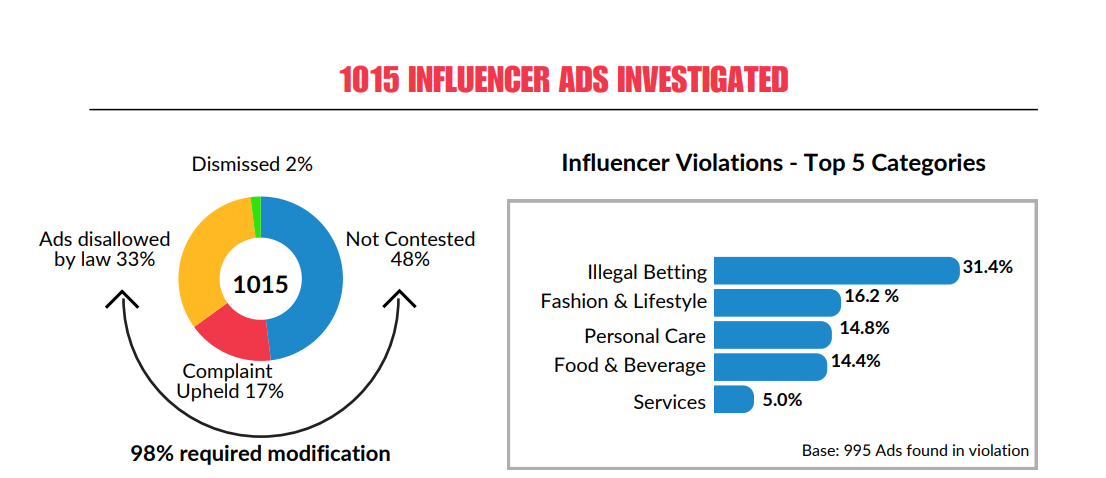
During the year, ASCI processed 1,015 influencer-linked advertisements. Of these, 98 per cent required modification, highlighting systemic lapses rather than isolated errors. A majority of flagged posts lacked adequate disclosure. Around 56.8 per cent carried no disclosure label at all, while 43.2 per cent buried disclosures within hashtags, rendering them ineffective under ASCI norms.
Manisha Kapoor's strategy for 2026
Only 29 per cent of influencer posts reviewed during the period complied fully with disclosure requirements. In several cases, ASCI also flagged influencers promoting products that are legally barred from advertising, including offshore betting platforms, alcohol, and so-called miracle health remedies. Nearly one-third of the influencers flagged were found to be involved in such promotions.
Corrective action followed regulatory intervention. Fifty-nine influencers voluntarily corrected their content after being contacted by ASCI. Five modified posts after review by the Consumer Complaints Council, while another five cases were escalated to the Ministry of Information & Broadcasting due to continued non-compliance.
ASCI wants paid posts to be labelled
LinkedIn Comes Under the Scanner
Professional networking platform LinkedIn also emerged as a focus area for regulators. While the platform introduced a ‘Brand Partnership’ label two years ago, ASCI observed that its usage remains limited and its visibility inconsistent. This has resulted in promotional posts appearing as independent professional opinions, particularly misleading in a platform built on credibility and expertise.
Since January 2025, ASCI has investigated 121 LinkedIn influencer posts flagged by users for failing to disclose material connections. The regulator issued a formal advisory urging LinkedIn influencers to comply with the ASCI Guidelines for Influencers in Digital Media, alongside the Central Consumer Protection Authority’s regulations under the Consumer Protection Act, 2019.
Influencer ads flagged for betting links
As of May 14, 2025, ASCI reported that 83 per cent of influencers were compliant with disclosure norms. However, the regulator emphasised that continued enforcement remains necessary to ensure transparency across digital platforms.
From Voluntary Norms to Enforceable Accountability
The developments across influencer advertising reflect a broader regulatory shift. From SEBI’s crackdown on finfluencers to ASCI tightening disclosure rules for influencers and media houses, and platforms such as Meta enforcing regulator-led verification, 2025 marked a clear move from voluntary compliance to enforceable accountability.
Manisha Kapoor, CEO & Secretary General, Advertising Standards Council of India, said, “2025 has been a transformative year for advertising regulation in India as we navigate the rapid evolution of AI-driven marketing and increasingly complex digital ecosystems. ASCI has responded by significantly strengthening monitoring systems and oversight mechanisms to keep pace with these changes. We’ve expanded our partnerships with digital platforms, enhanced our AI-powered ad scanning capabilities and processed record volumes of complaints while maintaining our commitment to swift resolution.
ASCI remoulding how media sells on social
“Our work on regulating betting, gambling and offshore betting advertisements has been particularly crucial, as we’ve worked closely with stakeholders to protect consumers from misleading claims in this high-risk category. The influencer marketing space continues to demand attention. As detailed in our half-yearly complaints report, ASCI conducted its second dipstick study on Forbes India’s Top 100 Digital Stars 2024, who collectively command a following of over 110 million. The study revealed an increase in the number of influencers failing to disclose paid collaborations – 76% vs 69% the previous year.
“Accordingly, we’ve made considerable progress in ensuring transparency and authenticity in digital endorsements. Our Commitment Seal initiative, launched in November, has gained strong traction. The seal is a visual cue certifying members’ pledge to uphold the highest standards of transparency, fairness and authenticity in their advertising. Brands may display the seal on their websites, digital platforms, collaterals and advertising campaigns to convey to consumers their commitment to honest and accountable communication. This is strengthening consumer trust.
“We’ve also prioritised protecting children, recognising that children deserve special safeguards in today’s media-saturated environment. The AdWise programme for school students aims to cover 1 million children by the end of 2026 across India. This consumer education programme for children from Grades 3 to 8 has already achieved encouraging results.”
SEBI Draws a Clear Line Between Education and Advice
The most consequential move came from the Securities and Exchange Board of India. In a circular released in mid-2024 but fully enforced through 2025, SEBI took direct aim at unregulated financial influencers who were packaging market opinions as “education.”
Under the new framework, creators claiming to operate solely in an educational capacity can no longer use stock price data from the preceding three months in their content. This includes displaying prices, naming securities, using code names, or sharing screens in a way that could imply investment advice or future price movements. The intent is clear: real-time or near-real-time market commentary cannot masquerade as financial literacy.
SEBI also barred its registered entities—stockbrokers, exchanges, mutual funds, and other financial institutions—from associating with finfluencers who violate these norms. Any form of collaboration, whether promotional, referral-based, or data-sharing, is prohibited. Importantly, accountability does not stop with the creator. Financial firms working with influencers making false or misleading claims can be penalised as well.
Violations can invite penalties, suspension, or even cancellation of SEBI registration. While the rules technically came into effect on August 29, 2024, companies were given time until January 2025 to comply, making this the year when enforcement truly kicked in.
ASCI Introduces Nuance for Health and Finance Influencers
Parallel to SEBI’s tightening grip on financial content, the Advertising Standards Council of India updated its Influencer Advertising Guidelines, specifically through Addendum 2, addressing the BFSI and Health & Nutrition categories.
Earlier, influencers operating in these sectors were required to hold and declare formal qualifications regardless of the nature of the content. The revised guidelines introduced much-needed nuance. Influencers now need to be qualified and disclose those credentials only when providing technical information or advice. Generic messaging or public service-style communication no longer carries the same requirement.
This distinction allows brands to use influencers for awareness-driven campaigns without over-regulating benign content. An insurance company can partner with an influencer to talk about the importance of annual health check-ups, or a health food brand can collaborate with a chef to promote a meal service, without positioning the creator as a technical expert.
ASCI’s leadership has framed this as a sign of a maturing ecosystem, where influencer marketing is no longer limited to endorsements but has evolved into a strategic communication channel that demands proportional regulation rather than blanket rules.
Paid Content Disclosure Comes for Media Houses Too
In another significant development, ASCI extended disclosure obligations beyond creators and brands to media companies themselves. A new clause added to the Code for Self-Regulation in Advertising requires media outlets to clearly label paid or sponsored content on their social media handles.
Under Clause 1.8, disclosures such as “Advertisement,” “Sponsored,” “Partnership,” or platform-enabled tags must appear upfront, ensuring that promotional content is not mistaken for editorial. This move followed consumer complaints around undisclosed promotions appearing alongside news content on high-credibility platforms.
With social media now a primary distribution channel for news, ASCI has emphasised that transparency is essential to protect editorial trust. The rule reinforces long-standing journalistic norms in a digital-first context, making it harder for advertising to quietly blend into reportage.
Platforms Step In: Meta Makes SEBI Verification Mandatory
By mid-2025, platforms also began enforcing regulator-led compliance. Meta rolled out a sweeping policy on July 31, mandating SEBI verification for all investment-related ads targeting Indian audiences, regardless of where the advertiser is based.
Advertisers are now required to submit their SEBI registration details, including registration numbers and contact information, which are displayed publicly on ads along with disclaimers. For those exempt from SEBI registration, such as financial educators, alternate verification is mandatory through government IDs or business documents.
Once verified, these credentials remain visible in Meta’s Ad Library for up to seven years. Even strictly educational financial content, while exempt from SEBI registration, must go through the alternate verification route, signalling a platform-wide shift toward traceability and accountability.
This builds on earlier ASCI guidelines from 2023, which required finfluencers to disclose SEBI registration details and professional qualifications when offering investment-related advice.
Anurag Tyagi, Partner, Deal Value Creation Services, BDO India, "2025 saw the most deliberate effort from SEBI to elevate M&A since the 2011 SAST regulations. This overhaul seemingly intends to shift India from a promoter-dominated M&A environment to a market-driven, rules-based system where transparency, price integrity, and governance drive value creation.
“The more than incremental reforms in the form of notifications run across three themes: Improving governance, enhancing market integrity, enabling efficient buyouts, de-listings and acquisition financing. SEBI is solving for a market where deal prices are fair, disclosures are timely, information leaks are curbed, related-party opacity is reduced, and buyouts or de-listings take place. For dealmakers, the changes mean clearer pricing, stronger governance expectations, smoother buyout. delisting pathways, and more predictable capital-raising for acquisitions. Given the shifts exit opportunities for investors, markets are likely to witness a different kind of M&A in the next two to three years. However, smart money should start chasing true value creation."
What Lies Ahead: AI Content and the Next Regulatory Frontier
While 2025 focused heavily on financial transparency and advertising disclosures, the next phase of regulation is already taking shape. The Ministry of Electronics and Information Technology has proposed amendments to the IT Rules, 2021, that would require mandatory labelling of AI-generated content across text, audio, video, and images.
The proposal comes amid a sharp rise in AI-generated content and growing concerns around deepfakes, misinformation, and synthetic media. Deepfakes entered mainstream regulatory discourse after a manipulated video of an actor went viral in 2023, prompting strong government intervention. Prime Minister Narendra Modi has since described deepfakes as a new digital “crisis,” underscoring the urgency for safeguards.
If implemented, the amendments would fundamentally alter how creators disclose AI use, pushing platforms and influencers toward greater transparency and reshaping content authenticity norms.
ASCI is preparing for the next wave of AI applications in advertising, from generative content to targeting algorithms, ensuring that innovation and consumer trust go hand in hand. "Our focus will remain proactive regulation, industry collaboration and creating frameworks that protect consumers while allowing creativity and business growth to flourish,” Manisha said.
Taken together, 2025 marks a turning point. Influencer marketing in India is no longer operating on implied trust or loose disclosures. Regulators, platforms, brands, and creators are now part of a shared accountability framework.
Read more news about Influence Zone, Marketing, PR and Corporate Communication, Internet Advertising, People Movement
For more updates, be socially connected with us onInstagram, LinkedIn, Twitter, Facebook, YouTube & Google News
